
How does high-pressure water jetting work?
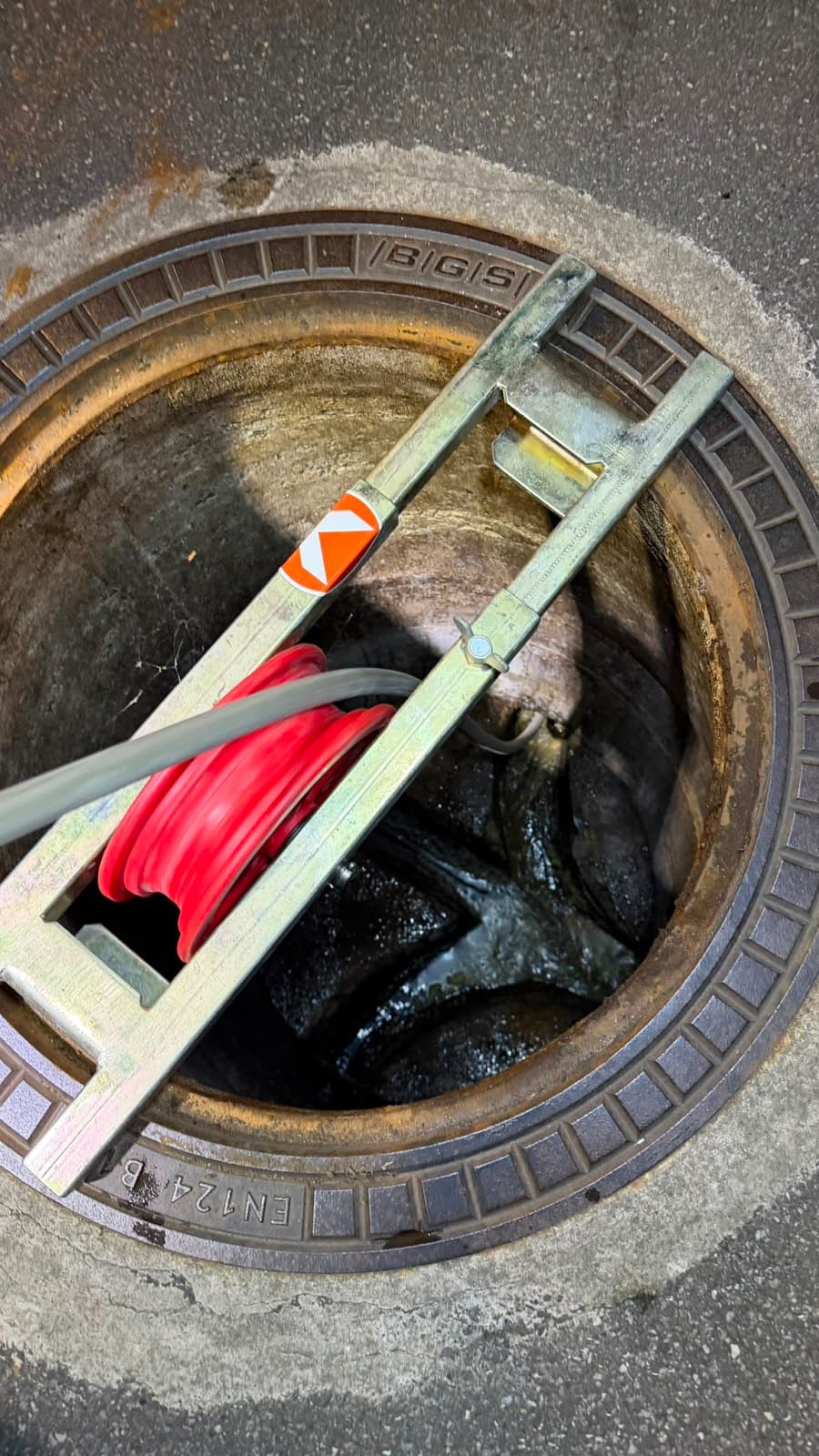
A high-pressure pump generates water pressure of usually 120 to 200 bar. This is fed through a hose to a jetting nozzle, whose backward-facing jets pull the nozzle through the pipe by themselves while rinsing the pipe wall.
The loosened material is carried with the jetting water to the next manhole, where it is vacuumed out. There are special nozzles for different tasks – such as cutting or root-cutting nozzles for stubborn encrustation and roots.
What is high-pressure water jetting used for?
It is the standard method for cleaning wastewater drains, underground drains, rainwater pipes and soil stacks. Heavily greased kitchen waste pipes and silted-up pipes can also be cleaned reliably with it.
Before a CCTV drain survey or rehabilitation, high-pressure water jetting is almost always the first step. Only a clean pipe allows a meaningful CCTV survey and professional liner installation.
Advantages of high-pressure water jetting
The method cleans thoroughly, without damaging the pipe material and without chemicals. The water pressure can be adjusted to the material and condition of the pipe, so that even sensitive pipes can be cleaned safely.
Because jetting and vacuuming take place in a single operation, the loosened dirt does not remain in the system. The result is a drain that is clear throughout and has good flow characteristics.
Safety and the right pressure
The right pressure is crucial. Too little pressure cleans inadequately, too much can strain sensitive or already damaged pipes. That is why specialists choose the pressure and nozzle to suit the pipe material.
With old or already damaged pipes, jetting is carried out more carefully and the condition is assessed beforehand by camera. This makes the cleaning both effective and gentle.
High-pressure jetting or high-pressure cleaning?
In drain technology, high-pressure cleaning and high-pressure jetting refer to the same method, technically known as hydrodynamic cleaning: water under high pressure loosens grease, sand, encrustation and roots from the pipe wall. «High-pressure cleaning» is also used more generally for facades or machinery, whereas «high-pressure jetting» emphasises flushing and carrying material away inside the pipe.
A typical case is an underground drain beneath a restaurant kitchen that has gradually closed up with a hard layer of grease over the years. A rotating nozzle removes the encrustation layer by layer, the loosened material is vacuumed out at the manhole, and a subsequent CCTV survey shows whether the pipe is intact.
Nozzles for different tasks
The cleaning effect is not produced by pressure alone, but to a large extent by the nozzle. Standard jetting nozzles with backward-facing jets clean the entire surface of the pipe wall and carry the dirt away, while rotating nozzles distribute the water in a circular pattern and loosen hard encrustation.
For root ingress, cutting heads and chain-flail nozzles are used, which sever the roots mechanically. With sensitive or older pipes, work is carried out at reduced pressure and with a gentle nozzle. Matching the pressure, water volume and nozzle determines whether the result is clean and the pipe material is spared.
In a restaurant in Bern, the kitchen wastewater drains away more and more slowly because thick layers of grease have formed in the pipe to the grease separator. Using high-pressure water jetting, the jetting nozzle removes the encrustation from the pipe walls completely. The pipe is fully clear again, entirely without chemicals.