What is a drain snake?
A drain snake is a tool made of coiled spring steel that can be used to clear a blockage in a waste pipe mechanically: the snake is pushed into the pipe and turned, and it drills through or grips the plug until the water drains away again. It works without chemicals and without the pipe having to be opened.
In everyday use, the same tools go by many names. «Drain spiral», «pipe spiral» and «cleaning spiral» essentially mean the same device; the names differ at most in size. A drain spiral usually means the short, thin hand-held snake for the washbasin and shower, while a drain snake tends to mean the longer, more powerful tool, right up to the motor-driven spiral of a drain cleaning machine.
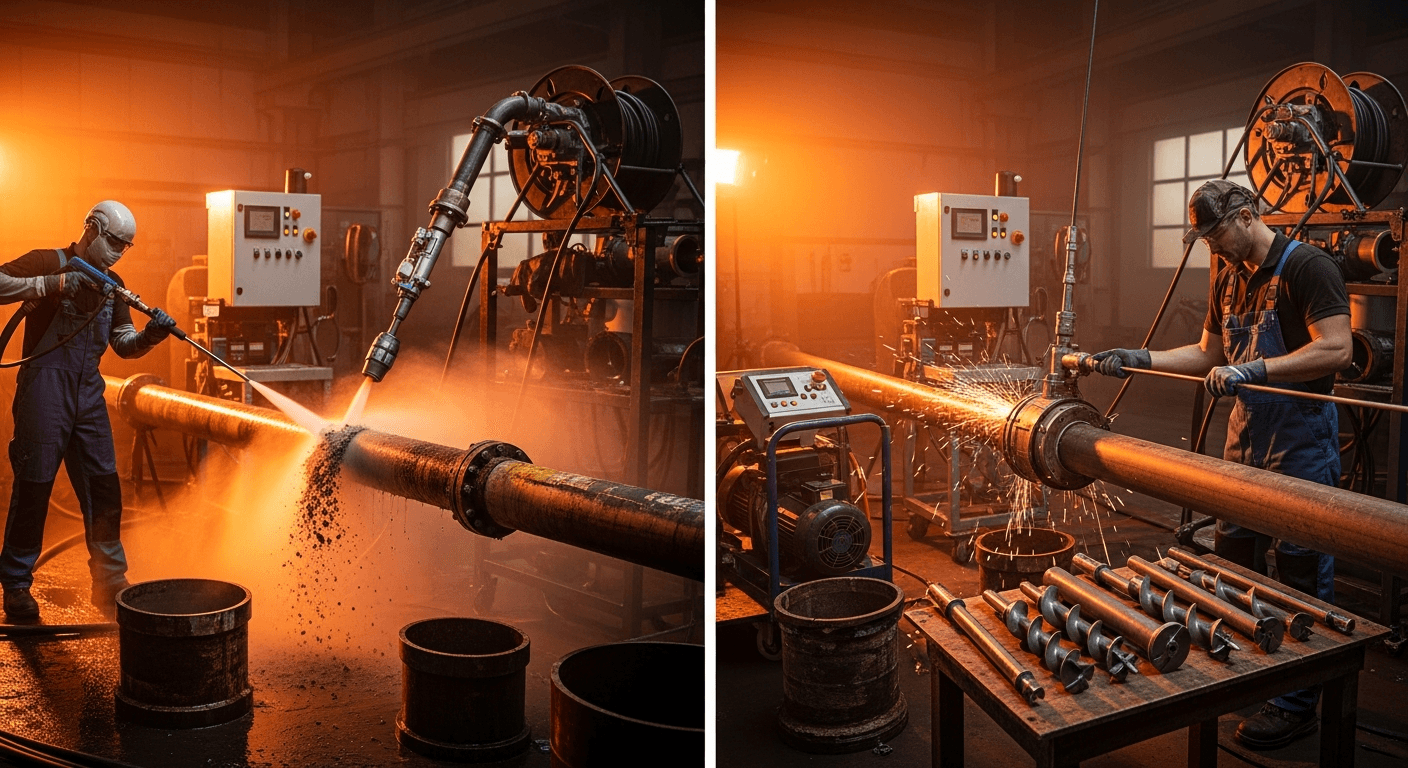
The snake is one of the mechanical cleaning methods. Its counterpart is high-pressure water jetting, in which water under high pressure is forced into the pipe through a nozzle. Which method is right depends on where the blockage is, what it consists of, and how large and old the pipe is.
How does a drain snake work?
The snake consists of a flexible steel wire or plastic core with a tool head at the end. Driven by hand or by an electric machine, the snake rotates as it is pushed forward into the pipe.
Through the rotation, the head eats its way through the blockage, breaks it up or hooks into it so that the plug can be pulled out. Different attachments – such as drilling, cross or retrieval heads – are used depending on the type of blockage.
Torsional stiffness is the key: the coiled steel is designed so that it can bend around pipe bends and still transmit the rotation right to the tip. A drill head opens a channel through soft plugs, a retrieval head or an open spiral tip hooks into hair and fibres and pulls them out, and a cutting or root head cuts through ingrown roots in smaller pipes.
Types: hand, drum and electric snakes
Drain snakes come in three basic forms, which differ in length, diameter and power. A simple hand snake is usually enough for the household, while specialist companies work with drum and electric snakes.
The hand snake is a short, thin spring steel cable with a crank or handle. It is pushed forward and turned by hand and only reaches a few metres. It is well suited to the typical hair blockage in the bathroom, at the trap connection or in the shower drain, but not to grease in the soil stack or blockages in the underground drain.
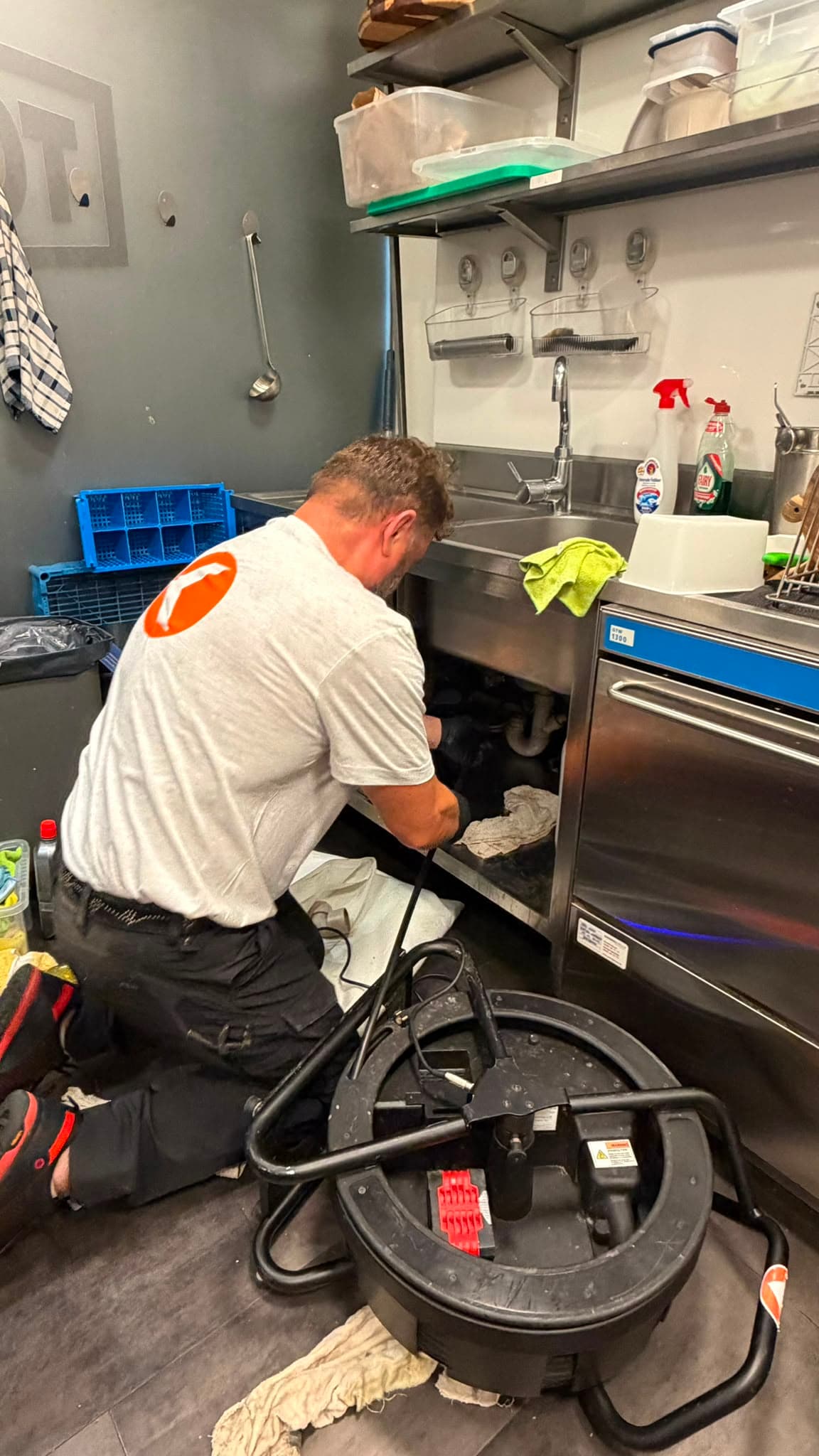
With a drum snake, the cable is coiled inside a closed drum from which it is unwound. The drum prevents the dirty cable from thrashing around uncontrollably and allows greater lengths. Drum snakes are available with a hand crank, as an attachment for a drill and as a motor-driven unit, such as the one Karo Kanaltechnik uses, for example, under sinks in restaurant kitchens.
The electric or motorised snake is part of a drain cleaning machine. An electric motor drives the snake, and spirals and heads are changed depending on the pipe diameter. It can be used to tackle longer pipes, stubborn deposits and root ingress. Because the torque and length are much greater, it belongs in experienced hands: an incorrectly guided machine snake can knot up in the pipe, break off or damage pipes.
| Type | Drive | Typical use | Limitation |
|---|---|---|---|
| Hand snake | Crank / hand | Washbasin, shower, bath | A few metres, little power |
| Drum snake | Crank, drill or motor | Kitchen, soil stack connection | Requires practice, no full-surface cleaning |
| Electric snake | Electric motor | Longer pipes, roots, hard plugs | Specialist staff, risk with old pipes |
Hand snake (drain spiral)
Short, thin, turned by hand. For hair and soap residue in the washbasin, shower and bath – the classic tool when someone searches for «unblocking a drain with a snake».
Drum snake
Cable coiled in a drum, cleaner to handle and longer. Available with a crank, a drill attachment or its own motor.
Electric snake (drain cleaning machine)
Motor-driven, with interchangeable spirals and heads, for longer pipes, hard deposits and roots. A professional tool.
When is the snake the right tool?
The drain snake is particularly suitable for narrower waste pipes in the bathroom, kitchen and toilet, for example with blockages caused by hair, soap residue, food scraps or paper. It is also effective against root ingress in smaller pipes.
For larger drains and underground drains, high-pressure water jetting is usually preferred instead. The two methods often complement each other: the snake breaks up the plug, and jetting then cleans the pipe wall.
Unblocking a drain with a snake: step by step
If you want to use a hand snake yourself, it is best to proceed in this order. First of all: if a chemical drain cleaner has already been poured in, do not use the snake – the caustic solution can spray out when it is turned.
First, prepare the area: put on gloves and safety glasses, have cloths and a bucket ready, and scoop out as much standing water as possible. Second, choose the access point: at the washbasin or kitchen sink, unscrew the trap and insert the snake directly into the outlet pipe in the wall. That way it does not have to pass through the tight bend of the trap, and much of the blockage is often in the trap itself anyway, which can be rinsed out by hand.
Third, push the snake in slowly until you feel resistance. Fourth, at the resistance, turn evenly in one direction while pushing gently until the head penetrates the plug or hooks into it. Fifth, pull the snake back while continuing to turn it in the same direction; anyone who changes direction when pulling it out risks the coil loosening or the captured material falling off.
Sixth, refit the trap and flush with plenty of warm water so that loosened residue is carried away. If the water then only runs freely for a short time and soon backs up again, the real cause is deeper in the pipe – and further poking around will usually achieve nothing.
In brief
Put on protection · unscrew the trap · insert the snake up to the resistance · turn in one direction · pull back while turning · refit the trap and flush with warm water.
Advantages of mechanical cleaning
The snake works in a targeted way directly at the blockage, even in narrow and convoluted pipes that a jetting hose can only reach with difficulty. It does not need chemicals and is therefore gentle on pipes and the environment.
Especially with solid, tangled blockages such as balls of hair or roots, the mechanical action is often more successful than flushing alone. This makes the snake a tried-and-tested tool in everyday pipe cleaning.
Risks: trap, ceramics and old pipes
The snake is a simple tool, but not a harmless one. Damage most often occurs where it is forced through tight bends. A trap made of thin plastic or chrome-plated brass can get scratched, become deformed or start leaking at the screw connections. It is therefore better to remove the trap than to force the snake through it.
With the toilet, the ceramic is the problem: bare spring steel leaves scratches in the bowl and the water seal, where urine scale and dirt later build up. There are special toilet snakes with a protective sleeve for the toilet; without one, it is best to stick to the plunger. Enamelled baths and shower trays also take scratches badly.
With old pipes, twice the caution is needed. Cast-iron pipes can be badly corroded inside, vitrified clay is brittle, and older properties sometimes have asbestos cement pipes, which must not be worked on mechanically without observing the safety regulations. A snake used with too much force can dislodge fragments here or enlarge an existing crack. Joints and seals can also shift.
Finally, the snake itself: if it is turned further against strong resistance, it forms loops, knots up in the pipe or breaks. A snake stuck in the pipe is a far bigger problem than the original blockage. With electric snakes, there is also a risk of injury if the rotating snake whips around outside the pipe.
Limitations and correct use
Improper use can damage pipes and seals, especially in old or narrow pipes and sharp bends. That is why the snake should be guided with a sure touch and the right tool head.
If the cause persists despite cleaning, there is often structural damage behind it, such as a collapsed pipe or displacement. A CCTV drain survey then provides clarity on how to proceed.
When is high pressure needed instead of the snake?
The snake opens a passage, but it does not clean the entire surface of the pipe wall. Wherever deposits sit over a long stretch, high-pressure water jetting is the better method. Typical cases are layers of grease in the kitchen stack and the soil stack, sand and sludge in the underground drain, limescale and urine scale deposits, and pipes that affect several outlets at once.
Karo Kanaltechnik jets chemical-free at up to 200 bar. The nozzle works its way forward against the direction of flow, loosens deposits from the pipe wall all round and flushes them to the next manhole. The methods are often combined: first the snake breaks up a hard plug, then high-pressure jetting cleans the whole pipe so that the blockage does not form again a few weeks later.
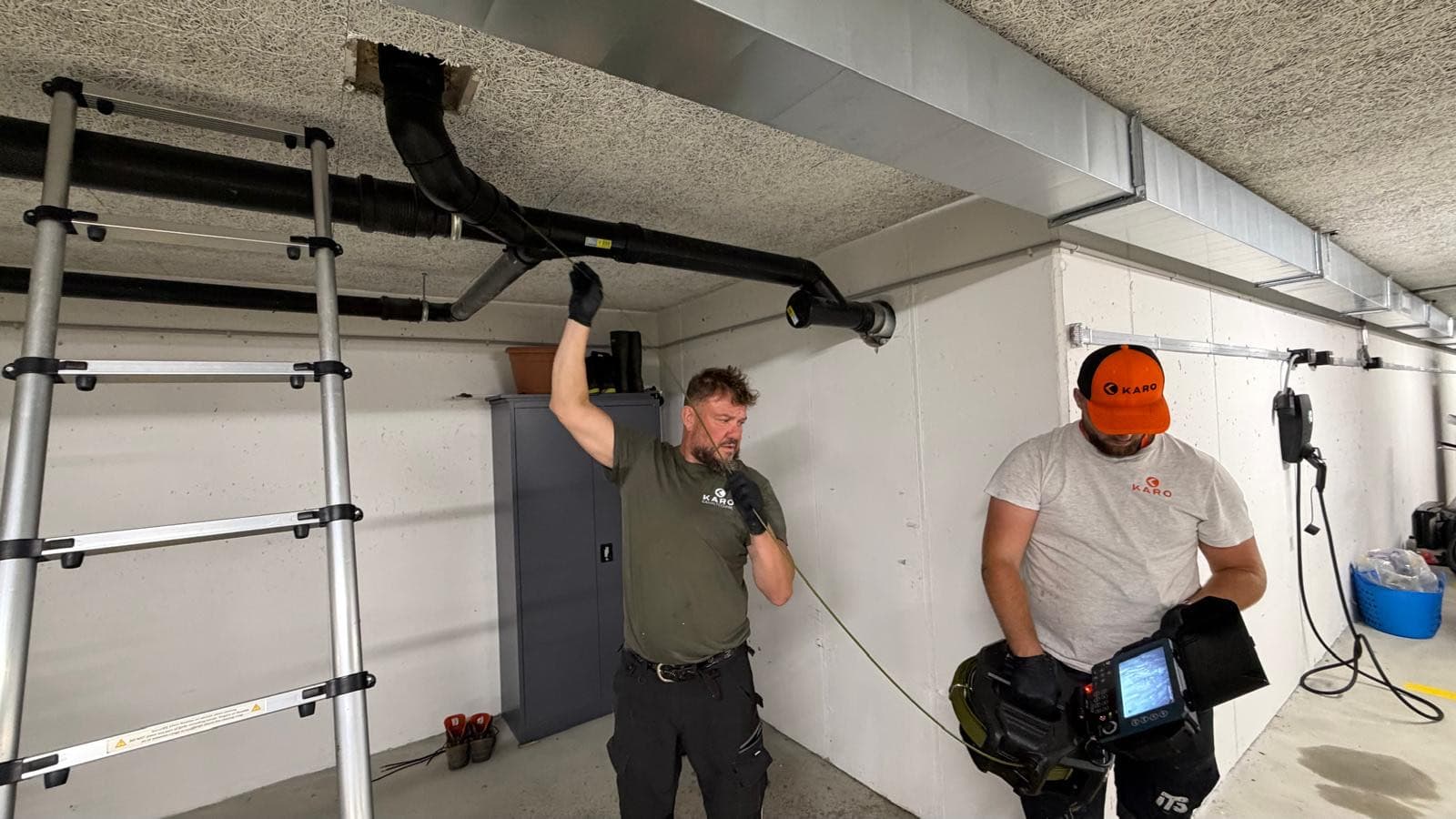
If a blockage keeps coming back at the same spot, a camera inspection is worthwhile. It shows whether a displacement, root ingress or a gradient defect is the cause. The footage is documented to SN EN 13508-2; a camera check as part of pipe cleaning incurs a surcharge from CHF 50.
Hire a drain snake or call a professional?
A simple hand snake costs little at a DIY store and is worthwhile for every household. Larger drum and electric snakes can be hired by the day from tool hire companies and some DIY stores. If you want to hire a drain snake, ask the provider directly about the terms – in addition to the daily hire charge there is often a deposit and transport, and you need to know the pipe diameter to choose the right head.
The real risk lies less in the hire price than in operating the tool. Without experience, it is hard to tell whether the resistance is a plug, a pipe bend or damage. If the blockage remains, you pay the hire charge for nothing and still have to call the specialist company; in the worst case, repair costs for the trap or the pipe are added on top.
Karo Kanaltechnik charges CHF 160 per working hour and CHF 60 for the call-out (excl. VAT). A blocked washbasin or shower has a guide price of approx. CHF 40, a kitchen or toilet outlet around CHF 80, plus call-out in each case. A typical job in a single-family home costs around CHF 150 to 400. For that, you get the right equipment, the right heads, flushing afterwards and, on request – for a surcharge from CHF 50 – the camera check.
In an apartment in Thun, the washbasin no longer drains. A hand-held drain snake is inserted through the trap, catches a solid plug of hair in the bend and pulls it out. After a few minutes, the water drains freely again without the pipe having to be opened. The case is different in a restaurant kitchen: water keeps backing up under the sink despite several attempts with the hand snake. Here the technician uses a motor-driven drum snake, opens up the greasy plug in the connecting pipe and recommends jetting the kitchen stack with high pressure afterwards so that the layer of grease on the pipe wall disappears completely.