What is drain cleaning?
Drain cleaning is the professional removal of everything that obstructs the flow in a wastewater pipe: layers of grease, sand and sludge, leaves, limescale and urine scale encrustation, ingrown roots and solids such as wet wipes. The pipes cleaned are those outside the living space, in other words underground drains below the floor slab, house connections up to the public sewer, manholes, and rainwater and land drains.
The aim is a clear bore along the entire length. Only when the inside of the pipe is clean does the wastewater drain away at the intended gradient, without backing up and without forming sewer gases that rise into the house as drain smells. Drain cleaning is therefore not just an emergency call-out but a regular part of property maintenance – much like servicing the heating.
Professionals distinguish between preventive cleaning at set intervals and cleaning in response to an acute blockage. Both use the same methods but pursue different goals: preventive cleaning keeps the pipe clear before any damage occurs, while emergency cleaning makes an already blocked pipe flow freely again.
What builds up in a drain
The deposits depend heavily on what water enters the pipe. Kitchen pipes are dominated by grease: it drains away warm, cools in the underground drain and settles as a sticky layer on the pipe wall. With every meal the layer grows and traps food scraps and coffee grounds until only a small part of the bore remains.
In toilet and urinal pipes, hard crusts of limescale and urine scale form, roughening the inside of the pipe and catching paper. Rainwater and land drains, on the other hand, fill up with sand, leaves, moss and fine sludge washed in from the roof and the forecourt. Where a joint leaks, fine tree roots get in and grow into dense root masses in the damp pipe.
Each of these deposits calls for a slightly different approach. Soft grease and sand can be loosened and flushed out with water pressure, whereas hard crusts and roots also need a mechanical tool. That is why good drain cleaning first establishes what is in the pipe before choosing the right method.
How does drain cleaning work?
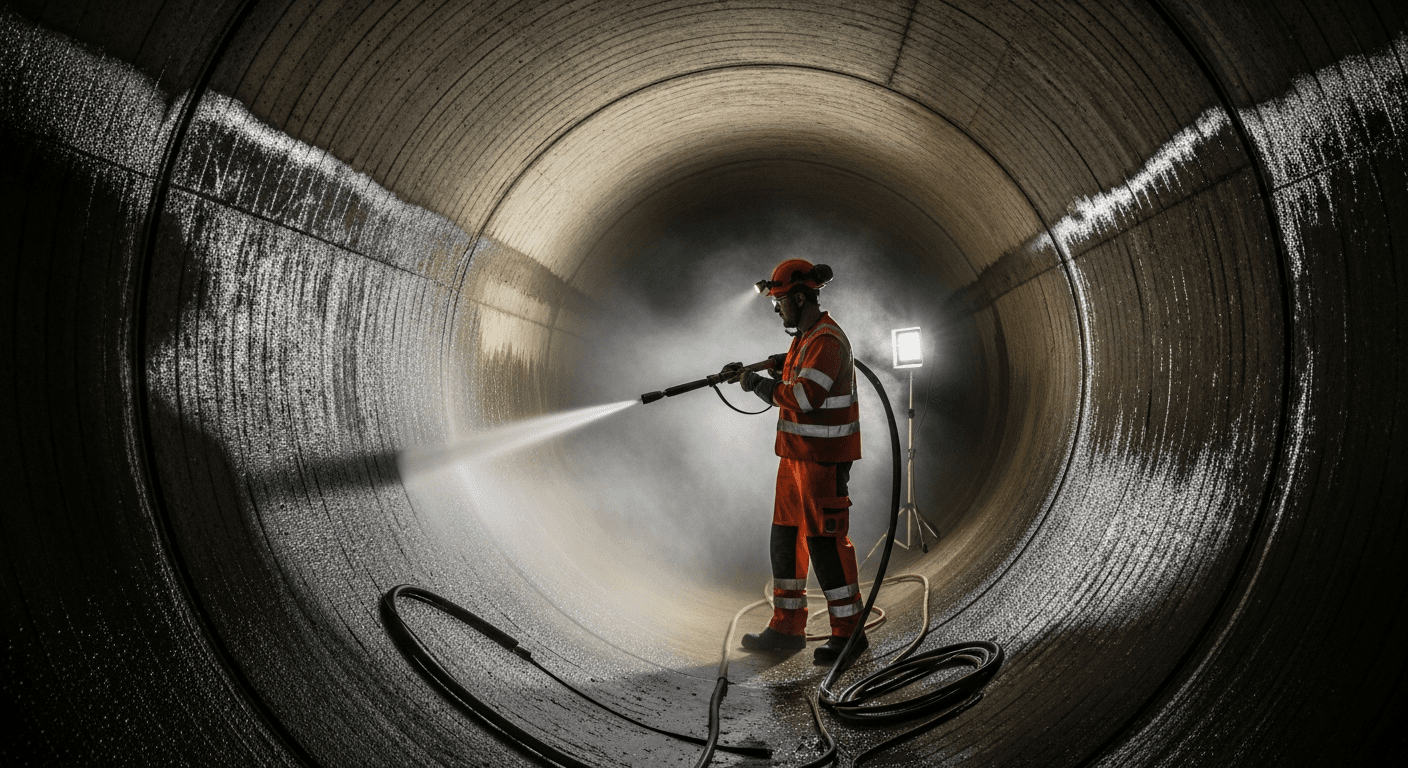
Modern drain cleaning almost exclusively uses the hydrodynamic high-pressure method. Water at high pressure – usually between 120 and 200 bar – is fed into the drain through a jetting hose and a special nozzle. Thanks to its backward-facing water jets, the nozzle pulls itself through the pipe and loosens deposits from the pipe walls.
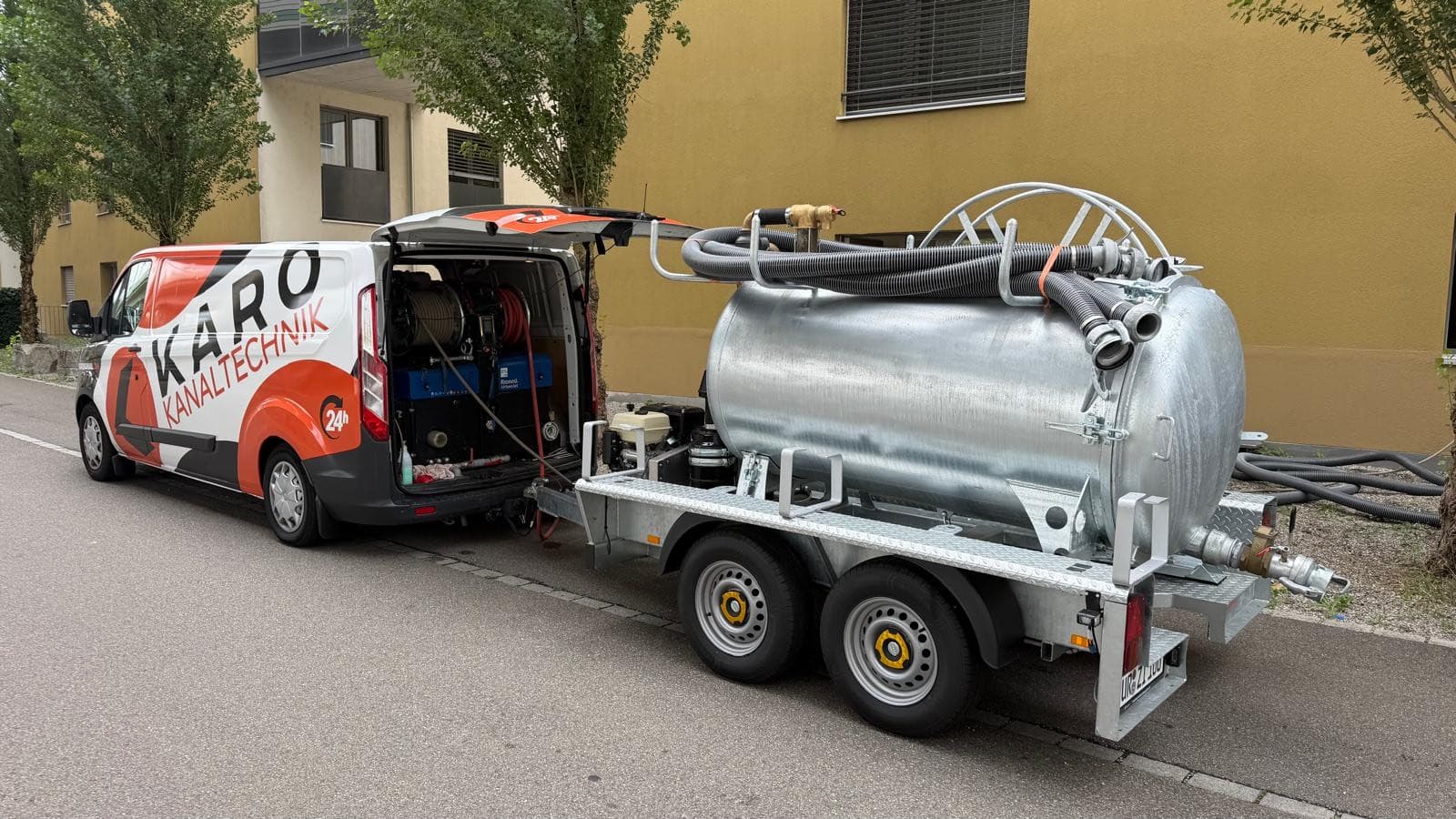
The loosened material is then carried with the jetting water to the next manhole, where it is vacuumed out. Larger vehicles combine a high-pressure pump and a suction system in one combination unit, so that jetting and vacuuming happen in a single operation. This way, the dirt removed does not stay in the system.
Methods compared: high pressure, mechanical, cutting – and why no chemicals
In practice, the method is chosen according to the type of deposit, the pipe diameter, the material and access. A job often combines several methods: first the pipe is cut clear, then it is rinsed with high pressure and the loosened dirt is vacuumed out.
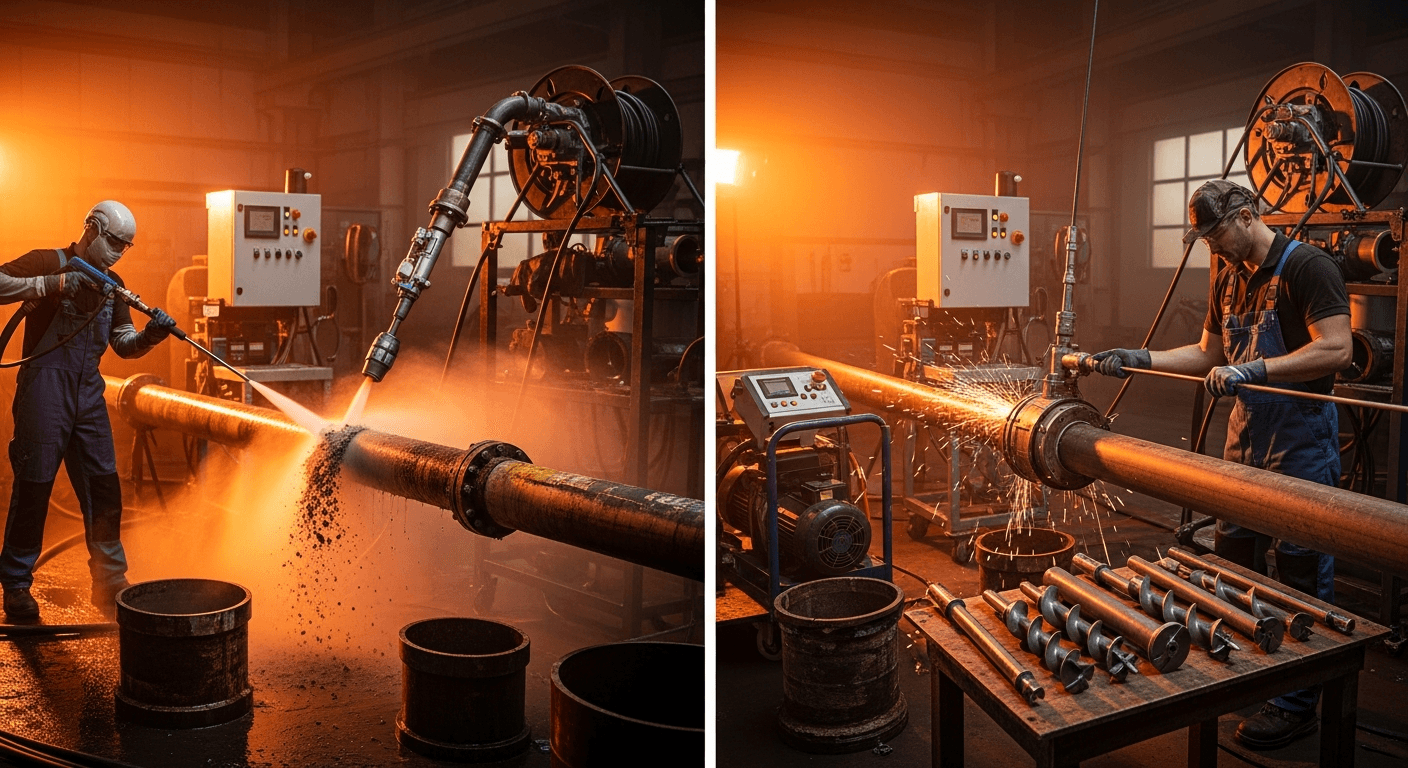
High-pressure water jetting is the standard method for underground drains, connecting pipes and rainwater pipes. It removes grease, sand and sludge thoroughly and gently, because pressure and nozzle can be adapted to the pipe. Mechanical methods such as the drain snake or the electromechanical cleaning machine are suited to smaller pipes inside the house, for example from the washbasin, shower or toilet to the soil stack. Cutting is used when hard crusts, roots, mortar residue or protruding connections sit in the pipe that water alone cannot remove.
We do not use chemical drain cleaners for drain cleaning. They only act on organic blockages close to the outlet, dissolve neither sand nor roots nor limescale crusts, can attack seals and older metal pipes, and put a strain on the wastewater treatment plant (WWTP, ARA). If the blockage remains, there is also a caustic liquid standing in the pipe that can spray out when it is opened later. Chemical-free high-pressure jetting at up to 200 bar is the better choice for both the pipe and the environment.
| Method | Effective against | Typical use | Limitations |
|---|---|---|---|
| High-pressure water jetting (120–200 bar) | Grease, sand, sludge, leaves, loose deposits | Underground drains, connecting pipes, rainwater pipes and land drains | Hard crusts and dense roots also require a tool |
| Drain snake / cleaning machine | Hair, paper, localised plugs | Small pipes in the house: washbasin, shower, toilet, kitchen | Does not flush anything out, unsuitable for long underground drains |
| Cutting (cutting nozzle, robotic cutter) | Roots, limescale and urine scale, mortar, protruding connections | Pipes with hard obstructions, preparation for rehabilitation | Does not remove the cause; leaking points must be rehabilitated afterwards |
| Vacuuming (combined jetting and suction) | Sludge, sand and debris in manholes and collectors | Inspection chambers, silt traps, separators | Does not replace jetting the pipe |
| Chemical cleaners | Only organic blockages close to the outlet | Not used at Karo | Does not dissolve sand or roots, harms pipes and watercourses |
High-pressure water jetting
A pump in the jetting vehicle forces water through a high-pressure hose to the nozzle. The rear-facing jets drive the nozzle forwards and rinse the pipe wall; as the nozzle is slowly pulled back, the loosened dirt is carried towards the manhole. There are dedicated nozzles for different tasks, such as all-round, bottom or rotating nozzles.
Mechanical cleaning with snake and machine
A rotating steel spiral with a tool head is pushed through the pipe and drills through the plug or pulls it out. The method is practical indoors because it does not need a large vehicle, but it does not clean the pipe wall as thoroughly as water pressure.
Cutting roots and crusts
Rotating cutting and chain-flail nozzles or a remote-controlled robotic cutter remove hard obstructions while sparing the intact pipe wall, provided the tool and speed suit the pipe material. Because roots grow back at leaking points, cutting is usually followed by a camera check and, if necessary, localised sealing.
When is drain cleaning needed?
Cleaning is advisable as soon as wastewater drains away more slowly, unpleasant odours appear or backflow occurs. Gurgling noises in outlets and recurring blockages are also typical warning signs of deposits in the drain.
For properties with commercial premises, restaurants or heavy leaf fall, regular preventive cleaning every one to three years is recommended. For private underground drains, cleaning as and when needed is often sufficient, combined with a CCTV drain survey to check their condition.
Cleaning also makes sense before a change of ownership, before a renovation, before a CCTV drain survey and before any rehabilitation. A camera can only see whether a pipe has cracks, displaced joints or roots if the pipe is clean, and a liner only bonds to a cleaned pipe wall.
Professional drain cleaning in 5 steps
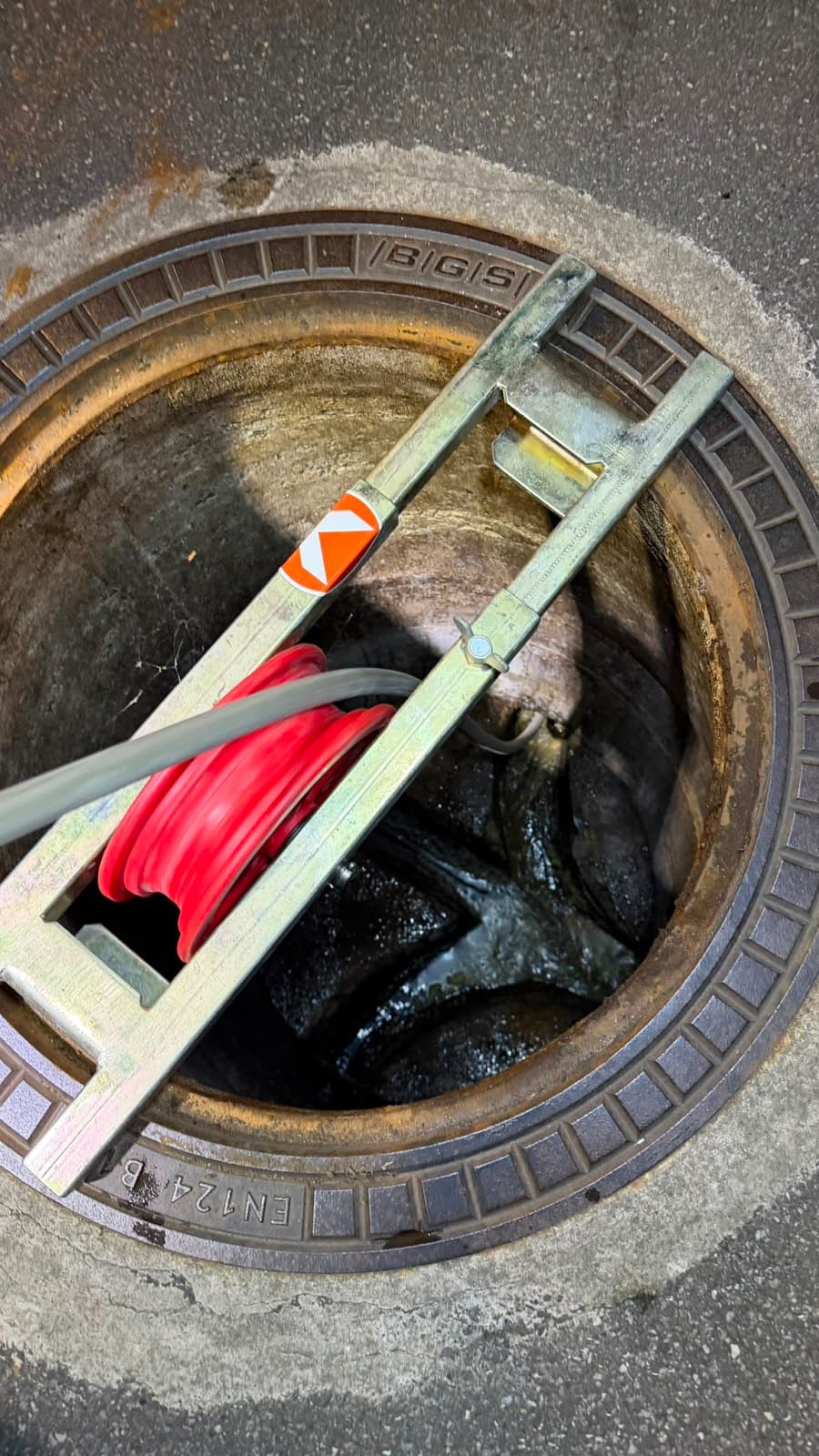
First we gain access to the drain via manholes and access openings. After a brief visual check, the jetting nozzle is inserted and the pipe is cleaned section by section. Where there is heavy encrustation or root ingress, we use special cutting or root-cutting nozzles.
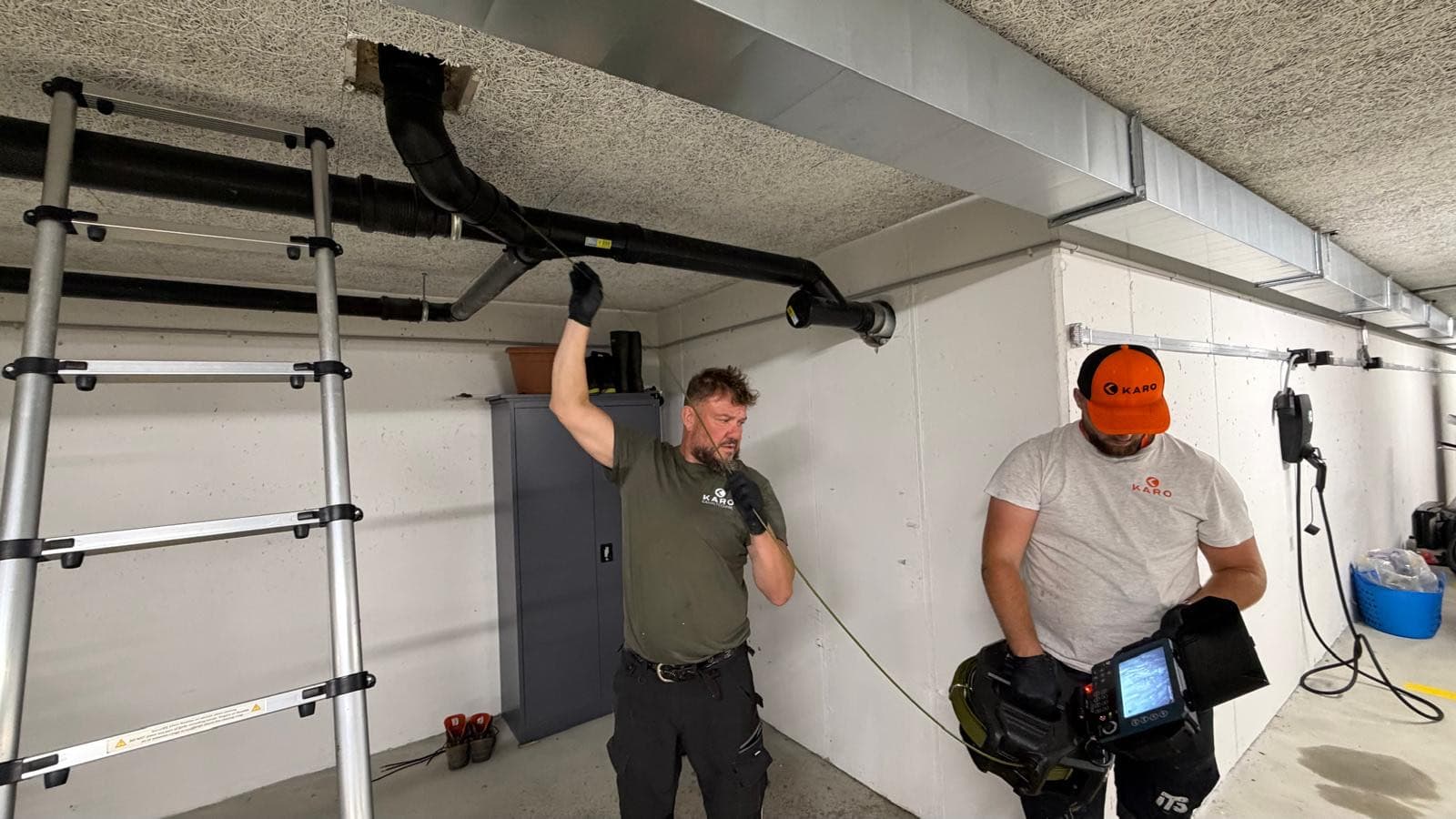
After cleaning, a CCTV drain survey is advisable to document the condition of the pipe and identify any damage at an early stage. The cleaning thus also becomes the basis for planning any rehabilitation that may be needed.
In summary, a job runs in five steps: 1. clarification and access via manholes or rodding eyes, 2. visual check and choice of pressure and nozzle, 3. jetting, with cutting if needed, section by section from the lowest point, 4. vacuuming and proper disposal of the loosened material, 5. checking for free flow, with a CCTV survey and report on request.
1. Clarification and access
On the phone or on site we clarify where the problem occurs, which outlets are affected and where the manholes and rodding eyes are located. If the pipe layout is unknown, property drainage plans or pipe locating can help.
2. Visual check and choice of method
A look into the manhole shows how much water is standing and what kind of deposit is present. Pressure, water volume and nozzle are then matched to the pipe material, diameter and condition – an old vitrified clay or concrete pipe is jetted more carefully than a new plastic pipe.
3. Jetting and cutting if needed
The nozzle is inserted against the direction of flow and works with the water flow as it is pulled back, so that the loosened dirt moves towards the manhole. Hard obstructions are cut away beforehand.
4. Vacuuming and disposal
Sludge, sand and lumps of grease are vacuumed out at the manhole rather than simply being flushed on into the public sewer. This prevents coarse solids from entering the pipes further downstream.
5. Check and documentation
Finally, we check that water drains freely from all outlets again. On request, this is followed by a CCTV survey with a report to SN EN 13508-2 that records the condition of the pipe.
Is a CCTV report needed after cleaning?
Not after every cleaning. If a pipe is blocked on a one-off basis, for example by wet wipes, and it drains perfectly again after jetting, the cleaning is enough. A CCTV drain survey is worthwhile if the same pipe blocks repeatedly, if roots or pipe fragments come to light, if the house is older and the condition of the underground drain is unknown, before a purchase or renovation, and when the municipality requires proof of condition.
The report shows each finding with its position in metres from the manhole, a photo and coding to SN EN 13508-2. This makes it possible to decide whether a pipe is in order, should be monitored or needs rehabilitation. Because the pipe has to be clean for the camera anyway, cleaning and inspection can easily be combined in one appointment; at Karo, a CCTV surcharge from CHF 50 applies.
What does not belong down the drain
Many blockages are caused not by a fault in the pipe but by what goes into it. Anyone who disposes of the following items with the rubbish rather than via the washbasin, sink or toilet will significantly extend the time until the next cleaning.
The following do not belong down the drain: cooking fat and frying oil, meat juices and leftover sauces, food scraps and coffee grounds, wet wipes, cotton buds, sanitary towels, tampons and nappies, cat litter, hair in larger quantities, cigarette ends, medicines, paints, solvents and used oil, as well as cement slurry and building site residues. Even wet wipes sold as «flushable» often barely break down in the pipe and tend to snag on joints and roots.
Once cooled, soak up fat and oil with kitchen paper or collect it in a container, take medicines back to the pharmacy, and hand in paints, solvents and used oil at a collection point. A simple strainer in the sink and shower holds back food scraps and hair before they reach the pipe.
Who pays for drain cleaning: tenant or owner?
In Switzerland, the owners of a property are responsible for its private wastewater pipes, in many municipalities including the house connection up to where it joins the public sewer. Cleaning is part of maintenance and is therefore, as a rule, paid for by the landlord. Where the boundary with the municipality lies is set out in the municipal wastewater regulations.
Tenants are responsible for minor cleaning, such as a trap under the washbasin, and must use the installations with care. If a blockage can be shown to have been caused by improper use, for example by grease or wet wipes, the costs can be charged to the person responsible. In condominium ownership, soil stacks, underground drains and the house connection are generally among the common parts, whose maintenance is borne by the community of owners.
Whether an insurance policy covers consequential damage such as a flooded basement after backflow depends on the policy in question. In any case, a cleaning report stating the cause and findings helps to allocate the costs properly.
Drain cleaning, pipe cleaning and drain rehabilitation: the differences
The terms are often used interchangeably. Pipe cleaning generally refers to the smaller pipes inside the building, i.e. outlets from the kitchen, bathroom and toilet down to the soil stack. Drain cleaning covers the larger pipes outside the living space: underground drain, house connection, manholes and rainwater pipes. Finally, sewer cleaning usually refers to cleaning the public network, which is the responsibility of the municipality or a wastewater association.
Cleaning removes whatever is lying in the pipe, but it does not repair any damage. If the camera shows cracks, leaking joints or root ingress, drain rehabilitation is needed – often trenchless, with a patch liner for individual points or a CIPP liner for entire pipe runs. Karo provides a warranty of up to 10 years on rehabilitation work.
How to recognise a reputable company
In an emergency in particular, many people make decisions under time pressure. A few points help to distinguish a reputable drain cleaning company from a disreputable one.
A reputable company states its hourly rate and call-out fee before the job, charges transparently by time and issues an invoice listing all items. It cleans with water pressure and mechanical tools rather than chemicals, explains what it has found and backs up damage with images or a camera report. It only recommends rehabilitation once an inspection has shown the damage, and it gives you time to obtain a quote.
Be wary of flat rates that are only quoted on site, cash payment without a receipt, expensive rehabilitation proposals without photographic evidence, and firms that can only be reached on a mobile number and have no legal notice. Independent reviews, for example on the Google profile, also give an impression of how a company works.
How much does drain cleaning cost?
The costs depend on the effort involved and on the length and condition of the drain. At Karo, drain cleaning is charged at an hourly rate of CHF 160, plus a call-out fee of CHF 60 (excl. VAT). These figures may vary by around 15% depending on the region and the job.
One hour of work including call-out comes to CHF 220 excl. VAT or CHF 237.82 incl. 8.1% VAT at Karo; a typical job in a single-family home usually costs between CHF 150 and 400. A price table and worked examples can be found on the «Drain cleaning costs» page.
For a binding quote, we assess the situation and access in advance. For jobs that can be planned, several buildings or an entire property can be efficiently grouped into one appointment, which lowers the cost per metre.
An apartment building in Winterthur reports recurring backflow in the basement. During hydrodynamic cleaning of the underground drain, the jetting nozzle dislodges a massive grease deposit from the kitchen waste pipe. After just under two hours, the wastewater flows freely again; the subsequent CCTV drain survey shows that the pipe itself is intact. Because the cause was grease from the kitchens rather than damage to the pipe, preventive cleaning at regular intervals will be enough in future – no rehabilitation is needed.