
Drain cleaning in the canton of Zug
In the canton of Zug we work in the town of Zug, in Baar, Cham, Steinhausen, Hünenberg and Rotkreuz; Walchwil and the municipalities of the Aegeri valley (Ägerital) are also part of our service area. The teams set off from our base in Zurich-Wiedikon.
Our services: drain cleaning with high-pressure water jetting, pipe cleaning in kitchen, bathroom and toilet, CCTV drain survey, manhole cleaning, leak-tightness testing and leak detection. If only one drain in the house is blocked, you will find guide prices on the pages pipe cleaning in Zug, pipe cleaning in Baar, pipe cleaning in Cham, pipe cleaning in Steinhausen and pipe cleaning in Rotkreuz.
What does drain cleaning in the canton of Zug cost?
Our guide prices apply: CHF 160 per hour of labour plus a CHF 60 call-out fee, excluding VAT. A washbasin or shower drain costs approx. CHF 40, a kitchen or toilet drain approx. CHF 80, plus the call-out fee in each case. The binding costs are set out in the quote or the job report.
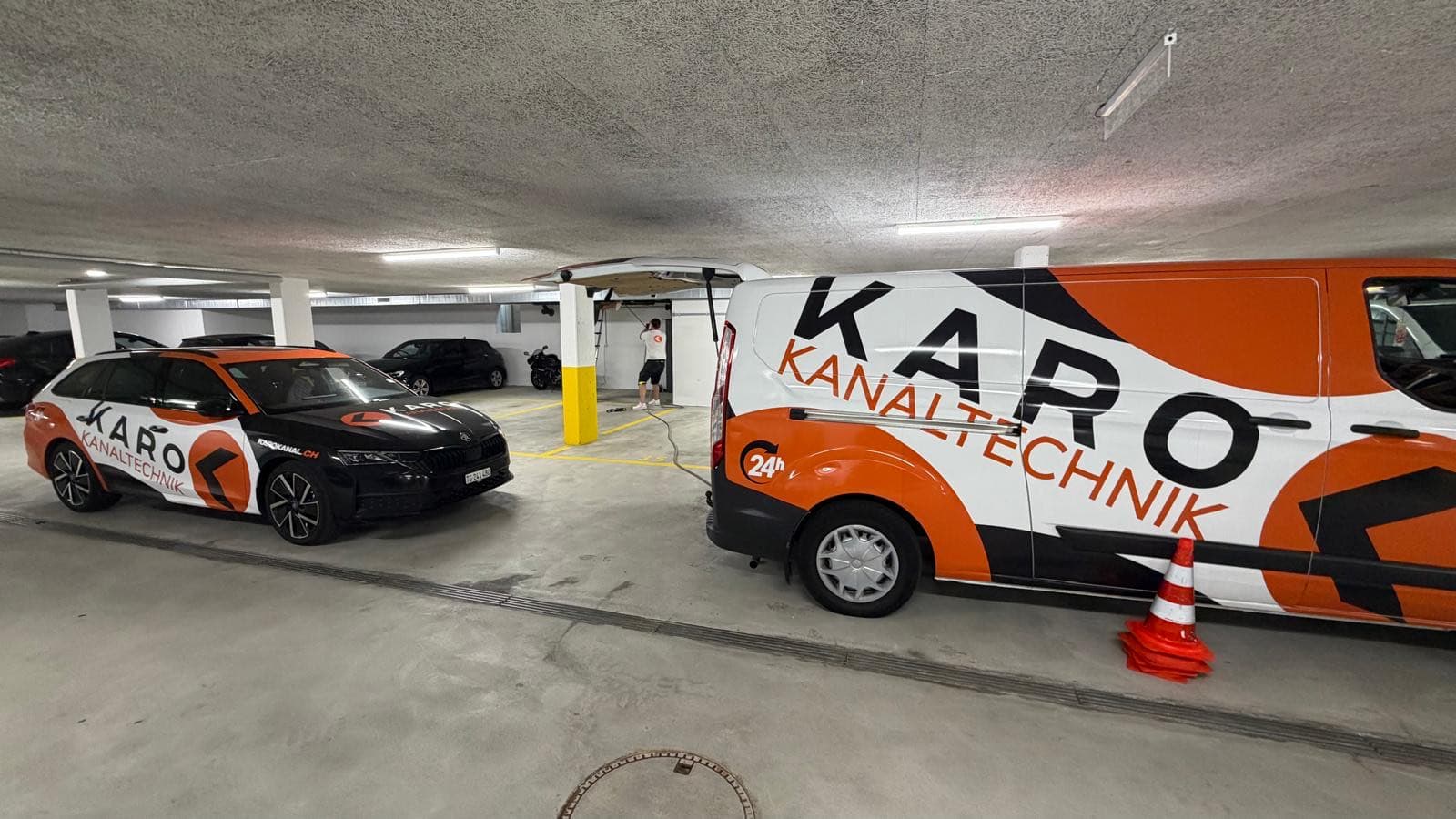
A worked example for a commercial property: after a thunderstorm, water is standing in the underground car park. The team empties the silt traps by suction and jets the floor drains and the pipe clear up to the pump chamber – two hours of labour.
| Item | Amount |
|---|---|
| Labour 2 hrs × CHF 160 | CHF 320.00 |
| Call-out fee | CHF 60.00 |
| Subtotal excl. VAT | CHF 380.00 |
| VAT 8.1% | CHF 30.78 |
| Total incl. VAT | CHF 410.78 |
Worked example using Karo Kanaltechnik's guide prices (CHF 160 per hour, CHF 60 call-out fee, excl. VAT). A camera check after cleaning costs a surcharge from CHF 50. The quote or the job report on site is binding.
A typical job in a single-family home usually costs CHF 150 to 400. All the factors under drain cleaning costs; you can calculate your guide price via the enquiry form.
Underground car parks, office and residential developments
Between Zug, Baar, Cham and Steinhausen there are many newer residential and commercial developments with underground car parks. Typical jobs are silted-up floor drains and silt traps, backflow in basements below the backflow level and the maintenance of lifting stations and pump chambers. Working backflow protection protects the basement during heavy rain.
In canteens, restaurants and hotels, fat is the most common cause of blockages. We clean kitchen pipes up to the grease separator and, on request, work outside operating hours.
How often should cleaning be done?
Our guide values for maintenance in the canton of Zug:
- Single-family home: every two to five years, every two to three years under heavy use.
- Apartment buildings and condominiums: every year to every two years.
- Restaurant, canteen, hotel: at least once a year, often every six months; grease separator as required by the municipality.
- Underground car park: empty silt traps and floor drains by suction before winter and after heavy thunderstorms.
For property management companies, we record the interval in a maintenance plan – more under drain maintenance for property management companies and in the guide How often is drain cleaning needed?.
Drain rehabilitation in the canton of Zug
If the camera shows cracks, displaced joints or roots, in most cases we rehabilitate without digging: with a CIPP liner for entire sections, a patch liner for individual damaged spots and spray lining for narrow building pipes. The surroundings, access road and underground car park remain in use.
We quote the price after the findings of the camera survey; we give a warranty of up to 10 years on rehabilitation work. More on methods and process on the page drain rehabilitation and in the guide Drain rehabilitation: cost per metre.
Regulations and responsibilities in the canton of Zug
The cantonal Zug Office for the Environment describes wastewater disposal in the canton: the wastewater of over 99 percent of the population is fed to a wastewater treatment plant. The largest is ARA Schönau, the plant of the Zug Region Water Protection Association (GVRZ) in Friesencham near Cham; it treats the wastewater of 18 municipalities, including ten municipalities in the canton of Zug. The Office for the Environment also provides the municipalities with model wastewater regulations as a template for their own regulations.
The private pipes up to the connection to the public sewer are generally the responsibility of the owners; the municipality maintains the public sewer. Whether a property drains into a combined system or a separate system is set out in the general drainage plan, and the details in the municipality's drainage regulations.
What should not go down the drain?
In office and residential developments, many households and businesses share the same soil stacks and underground drains. Whatever one flat puts down the drain ends up in the shared stack – and often blocks it in the basement, where the backflow affects everyone. Wet wipes and kitchen fat are the most common causes. For property management companies, a short note in the house rules is therefore worthwhile:
- Kitchen: no frying fat, deep-frying oil or leftover sauces in the sink – collect them in a jar once cold and dispose of them with the household rubbish.
- Food waste and coffee grounds belong in the green waste or rubbish bag, not in the drain.
- Toilet: only toilet paper. Wet wipes, including those labelled «flushable», cotton buds and sanitary products go in the bin.
- Never dispose of cat litter or cigarette butts via the toilet.
- Medicines back to the pharmacy; paints, solvents and engine oil to the municipal collection point.
Chemical drain cleaners are not a solution: they attack seals and rarely clear stubborn blockages. First steps you can take yourself are described in the guide Blocked drain: first aid.
Process and emergency service
This is how a job in the canton of Zug works:
- Call or online enquiry – you receive the guide price and time window.
- Finding the cause, clearing the blockage chemical-free with a drain snake or high-pressure jetting at up to 200 bar.
- On request, a camera check with documentation according to SN EN 13508-2.
- Job report and invoicing based on the actual effort.
In the event of backflow, water in the underground car park or a completely blocked drain, our emergency service helps around the clock on +41 43 588 12 08.