
What is a plunger?
A plunger is a simple hand tool for clearing blocked drains. It consists of a flexible cup made of rubber or soft plastic and a handle made of wood or plastic. The cup is placed over the drain opening, and the handle serves as a grip with which you pump. Apart from water in the basin, it needs neither electricity nor chemicals.
Several names are in use in German (Saugglocke, Pümpel, Pömpel, Gummisauger), as is the English «plunger». They all refer to the same principle. With a fresh blockage close to the surface, it is often enough on its own. It is the first step in self-help – not the last.
How does the suction cup work? Suction and pressure
The plunger works with changes in pressure. When you push the cup down, it forces the water in the cup into the drain and creates positive pressure in the pipe. When you pull the handle back up, negative pressure forms under the cup and pulls on the plug. The water between the cup and the blockage acts like a piston: it can hardly be compressed and transfers the force directly to the plug.
Repeated pushing and pulling moves the blockage back and forth, loosens it and finally breaks it into pieces that drain away or are sucked upwards. That is why a single strong thrust is rarely enough. What works is a steady rhythm with several strokes, followed by pulling the cup off with a jerk.
For the pressure to arrive where it should, the system has to be sealed. Every second opening – the overflow on the washbasin, the second bowl of a double sink, the overflow of the bathtub – is a valve through which the pressure escapes. If it is open, you pump air and water through the overflow instead of against the blockage.
What types of plunger are there?
The classic flat plunger has a hemispherical cup with a smooth rim. It seals well on flat surfaces and is therefore suitable for washbasins, sinks, showers and bathtubs. It is not well suited to the WC, because it does not seal tightly around the curved opening of the bowl.
The WC plunger has an additional collar at the bottom, a kind of rubber sleeve that fits into the drain opening of the WC bowl. This way it sits tightly and transfers the pressure into the water seal trap of the bowl. Many models can be turned inside out: collar folded out for the WC, folded in for flat drains.
The bellows plunger has a bellows with several folds instead of a simple cup. It displaces more water per stroke and therefore generates stronger pressure. There are also pump-type drain cleaners with a piston that force water into the drain or suck it out in a targeted way. They work on the same principle but require particular care, because the higher pressure also acts on trap connections and seals.
Using a plunger correctly: step by step
First expose the drain: remove the strainer insert, plug or shower cover and pull out any visible hair or residue by hand, wearing gloves. The plug often sits directly under the strainer and is then already cleared.
Then run in enough water for the cup to be completely submerged – a few centimetres are enough. Without water, the plunger only pumps air, which can be compressed and transfers hardly any force. You can moisten the rim of the cup slightly or smear it with a little petroleum jelly so that it seals better.
Now seal all second openings, for example by pressing a wet cloth firmly over the overflow. Place the cup vertically over the drain without trapping air, then push the handle down firmly and evenly 15 to 20 times and lift it again, without the cup losing contact. Finally, pull the cup off with a jerk.
If the water drains away, flush with plenty of warm water to carry loosened residue out of the trap. If it stays put, repeat the process two or three times. If even that does not help, the blockage is too deep or too firm – then further pumping is not worth it.
On the washbasin, in the shower and bathtub
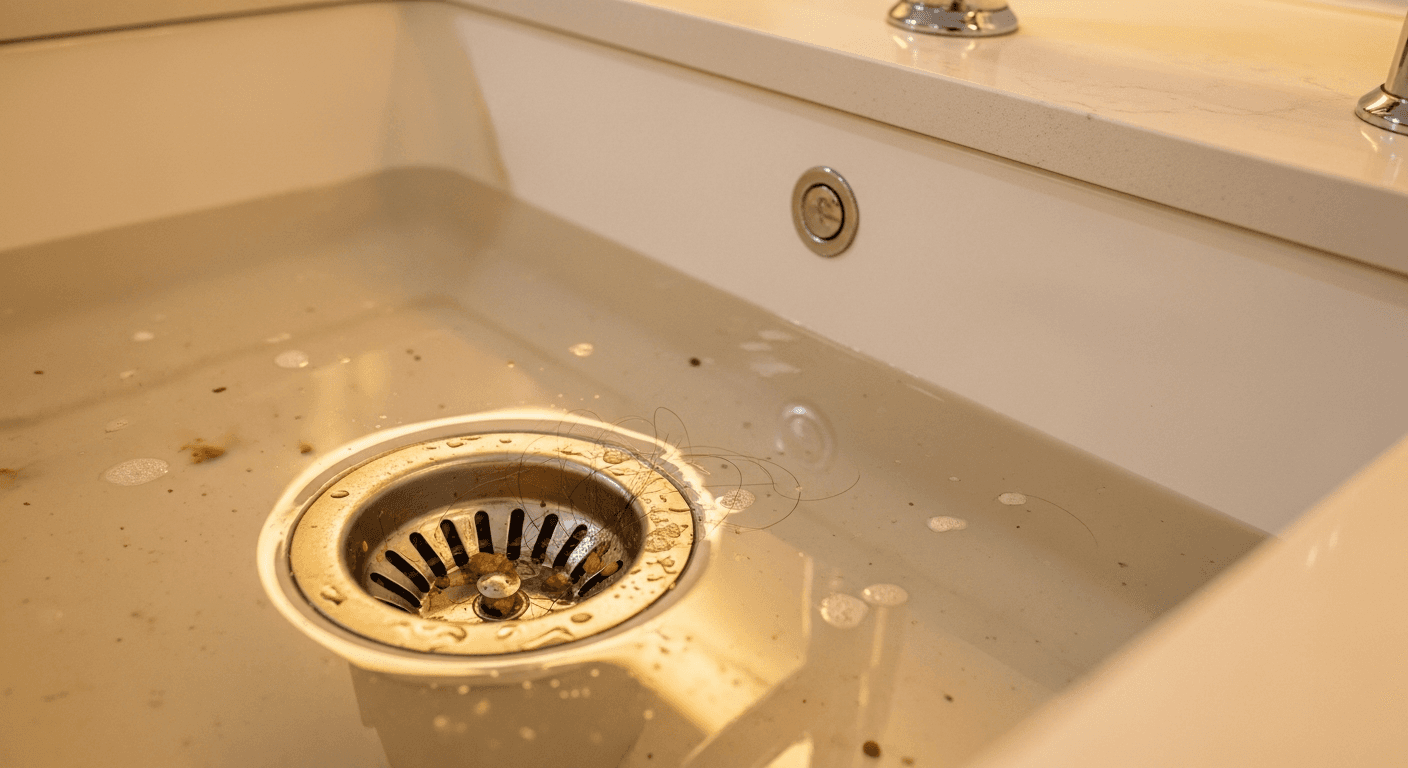
On the washbasin, the overflow is the most common source of failure. The small opening under the rim of the basin is connected to the drain; if it stays open, the pressure escapes immediately. It works best when one person seals the overflow with a wet cloth or the flat of their hand while the second person pumps. With a double sink in the kitchen, the second bowl must be closed with a plug or a second plunger.
In the shower, the blockage is usually in or just below the drain, typically a tangle of hair and soap residue. It helps to remove the cover first and clean the strainer insert. With shower channels, the round cup often does not fit the elongated opening; in that case, apply it directly to the exposed drain spigot.
In the bathtub, the overflow at the head of the tub is connected to the drain. It must be sealed, otherwise you are pumping into thin air. With the washbasin, on the other hand, it is often worth looking in the trap: with a bucket underneath it can be unscrewed, and if the plug sits there, it is quicker to remove by hand than with the plunger.
On the WC: collar plunger and water level
The WC calls for a plunger with a collar or a bellows plunger. The collar is placed in the drain opening of the bowl so that the cup sits tightly. The water should cover the cup; if there is too little water in the bowl, add a little, and if it is up to the rim, scoop some out with a cup first.
Important: as long as the WC is blocked, do not flush again. Each flush fills the bowl further, and the water overflows. Start pumping slowly so that no dirty water splashes out, then more firmly. If the water level drops and it gurgles, the plug is coming loose. Only then flush once and watch whether the water drains normally.
Common causes in the WC are too much paper at once, wet wipes, sanitary products, cotton buds or cat litter. Paper usually comes loose well with the plunger. Wet wipes and sanitary products, by contrast, do not break down, and pressure often only pushes them a little further along, where they later get stuck again.
When does the plunger not help?
The plunger only works over a short distance: in the trap, in the water seal trap of the WC bowl and in the first section of the connecting pipe. If the blockage sits further down the pipe, the pressure dissipates on the way there. A clear sign of this is when several drains are affected at the same time, for example the shower and WC, or when water rises in the shower drain when the WC is flushed. Then the problem lies in the soil stack or the underground drain, not at the individual drain.
Grease in the kitchen soil stack cannot be removed with the plunger either. Cooking fat solidifies on the pipe wall as it cools and narrows the cross-section over the years. The plunger can loosen a fresh plug, but the layer of grease behind it remains, and the next blockage soon follows.
Solid foreign objects such as toys, toothbrushes, lids or sanitary products should not be tackled with pressure. The plunger often only pushes them deeper, where they wedge themselves in a bend and are then harder to retrieve. It is better to pull out visible objects with gloves or a grabber. The plunger is also no help with root ingress, crushed or displaced pipes, or backflow from the sewer.
Take care with old pipes and after using drain cleaner
The pressure from a plunger is harmless for intact pipes. In older properties, however, brittle seals, corroded cast-iron pipes or loose trap connections can give way. Pumping hard can then cause a leak under the washbasin or in the wall. After plunging, it is therefore worth checking the trap and connections: if something drips, tighten the fitting or have the seal replaced.
The combination with chemical drain cleaner is particularly dangerous. If a caustic product has already been poured into the drain, you must not use the plunger any more. The water in the basin then contains alkali or acid, which can splash out during pumping and injure skin and eyes. In this case, tell the specialists which product was used so that they can protect themselves accordingly.
Boiling water is not a good addition either. It can deform plastic pipes and crack the ceramic of a WC bowl through thermal shock. Warm water from the tap is enough for flushing.
The next step: drain snake or specialist firm
If the plunger does not help after several attempts, the drain snake is the next tool. It is pushed into the pipe through the drain or after unscrewing the trap and breaks up the plug mechanically or pulls it out. It therefore reaches further than any plunger, but requires a feel for the job so that bends and older pipes are not damaged.
At the latest when several drains are affected, water rises in the basement or the blockage keeps coming back, the pipe belongs in the hands of specialists. Karo Kanaltechnik clears blockages with the drain snake and jets soil stacks and underground drains without chemicals at high pressure of up to 200 bar. If the cause remains unclear, a CCTV drain survey shows whether grease, roots or pipe damage is behind it.
Work is charged by time: CHF 160 per hour plus CHF 60 call-out fee, each excl. VAT. A one-hour call-out therefore costs CHF 220 excl. VAT or CHF 237.82 incl. 8.1% VAT. If you have already tried a plunger, it is best to say so on the phone – that helps to narrow down the cause more quickly.
In a rented flat in Winterthur, the washbasin in the bathroom is only draining drop by drop. The first attempt with the plunger achieves nothing, because the overflow stays open and the water bubbles out there. On the second attempt, a second person presses a wet cloth onto the overflow, there are a few centimetres of water in the basin, and after around 20 even strokes and a firm pull it gurgles: a tangle of hair and soap residue comes loose and the water drains away. Had the shower and WC been backed up at the same time, the plunger would have been the wrong tool – then the blockage is in the soil stack, and a drain snake or high-pressure water jetting by specialists is needed.