
When the drain is blocked, the first quarter of an hour decides whether you solve the problem yourself or whether it gets bigger. The good news: most blockages sit in the trap or just behind it and can be cleared with simple mechanical means. The bad news: anyone who reaches for the wrong method, such as aggressive chemicals or a wire coat hanger, can quickly turn a small blockage into damage to seals and pipes.
This guide takes you through the diagnosis, the right order of measures and the clear signs of when nothing more helps and a professional should take over. If you are mainly interested in bicarbonate of soda, vinegar, baking powder and other home remedies, you will find the details in the sister article Cleaning drains with home remedies. Before you pick up the phone, there are a few measures you can try yourself. We show you what really works — and what you are better off avoiding.
Drain, outlet, sink: what we are talking about
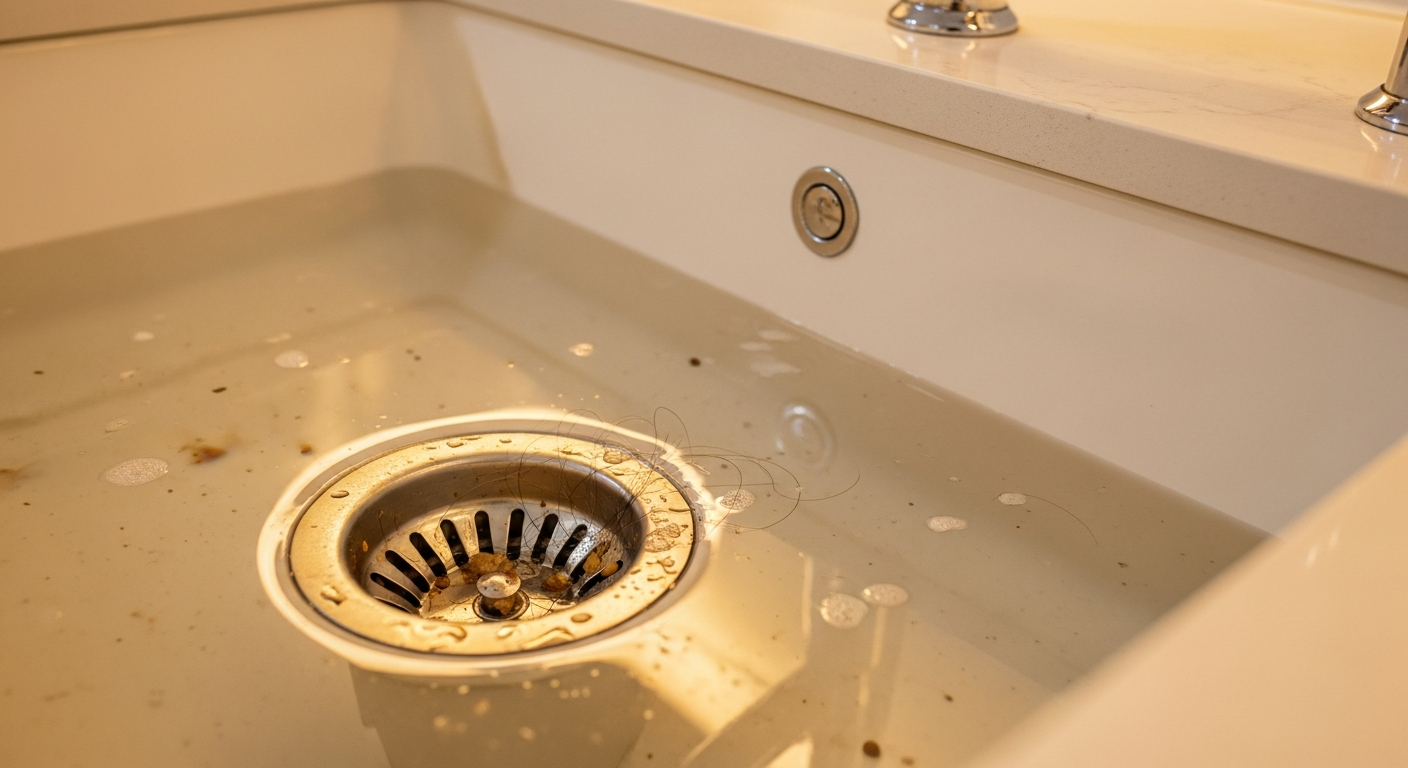
In Switzerland people usually say the outlet («Ablauf») is blocked, in Germany rather the drain («Abfluss»). Both mean the same thing: the opening in the washbasin, kitchen sink, shower, bath or floor through which wastewater flows into the pipe. Directly below sits the trap, technically known as a water seal trap. With a small reservoir of water it keeps the drain smell out and is at the same time the spot where hair, soap residue, grease and limescale most like to collect.
Behind the trap, a short branch pipe leads to the soil stack, the vertical collector pipe that carries the wastewater from several flats downwards. In the basement or below the floor slab, the soil stack flows into the underground drain, which carries the wastewater of the whole building to the public sewer. Exactly where your blockage sits decides whether a home remedy is enough or whether machines are needed.
Diagnosis in three questions: where is the blockage?
Take two minutes for the diagnosis before you get started. This saves time and avoids measures that tackle the wrong spot. Three questions are enough:
- Is only one drain affected or several? A single washbasin points to the trap, several drains at once to the soil stack or the underground drain.
- Is the water not draining at all or only slowly? Slow drainage usually means a growing deposit, a complete stop more likely a solid plug.
- Is there gurgling in other drains, a smell of sewage, or is water rising at a lower point, for instance in the basement floor drain or in the ground-floor shower? Then the wastewater is backing up in the building's pipework.
The following overview classifies the typical signs. It does not replace an inspection, but it helps you decide where to start.
| Sign | Likely location | What you can do |
|---|---|---|
| One washbasin or shower drains slowly | Trap, waste valve, first few centimetres of the pipe | Remove hair, plunger, clean the trap |
| Kitchen sink stays full | Trap or branch pipe, usually grease and food scraps | Hot water with washing-up liquid, plunger, clean the trap |
| Toilet does not drain, everything else works | Toilet outlet or short connection | Do not flush again, toilet plunger or toilet auger |
| Several drains in one flat affected | Branch pipe or soil stack | Stop putting water down, call a drain specialist |
| Water rises in the basement or floor drain | Underground drain or house connection | Call a professional immediately, stop water use throughout the building |
| Blockage returns after a few weeks | Structural cause, for example roots or displacement | Cleaning followed by a camera check |
Depending on the room, there are typical causes and tricks. You will find detailed instructions in our guides Blocked toilet: what to do?, Blocked shower, bath and washbasin and Kitchen drain blocked by grease.
Step by step: how to proceed
The order is deliberate: from the gentlest to the most involved method. Stop as soon as the water drains freely again, and then flush with plenty of warm water.
Step 1: 1. Stop the water and scoop it out
Do not let any more water run in and do not flush the toilet again. If the basin is full, scoop the water into a bucket with a cup so that you can see and reach the drain.
Step 2: 2. Remove visible dirt
Pull out the plug or the drain strainer and remove hair and residue wearing gloves or with a narrow plastic hair remover from a specialist shop. For washbasins and showers, this is often already the solution.
Step 3: 3. Hot water with washing-up liquid
For grease and soap, hot but not boiling water with a dash of washing-up liquid helps. Pour it in several portions and leave it to work for a few minutes.
Step 4: 4. Use the plunger correctly
Seal the overflow with a damp cloth, leave some water in the basin, place the plunger centrally and pump vigorously 15 to 20 times. Then pull it off sharply.
Step 5: 5. Unscrew and clean the trap
Place a bucket and a cloth underneath, loosen the union nuts by hand, empty the trap and rinse it out. Check the seals and refit everything hand-tight.
Step 6: 6. Use a drain snake
If the blockage sits behind the trap, push a hand-operated drain snake into the pipe with turning movements until you feel resistance, and loosen the plug by turning and gently pulling back and forth.
Step 7: 7. Check the result and flush
Run a few litres of warm water and watch whether the water drains away quickly and nothing gurgles anywhere. If the problem remains, stop here and call a drain specialist.
Tip 1: Hot water and washing-up liquid
For light grease blockages in the kitchen, hot water with a little washing-up liquid can already help. Slowly pour one litre of hot water into the drain and leave it to work for 15 minutes. The grease liquefies and can drain away. A tip from experience: with plastic pipes and older pipework, it is better to use hot but not bubbling boiling water. Let the water from the kettle stand briefly before pouring it in. Your seals and plastic pipes will thank you.
Tip 2: Use the plunger correctly
The plunger, in Switzerland also called a suction cup (Saugglocke or Pümpel), is the most effective tool for light blockages. Important: seal the overflow with a damp cloth, fill the basin with a little water, place the plunger directly over the drain and pump vigorously 15 to 20 times. The alternating suction and pressure clears most blockages.
Common mistakes: the overflow is left open, so the pressure escapes there instead of acting on the plug. With double sinks, the second drain must also be held closed. And for the toilet you need a plunger with a flange that fits into the opening of the bowl; the flat washbasin plunger does not seal there.
Tip 3: Bicarbonate of soda and vinegar — with realistic expectations
Put 4 tablespoons of bicarbonate of soda into the drain, followed by half a cup of vinegar. The fizzing reaction loosens organic deposits. Leave the mixture to work for 30 minutes and then flush with hot water. This method is environmentally friendly and gentle on the pipes. To be honest, however, its effect is limited: the fizzing does little against a solid plug of hair or a foreign object. Baking powder does contain bicarbonate of soda, but works less well because of the added acid and starch. Why this is and which home remedies are really worthwhile is explained in the article Cleaning drains with home remedies: bicarbonate of soda, vinegar and co..
Tip 4: Clean the trap and use a drain snake
If the plunger does not help, the plug is often in the trap itself. Under the washbasin or kitchen sink it can usually be unscrewed without tools: bucket underneath, loosen the union nuts, empty the contents, clean the parts under running water. When reassembling, make sure the seals are seated correctly, otherwise it will later drip unnoticed into the base cabinet.
If the blockage is further back, the drain snake comes into play. Hand-operated drain snakes a few metres long are available at DIY stores. Feed the snake in with turning movements, never by force, and pull it back slowly. Care is needed in old or thin-walled pipes and with chrome-plated traps. How far a hand-operated drain snake reaches and where its limits lie can be found in our guide to the drain snake.
Tip 5: Use a hair catcher and drain strainer
The best method against blockages is prevention. Use a drain strainer in the shower and bath — hair is the most common cause of blockages in the bathroom. In the kitchen, food scraps should always be put in the bin and never washed down the drain. Frying fat and deep-frying oil should be left to cool, put in a sealable container and disposed of with the household waste or at a collection point, never down the sink.
Tip 6: Keep away from chemical drain cleaners
Chemical drain cleaners may work in the short term, but damage your pipes in the long term. The aggressive alkalis attack seals and older pipe materials and often do more harm than good. They are also harmful to the environment and to health. Our glossary explains what types of drain cleaners exist and when an enzymatic product makes more sense than a chemical one.
It becomes particularly dangerous when a chemical cleaner does not work: then caustic alkali is standing in the pipe. Never mix it with vinegar, bicarbonate of soda or a second cleaner, do not pour boiling water after it and tell the drain specialist when you call what you have already put in. That way they can protect themselves.
What you should not do
- No straightened wire coat hanger: it scratches the trap and pipe and often just pushes the plug deeper.
- No mixing of different cleaners: products containing chlorine form toxic gases with acids such as vinegar.
- Do not flush repeatedly if the toilet does not drain: the bowl will overflow.
- Do not put a pressure washer from the garage into the household drain: the nozzle is not made for it, water sprays back and seals can be damaged.
- Do not carry on if water rises elsewhere: then the problem is no longer in the trap.
Drain blocked and nothing helps: these are the reasons
You have plunged, cleaned the trap, inserted the drain snake, and the water is still standing? That is not a failure, but a sign that the cause lies beyond the reach of household means. Typical reasons are:
- The blockage sits in the soil stack or underground drain, i.e. several metres from the drain.
- Deposits of grease, limescale or urine scale that have built up over years narrow the pipe, so that a new plug keeps getting stuck.
- A foreign object such as a toy, a bundle of cotton buds or wet wipes has become wedged.
- Roots have grown into the pipe through a leaking joint.
- The pipe is damaged, has sunk or is displaced at a joint, and the wastewater gets stuck at that point.
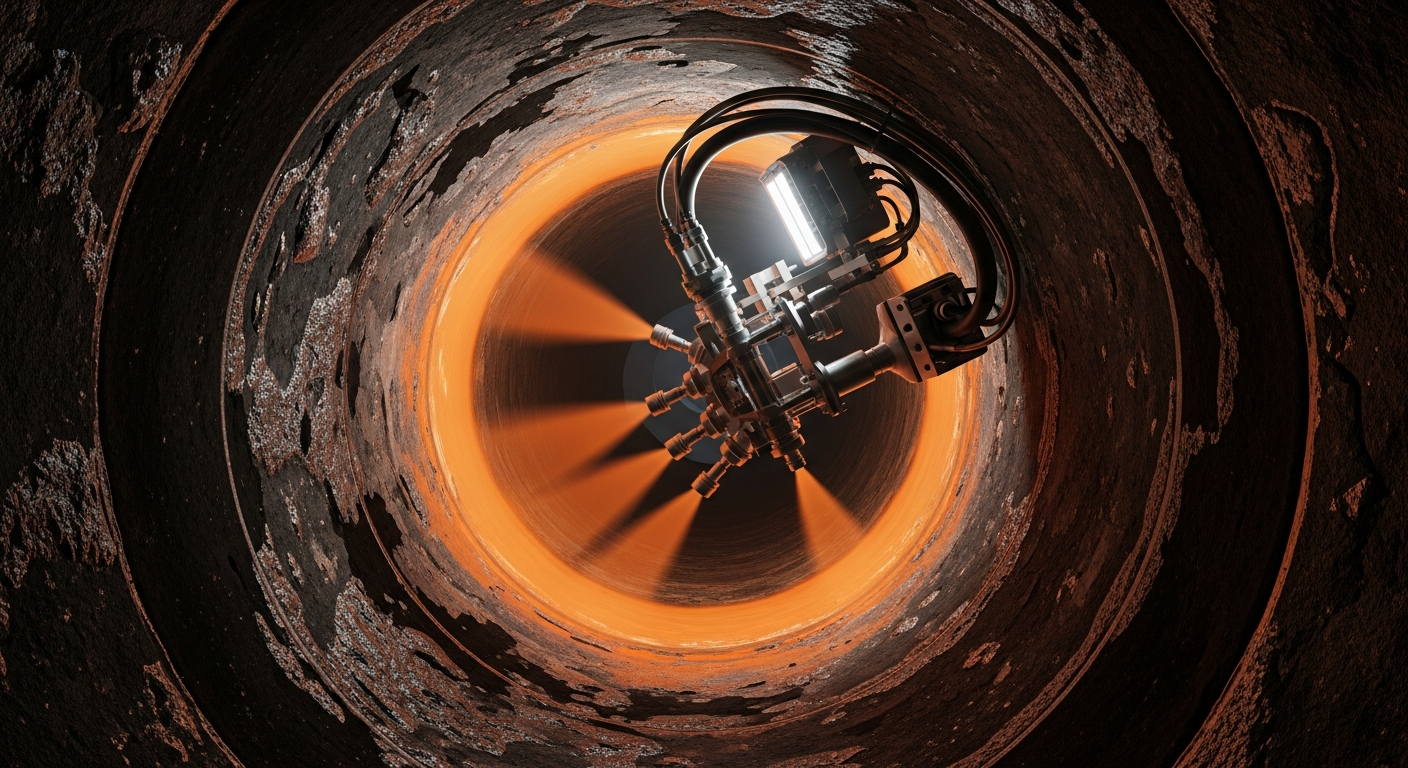
In these cases, only professional equipment helps. For professional pipe cleaning, we work with electromechanical cleaning machines and with chemical-free high-pressure water jetting at up to 200 bar. For pipes that keep blocking, a CCTV drain survey follows: a camera travels through the pipe and shows whether roots, cracks or a displacement are behind it. The findings are coded and documented to SN EN 13508-2, so that you and any property management can see in black and white what is going on.
When you should call a professional
Call a professional drain specialist if the blockage persists after the measures above, several drains are affected at the same time, water comes back out of the drain (backflow), unpleasant odours persist despite cleaning or the blockage keeps recurring. In these cases the problem lies deeper in the drainage system and requires professional equipment.
If wastewater rises in the basement, every hour counts: stop all water use throughout the building, i.e. no washing machine, no shower and no toilet flushing, and call the emergency service. How to protect the basement permanently against backflow is explained in the guide Backflow in the basement. Whether self-help is still worthwhile in an individual case is also examined in our comparison Drain cleaning: DIY or professional?.
What does it cost when the professional comes?
Many people put off the call because they fear high costs. Karo Kanaltechnik has transparent guide prices: CHF 160 per working hour plus a CHF 60 call-out, excl. VAT. One hour of work including call-out therefore costs CHF 220 excl. VAT, or CHF 237.82 incl. 8.1% VAT. As a guide price for the work on a blocked drain in the kitchen or toilet we charge approx. CHF 80, for a washbasin or shower approx. CHF 40, each plus call-out. A typical job in a single-family home comes to around CHF 150 to 400. If the cleaning is followed by a camera check, a surcharge from CHF 50 is added. All amounts are guide prices excl. VAT and materials.
| Service at Karo Kanaltechnik | Guide price (excl. VAT) |
|---|---|
| Working hour | CHF 160 |
| Call-out | CHF 60 |
| Blocked drain, washbasin or shower | approx. CHF 40 plus call-out |
| Blocked drain, kitchen or toilet | approx. CHF 80 plus call-out |
| Typical job in a single-family home | around CHF 150 to 400 |
| Surcharge for camera check after cleaning | from CHF 50 |
Particular difficulties are added depending on the case; we will tell you the range in advance over the phone. A broader overview of prices for pipe and drain cleaning in Switzerland is given in the article Costs of pipe cleaning and drain cleaning. In a rented flat, there is also the question of who pays the bill; we clarify this in the guide Blocked drain: who pays, tenant or landlord?.
Prevention: keeping the drain clear
Most blockages develop gradually. With a few habits you can reduce the risk considerably:
- Fit drain strainers in the shower, bath and kitchen sink and empty them regularly.
- Put grease, oil, coffee grounds and food scraps in the bin instead of down the sink.
- Never put wet wipes, cotton buds, sanitary products or cat litter down the toilet.
- Flush drains that are rarely used with water from time to time so that the trap does not dry out.
- Unscrew and clean the washbasin and kitchen sink traps occasionally, before the water starts to stand.
- For older properties or recurring problems, have the underground drain cleaned periodically and checked with a camera.
Conclusion: diagnose first, then clear mechanically
A blocked drain can usually be fixed quickly if you take a structured approach: first establish where the blockage is, then work with a plunger, hot water, trap cleaning and a drain snake. Aggressive chemicals and force rarely achieve anything, but often cause damage. As soon as several drains are affected, water pushes back or the blockage returns, the limit of self-help has been reached.
Your drain remains blocked despite all your attempts? Call us on +41 43 588 12 08. Our team at six locations in Frauenfeld, St. Gallen, Winterthur and Zurich takes care of pipe cleaning and, for larger pipes, drain cleaning, and in acute emergencies round the clock via our 24/7 emergency service.