
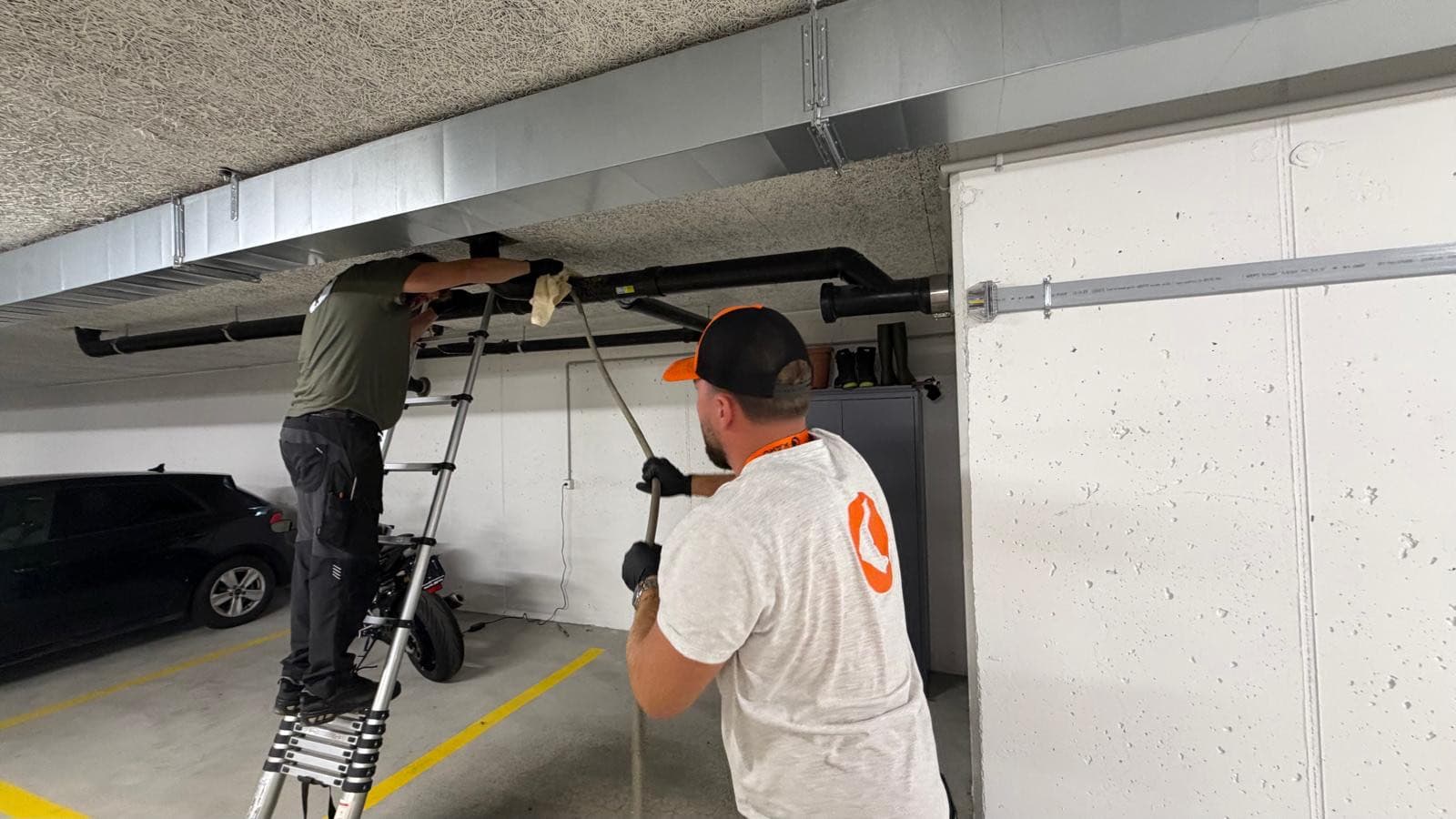
What is a rodding eye?
A rodding eye is a fitting in the wastewater pipe with a removable, tightly closing cover. In normal operation it is closed and hardly noticeable. Once opened, it gives direct access to the inside of the pipe – exactly where blockages occur particularly often.
In practice you will come across various names: access cap (Putzstück), inspection opening, cleaning pipe or cleaning cover. They all refer to the same principle. In the ground, inspection and cleaning chambers perform this task for the underground drains.
Where are rodding eyes located?
Traditionally, an access cap sits at the lower end of a soil stack in the basement, just before the vertical pipe joins the underground or collecting drain. Further rodding eyes are found on longer horizontal pipes, after changes of direction, at connections of kitchen and commercial pipes and upstream of lifting stations and separators.
SN 592 000 and SN EN 12056 require pipes to be arranged so that they can be cleaned and inspected. The openings must therefore remain accessible. However, they are often boxed in, bricked up or hidden behind cupboards during conversions.
Why are access caps so important?
Without a rodding eye, cleaning has to be done through the nearest drain – for example a washbasin, a WC or a floor drain. This is often awkward, because traps and tight bends obstruct the drain snake and jetting hose. Sometimes it is not possible to reach the blockage this way at all.
A well-placed opening is just as crucial for a camera survey. The camera is inserted directly into the pipe and can document damage in both directions. If there is no access, a section of pipe may have to be dismantled or a new opening installed.
What to watch out for when opening
Opening a rodding eye on a backed-up pipe is tricky. If wastewater is standing in the pipe, it pours suddenly into the room when the cover is loosened. Lay people should therefore not open a blocked pipe themselves via the access cap, but call a specialist who works with a collection container, suction hose and suitable tools.
After cleaning, the cover must be closed tightly again, usually with a new seal. An access cap that is not closed tightly lets drain smells escape and can let water into the basement in the event of backflow. Old covers that have rusted solid are replaced if necessary.
No rodding eye available – what now?
In older properties in particular, access caps are often missing or can no longer be found. Pipe locating with a sonde and a camera survey from another access point show where a new rodding eye would make sense. It can be installed with little effort during the next conversion or rehabilitation.
When planning conversions: do not box in rodding eyes, but keep them accessible with an access panel. A short note in the building file of where the openings are located makes every future job easier.
In an apartment building in Winterthur, the kitchen stack became blocked every few months. Until then it had always been cleaned via the sink on the ground floor, which only partly cleared the blockage. During the job, the team found an access cap at the foot of the stack in the basement, behind wooden panelling added later. Through this opening the pipe was jetted down to the underground drain and surveyed by camera: grease deposits and a displaced joint were the cause. The property management company had an access panel installed so that the access cap remains accessible.