
What is pipe locating?
In many properties, nobody knows exactly where the wastewater pipes run any more. Drawings are missing, inaccurate or no longer correct after several conversions. Anyone who then wants to repair damage, build an extension or redesign the garden faces the question: where is the pipe, how deep is it, and exactly where is the spot that the camera showed?
Pipe locating answers this question non-destructively. It makes the route of a pipe visible on the surface, usually with spray or chalk markings, and provides the depth at the measured points. For wastewater pipes, it is generally carried out together with the CCTV drain survey.
How does locating with a sonde work?
Plastic, concrete and vitrified clay pipes cannot be found with metal detectors. That is why an active sonde is used for wastewater pipes: a small transmitter that emits an electromagnetic signal. It sits in the camera head or at the tip of a push rod and is pushed through the pipe.
On the surface, a technician follows the signal with a receiver. The device indicates when it is exactly above the sonde and calculates the depth from the signal strength. Step by step, the route of the pipe is built up. Because the camera is filming at the same time, every damaged spot in the footage can be marked precisely on the surface.
Other locating methods
Metallic pipes, such as cast iron pipes or steel water pipes, can also be located with cable and pipe locators that apply a signal directly to the pipe or detect existing fields. Ground-penetrating radar can make cavities and pipes underground visible, but delivers results of varying quality depending on the soil.
Pipe locating is not the same as leak detection. Pipe locating looks for the route of a pipe, leak detection looks for a leaking spot – for example with acoustic methods, smoke or pressure testing. In practice the two complement each other: first the pipe is found, then the damage within it is pinpointed.
When pipe locating makes sense
Typical occasions are repairs using open-cut construction, where only a small hole is to be dug exactly above the damaged spot. Locating is just as important before building work on the plot: a pool, a garage, a conservatory or tree planting above a wastewater pipe can cause expensive problems later on.
Locating is also indispensable when creating or updating property drainage drawings, for example when the municipality requires up-to-date documents or a property is being sold. And if a manhole has been covered over or has disappeared, it helps to find it again without breaking up the entire forecourt.
Limits and safety
The accuracy of locating depends on depth, soil conditions and sources of interference. Reinforcing steel, parallel pipes or power cables can affect the signal. Experienced technicians therefore check several times and at several points before marking. At great depths, the figures are understood as a guide value.
Before any excavation, obtaining the utility plans of the electricity, gas, water and telecommunications providers remains mandatory. Locating the wastewater pipe does not replace this check but complements it. Only when all pipes and cables are known can digging be carried out safely.
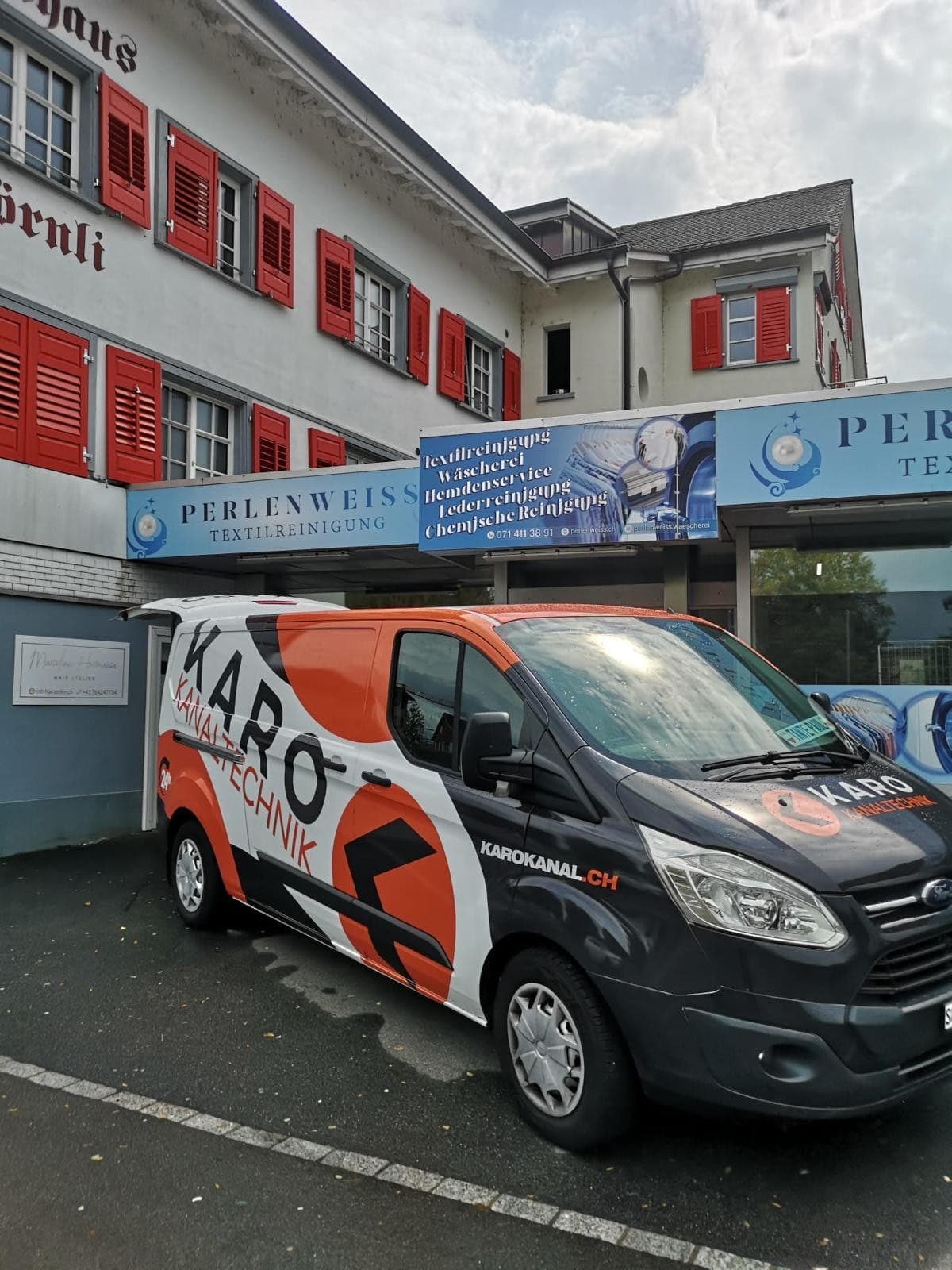
A commercial business in Wil SG wanted to build a new storage shelter with foundations on its forecourt. The drawings from the 1980s showed the underground drain only approximately. Karo Kanaltechnik ran the camera and sonde through the pipe and marked the route and depth on the surfacing. This revealed that the pipe ran around two metres away from the position shown on the drawing – right under a planned foundation. The shelter was moved before the excavator arrived.