A light drain blockage in the washbasin or shower can often be fixed yourself, for example with a plunger, a mechanical drain snake or hot water. However, as soon as several drains are affected at the same time, water rises back into lower-lying sanitary fittings or the blockage is in the underground drain, the job belongs in the hands of a specialist firm. Incorrectly used home remedies can even cause damage.
In this guide, we show honestly what you can achieve yourself with simple means and where the limits of DIY lie. As a drain cleaning specialist in the greater Zurich area and Eastern Switzerland, we know the typical cases in which well-meant DIY attempts make the problem worse.
What you can safely try yourself
For a single, superficial blockage, mechanical methods are the safest. The plunger creates pressure and suction and so loosens light plugs of hair and soap residue. It is important to seal the overflow with a damp cloth so that pressure can build up. A standard household drain snake can also reach shorter blockages in the trap or pipe bend.
For grease and soap deposits, hot (not boiling) water often helps, combined with a little washing-up liquid if necessary. The home-remedy combination of bicarbonate of soda and vinegar can loosen light organic deposits; however, its effect is often overestimated and it is no substitute for thorough cleaning.
Keep away from chemical drain cleaners
Aggressive chemical drain cleaners seem convenient at first glance, but carry considerable risks. They attack older pipes, seals and plastic pipes, generate heat and, if they do not work, can remain in the pipe as a dangerous alkali. If a professional then arrives, working on a pipe filled with chemicals is more dangerous.
From an environmental point of view, these products are also problematic, as they end up in the wastewater and the treatment plant. Mechanical and pressure-based methods, as used by professionals, are both more effective and more environmentally friendly.
The limits of the DIY drain snake
Hand-operated drain snakes from DIY stores are designed for short distances and thin pipes. They reach neither the underground drain nor blockages further down. If too much force is applied or the snake jams, it can damage seals or break off in a pipe bend and get stuck. Then the situation is worse than before.
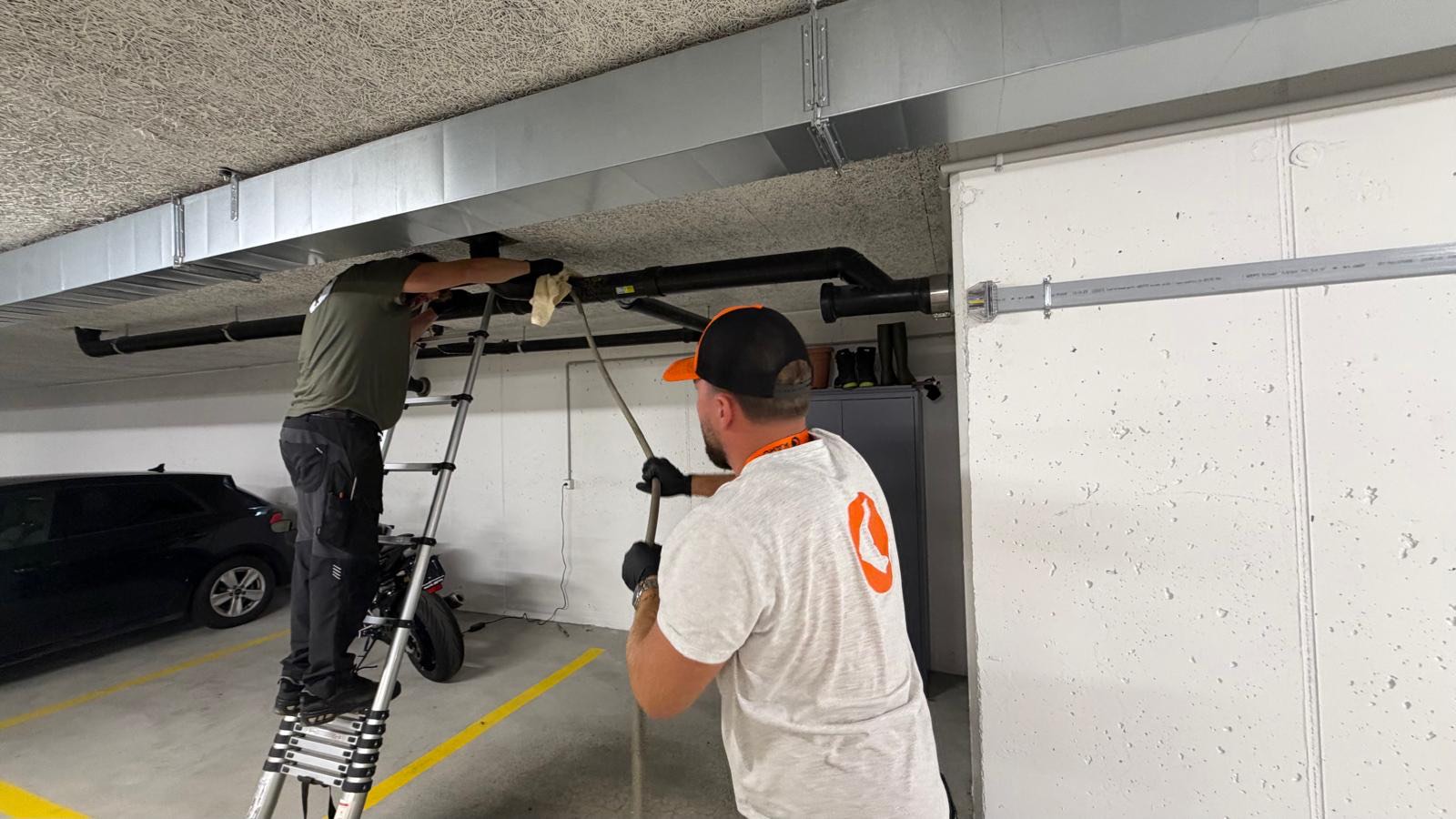
Professional drain cleaning machines work with motor-driven spirals, interchangeable tool heads and considerably more reach and torque. They are operated by trained staff who can tell from resistance and sound what is happening in the pipe. This control is missing with DIY tools.
Clear signals to call a professional
You should call a specialist firm if several drains are blocked at the same time, if wastewater rises from the toilet, shower or floor drain in the basement, if there is a strong and persistent smell or if your own attempts bring no improvement. These signs indicate that the blockage lies deep in the underground drain or in the connection to the public sewer.
Recurring blockages at the same spot are also a case for a professional. This often points to a structural cause such as root ingress, a pipe collapse, a displaced joint or a gradient defect. Such problems can only be reliably diagnosed with a CCTV drain survey and, if necessary, fixed with no-dig pipe relining.
Why a professional often pays off sooner
Many people underestimate how much time, tools and nerves a stubborn case costs that ultimately has to be solved professionally anyway. If you add up several DIY attempts, purchased aids and possible consequential damage, going straight to a specialist firm is often cheaper. Our guide values are around CHF 160 per hour of drain cleaning plus a CHF 60 call-out; a CCTV check costs about CHF 50 (each ±15%).
Then there is the certainty: specialist firms identify the cause, document the condition and give a reliable assessment of whether cleaning will suffice or further measures are needed. This clarity saves money in the medium term.
Do not forget responsibility and liability
In rented flats and condominium ownership, the question of responsibility is also important. Minor blockages in your own sanitary fittings are often the tenant's responsibility, while damage to the shared soil stacks and underground drains is a matter for the owners or the property management. Anyone who takes matters into their own hands with unsuitable tools and causes damage in the process can be held liable for it.
If in doubt, it is therefore worth making a quick call to the specialist firm or the property management before taking action yourself. A documented professional job not only results in a clean pipe, but also creates a clear situation with regard to the insurer and landlord, should water damage have occurred after all.
Prevention: the best protection against blockages
Many blockages can be avoided from the outset. Collect food scraps, grease and coffee grounds separately instead of putting them down the sink, use strainer inserts against hair and food scraps, and flush down the toilet only what belongs there. Wet wipes, sanitary products and cat litter are among the most common causes of stubborn blockages.
In addition, it helps to flush drains every now and then with plenty of hot water to wash away incipient grease deposits. These simple habits extend the intervals between professional cleanings and thus also noticeably reduce long-term costs.
Conclusion: DIY for minor jobs, a pro for the serious ones
You can safely tackle small, superficial blockages yourself, preferably mechanically and without aggressive chemicals. As soon as underground drains, recurring problems or structural causes are involved, a specialist firm is the right and usually also the more economical choice.
You are not getting anywhere with your own means or are unsure how deep the problem lies? Call us on +41 43 588 12 08. Our team at six locations in Frauenfeld, St. Gallen, Winterthur and Zurich will help quickly, in an emergency round the clock via our 24/7 emergency service.