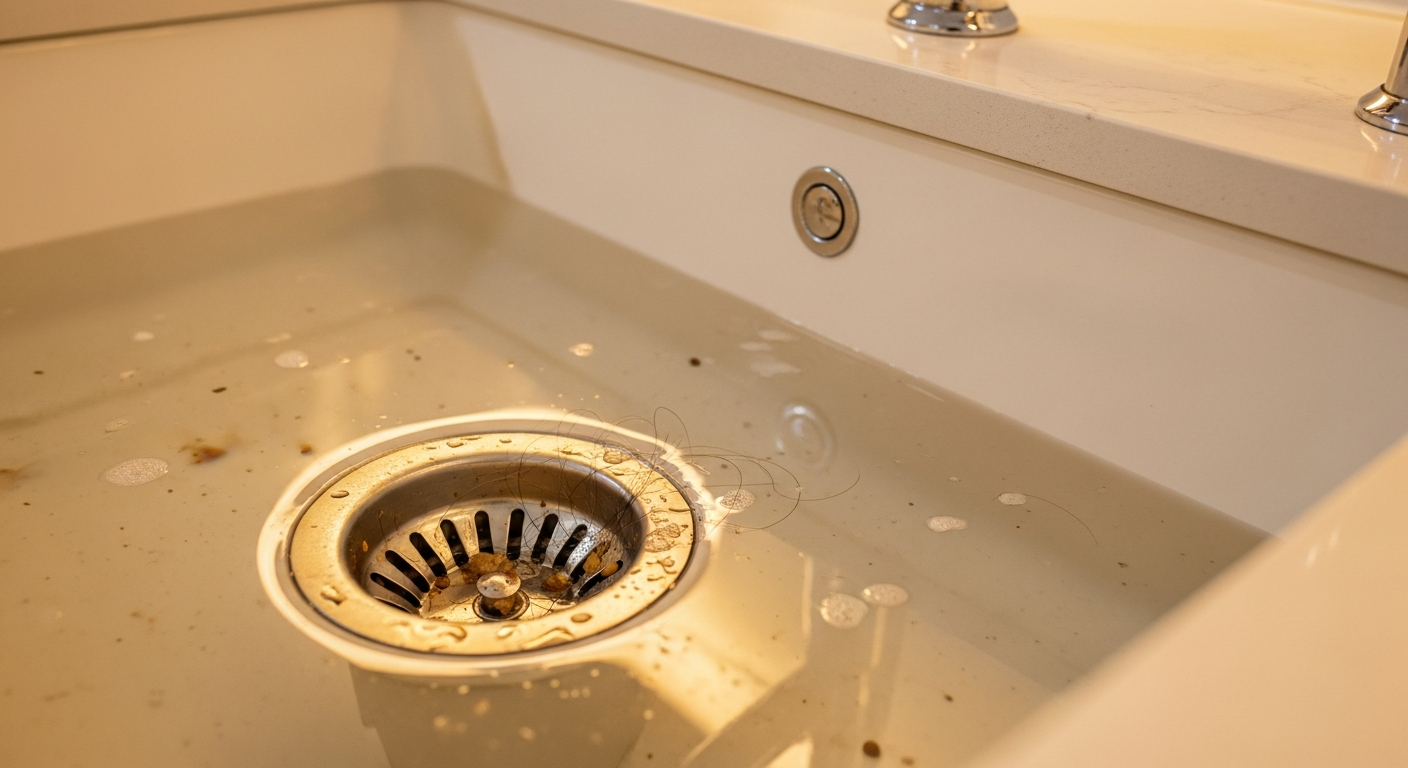
If the drain is blocked, a mechanical method helps first: place the plunger over the drain and loosen the plug by pumping vigorously. If that does not work, hot water with washing-up liquid or the combination of bicarbonate of soda and vinegar can loosen light grease and soap deposits. If there is no success or several drains are affected, it is time for a specialist firm.
This guide focuses on one question: which home remedies really clean the drain, and which tend to do harm? We explain what happens chemically with bicarbonate of soda and vinegar, why baking powder is weaker than its reputation, when salt, washing soda or washing-up liquid make sense and which internet tips you can safely forget. If you first want to know where your blockage is and how to proceed step by step, read our main article Blocked drain: what to do?.
First step: stay calm and stop the water
As soon as water stops draining away, you should not let any more water run in. If the basin is already full, scoop out the excess water so that you have free access to the drain. This prevents overflowing and creates the basis for the further measures. Home remedies also only work if they reach the deposit directly; in a full basin they become diluted and fizzle out.
First check whether the blockage affects only one sanitary fitting or several at the same time. If only one washbasin is affected, the cause is usually in the trap or just behind it, which is easy to fix yourself. If several drains are blocked, the problem lies deeper, and no home remedy reaches the spot.
Using the plunger correctly
The plunger (also called Pömpel or Pümpel in Switzerland) is the most effective home remedy for a fresh blockage. Place it centrally over the drain so that a little water covers the rubber cup. Important: seal any overflow with a damp cloth, otherwise the pressure escapes and the suction effect is lost.
Then pump up and down with vigorous, even strokes. The alternation of pressure and suction loosens the plug and pushes or pulls it out of the narrow point. It often takes several rounds. If the water then drains away, flush with plenty of hot water. Only when the plunger achieves nothing is it worth reaching for the home remedies in the kitchen cupboard.
The right order for cleaning the drain
Home remedies work best when you use them in the right order: first remove the coarse material, then loosen grease and soap, and finally flush. Anyone who pours in bicarbonate of soda and vinegar straight away while a ball of hair is sitting in the drain is wasting both.
Step 1: 1. Remove hair and residue mechanically
Take out the plug or strainer, pull out visible hair and soap residue wearing gloves or with a plastic hair remover.
Step 2: 2. Loosen with the plunger
Seal the overflow, leave some water standing and pump vigorously 15 to 20 times. This clears most fresh blockages without any product at all.
Step 3: 3. Hot water with washing-up liquid
Pour in one litre of hot, not boiling, water with a dash of washing-up liquid in portions and leave it to work for a few minutes. This loosens grease and soap films.
Step 4: 4. Add bicarbonate of soda and vinegar
Put around 4 tablespoons of bicarbonate of soda dry into the drain, pour in half a cup of vinegar, cover the drain with a cloth or plug and leave it to work for 30 minutes.
Step 5: 5. Flush thoroughly
Flush with one to two litres of hot water and watch whether the water drains away quickly.
Step 6: 6. Clean the trap if necessary
If the drain remains sluggish, unscrew the trap over a bucket, empty it and clean it. This is often more effective than any product.
Bicarbonate of soda and vinegar: what really happens
The well-known combination of bicarbonate of soda and vinegar can loosen light organic deposits: put a few spoonfuls of bicarbonate of soda into the drain, pour vinegar after it and let the fizzing reaction work before flushing with hot water. This method is environmentally friendly, but its effect is limited and it is no substitute for thorough cleaning.
Chemically speaking, the alkaline bicarbonate of soda (sodium hydrogen carbonate) reacts with the acetic acid. This produces carbon dioxide, water and a salt. The fizzing mechanically loosens loose deposits, and the bicarbonate of soda on its own has a slight grease-dissolving and odour-binding effect. However, because acid and base neutralise each other, what remains at the end is a rather mild solution. Against balls of hair, foreign objects or hardened layers of limescale and grease, the mixture achieves hardly anything.
For bicarbonate of soda and vinegar to reach their full potential, a few details matter: the bicarbonate of soda goes into the drain dry, not into a full basin. Cover the drain after pouring in the vinegar so that the reaction works downwards instead of upwards. And then flush with hot water so that the loosened deposits are carried away. Used regularly, for example once a month, the method is well suited to prevention.
Baking powder instead of bicarbonate of soda: does that work?
Baking powder is often mentioned as a substitute for bicarbonate of soda. It does contain bicarbonate of soda, but also an acidifying agent and starch as an anti-caking agent. The acidifying agent uses up part of the bicarbonate of soda as soon as it comes into contact with water, and the starch contributes nothing to the cleaning. The effect is therefore weaker. Baking powder will do in an emergency; anyone who wants to look after the drain regularly with home remedies is better off buying pure bicarbonate of soda, which is available in Swiss shops among the baking ingredients or cleaning products.
Hot water, washing-up liquid and salt
With grease and soap deposits, hot but not boiling water can work wonders, especially in combination with a little washing-up liquid, which loosens grease. Pour it in several portions and leave it to work. With plastic pipes, avoid boiling water to prevent deformation. So let the water from the kettle stand briefly before pouring it in. This also spares the seals in the trap.
Salt is often recommended together with hot water. It mainly has a slightly abrasive effect and helps to loosen deposits in the trap, but is not a real solvent. As a supplement to bicarbonate of soda, for example a few tablespoons of salt together with the bicarbonate of soda, it does no harm. Salt alone will not clear a real blockage.
Washing soda, citric acid and enzymatic cleaners
Washing soda (sodium carbonate) is considerably more alkaline than bicarbonate of soda and dissolves grease better. However, it is also a skin irritant: wear gloves and safety goggles and do not mix washing soda with acids. Citric acid is mainly suited to limescale in the waste valve and the trap, less so to organic blockages. A note to protect the pipes: never use acid and alkali at the same time or shortly after each other in high concentration.
An intermediate stage between home remedies and chemicals is enzymatic and biological drain cleaners. They slowly break down grease, proteins and hair with the help of enzymes or bacteria, usually overnight. For prevention in the kitchen and bathroom they are a gentle option, but for an acutely blocked drain they are too slow.
What works against what? Home remedies compared
The following overview summarises which home remedy makes sense for which cause. It also shows where the limits lie.
| Home remedy | Works against | Limits and notes |
|---|---|---|
| Plunger (suction cup) | Fresh plugs of hair, soap, food scraps | Seal the overflow; use a plunger with a flange in the toilet |
| Hot water with washing-up liquid | Grease and soap films, especially in the kitchen | Do not pour boiling water into plastic pipes |
| Bicarbonate of soda and vinegar | Light organic deposits, odours | Limited effect; do not combine with chemical cleaner |
| Baking powder | Like bicarbonate of soda, but weaker | Contains acidifying agent and starch |
| Salt | Helps loosen deposits | No effect on plugs on its own |
| Washing soda | Greasy deposits | Skin irritant; wear gloves and goggles |
| Citric acid | Limescale in the waste valve and trap | Hardly any effect on grease and hair |
| Enzymatic cleaner | Grease, proteins, hair over several hours | Too slow for an acute emergency |
Depending on the room, the focus is different: in the shower and washbasin it is hair and soap, in the kitchen grease and food scraps, in the toilet paper, foreign objects and urine scale. You will find targeted tips in the guides Blocked shower, bath and washbasin, Kitchen drain blocked by grease and Blocked toilet: what to do?.
Myths: these tips do more harm than good
- Cola in the drain: the acid it contains is far too weak to clear a blockage, and the sugar tends to leave new deposits.
- Coffee grounds for cleaning: coffee grounds dissolve nothing, but settle in the trap together with grease. They belong in the bin or on the compost.
- Boiling water always helps: in plastic pipes it can damage seals and pipes. Hot, not boiling, water is enough.
- The more bicarbonate of soda and vinegar, the better: the quantity only increases the fizzing, not the dissolving power. Repeating is more sensible than overdosing.
- A straightened coat hanger replaces the drain snake: the wire scratches the trap and pipe and often pushes the plug further in.
- Chemicals work when home remedies fail: chemical cleaners do not dissolve foreign objects or structural causes, but they do put a strain on pipes and wastewater.
Why you should avoid chemical cleaners
Aggressive chemical drain cleaners promise quick help, but are risky. They attack seals and older pipes, generate heat and pollute the wastewater. If they do not work, dangerous alkali is left standing in the pipe, which makes the later professional job more difficult. So it is better to rely on mechanical and mild methods.
Particularly important: never combine a chemical cleaner with vinegar, bicarbonate of soda or another product. Alkali and acid react violently, and the mixture can spurt out of the drain. Cleaners containing chlorine release toxic gases together with acids such as vinegar. If you have already poured in a chemical product, leave out the home remedies and tell the drain specialist when you call.
When home remedies are not enough: trap and drain snake
A standard household drain snake can also help to reach short blockages in the trap area. Proceed carefully so as not to damage the seals. If there is no success, do not use force. How to guide a drain snake correctly and where its limits lie is shown in our guide Drain snake: use and limits.
It is often easier to unscrew the trap: bucket and cloth underneath, loosen the union nuts by hand, empty the contents and clean the parts under running water. When reassembling, make sure the seals are seated correctly. A clean trap achieves more than any home-remedy treatment.
When you should call a specialist firm
At the latest when several drains are blocked at the same time, water rises from lower-lying fittings such as the basement drain, there is a persistent smell or your measures have no effect, the job belongs in professional hands. These signs point to a blockage in the underground drain or in the connection to the public sewer, and no home remedy gets there.
Recurring blockages at the same spot are also a warning sign. There is often a structural cause behind them, such as root ingress, a pipe collapse or a displaced joint. Such problems are clarified by a CCTV drain survey, and depending on the findings, targeted cleaning or no-dig pipe relining follows.
For professional pipe cleaning, Karo Kanaltechnik relies on mechanical cleaning machines and chemical-free high-pressure water jetting at up to 200 bar instead of chemicals. The guide prices: CHF 160 per working hour plus a CHF 60 call-out, excl. VAT. As a guide price, a blocked drain in the kitchen or toilet costs approx. CHF 80, a washbasin or shower approx. CHF 40, each plus call-out; a camera check after cleaning is added as a surcharge from CHF 50. More on this in the main article Blocked drain: what to do?.
Prevention with home remedies: the monthly plan
Home remedies really come into their own in prevention. Looking after your drains regularly prevents deposits from ever growing into a blockage:
- Weekly: empty the drain strainers in the shower, bath and kitchen sink, remove hair.
- Weekly in the kitchen: after washing up, pour in a litre of hot water with a little washing-up liquid.
- Monthly: bicarbonate of soda and vinegar in the washbasin, shower and kitchen drain, leave to work for 30 minutes, flush with hot water.
- Every few months: unscrew and clean the trap under the washbasin and kitchen sink.
- Always: grease, oil and coffee grounds in the bin instead of down the sink.
A drain strainer costs little and holds back most of the hair and food scraps before they reach the trap. This is the simplest and cheapest measure of all.
Conclusion: home remedies yes, but with the right expectations
With a fresh, single blockage, you can often succeed yourself with a plunger, hot water and mild home remedies. Bicarbonate of soda and vinegar are mainly suited to light deposits and regular care; baking powder and salt are weaker substitutes. It is important to avoid aggressive chemicals and to recognise your own limits. As soon as the cause lies deeper, calling a professional saves you time, nerves and follow-up costs.
Your drain remains blocked despite all your attempts? Then we will help quickly. Call us on +41 43 588 12 08. Our team at six locations in Frauenfeld, St. Gallen, Winterthur and Zurich is there for you, in acute emergencies round the clock via our 24/7 emergency service.