
What does the maintenance obligation mean?
A municipality's wastewater network consists of two parts: the public sewers operated by the municipality or a wastewater association, and the private installations of the individual properties. The owners are responsible for these private installations. The Swiss Waters Protection Act (GSchG) obliges the holders of wastewater installations to build, operate, service and maintain them properly.
Maintenance means more than «repairing it when it stops working». What is meant is a condition in which the installation fulfils its purpose: the wastewater drains away reliably, the pipes are watertight, manholes are accessible and separators are emptied regularly. Leaking pipes that let wastewater escape into the ground are contrary to water protection.
Where does the private pipe end?
The boundary between private and public pipes is not drawn in the same place everywhere. In many municipalities, the entire house connection up to where it joins the public sewer belongs to the property – even if it lies beneath the pavement or the road. Other municipalities draw the boundary at the property line or at a particular manhole.
The municipal wastewater or urban drainage regulations are decisive. They state who pays for which section of pipe, who is responsible for pipes shared by several properties and how costs are divided. If you are unsure, it is best to ask the municipal building administration or to ask to see the property drainage plans.
Inspections and condition checks
As part of their general drainage plan (GEP, Genereller Entwässerungsplan), many municipalities also check the condition of private pipes. Owners are then asked to have their underground drains and connection pipes examined with a CCTV drain survey and to submit the survey report. If the inspection reveals relevant damage, the municipality sets a deadline for the rehabilitation.
Proof of condition is also often required when a property changes hands, for conversions or for new connections, sometimes with a leak-tightness test. Anyone who knows their pipes has an advantage here: a documented condition assessment makes planning easier and prevents unexpectedly high rehabilitation costs from cropping up during a sale or conversion.
Rented flats and condominium ownership
In tenancies, the maintenance of the wastewater installations is in principle the landlord's responsibility. Tenants are responsible for minor cleaning and must use the installations with care. If someone demonstrably causes a blockage through improper use, for example by putting fat or wet wipes down the toilet, they can be held liable for the costs.
In condominium ownership, soil stacks, underground drains and the house connection are generally part of the common property. Their maintenance is decided by the owners' association and financed through the renewal fund or the service charges. The pipe sections within a flat up to the connection to the stack, on the other hand, may be part of the individual unit owner's exclusive ownership – the condominium regulations set this out.
How to meet the maintenance obligation sensibly
Sensible maintenance begins with an overview: where are the pipes, where are the manholes, which separators or pumps are there? This is followed by regular cleaning at intervals that match the use, and a CCTV drain survey at longer intervals or if anything unusual is noticed. In this way, minor damage is detected early and repaired locally at low cost.
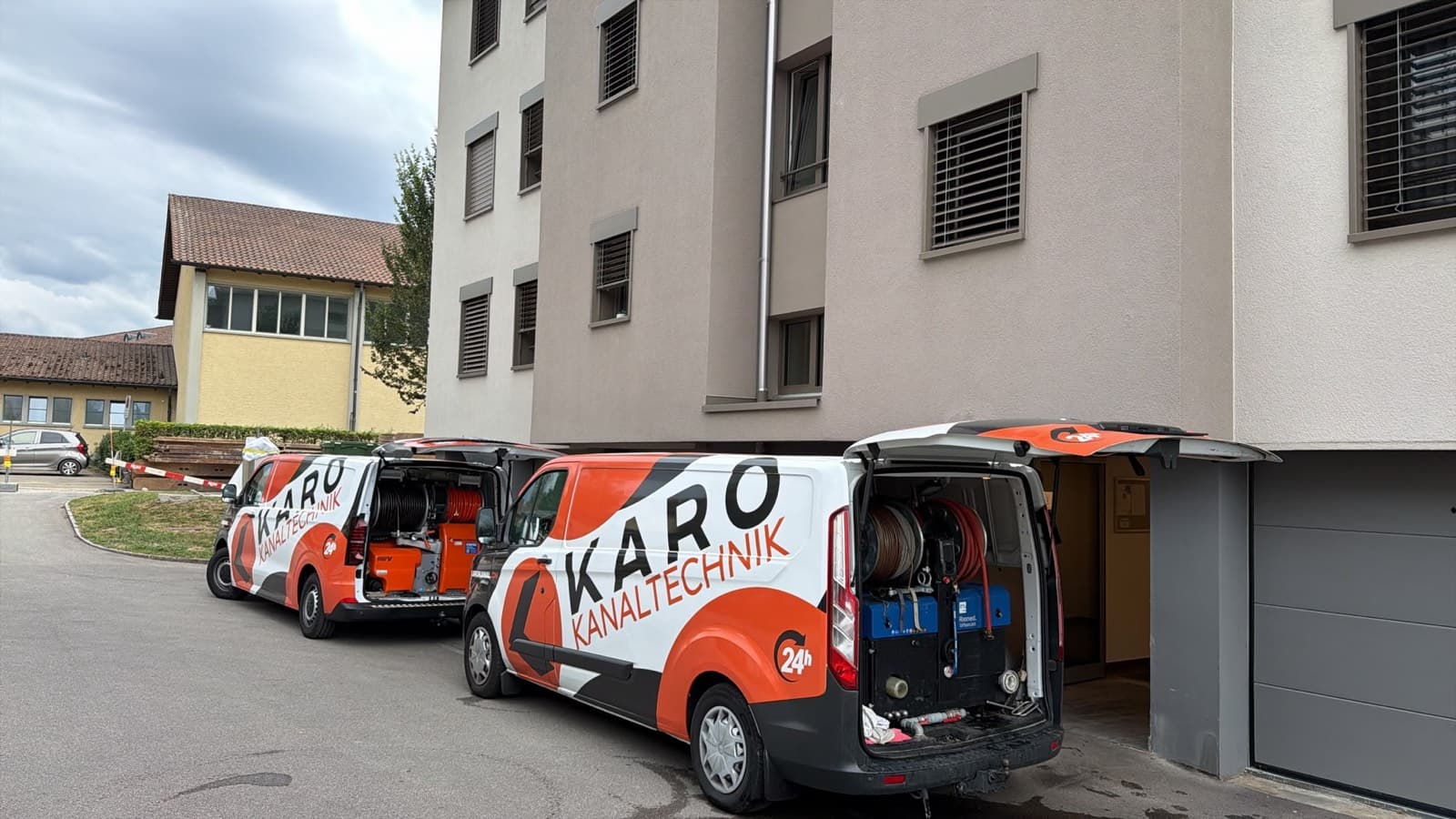
For property management companies and owners of several properties, a maintenance plan with fixed dates is worthwhile. It records when which installation is cleaned, emptied or inspected and at the same time serves as proof for the municipality and the insurer. Karo Kanaltechnik handles cleaning, inspection and documentation from a single source.
As part of its GEP, a municipality in the canton of Lucerne asked all owners in a neighbourhood to have their house connections checked by a set deadline. At a two-family house, the CCTV drain survey revealed a crack and an ingrown root mass in the house connection under the pavement. Because the regulations assigned the connection up to the public sewer to the property, the rehabilitation was the owner's responsibility. After root cutting, the damaged spot was rehabilitated without digging using a patch liner, and the survey report was submitted to the municipality.