
What are condition grades?
A CCTV drain survey initially produces a long list of individual observations: cracks, displacements, roots, deposits, leaking connections, deformations. Each of these observations is recorded using a uniform code. For owners and municipalities, however, one question above all is important: how bad is it overall, and by when does something have to be done?
That is exactly what the condition grade answers. It combines the damage in a pipe run – that is, a section of pipe between two manholes – into an overall assessment. In Switzerland, the system of the Swiss Association of Wastewater and Water Protection Professionals (VSA) has become established for this and is used by municipalities, engineering firms and specialist companies alike.
Grades 0 to 4 at a glance
Condition grade 0 refers to pipes that have already collapsed, are in imminent danger of collapse or no longer ensure flow – here there is an immediate need for action. Grade 1 stands for severe damage that must be repaired in the short term, such as large cracks with fragmentation or severe deformation. Grade 2 covers moderate damage with a medium-term need for action.
Grade 3 describes minor damage that is addressed in the long term as part of maintenance planning. Grade 4 means that there are no defects or only insignificant ones. Important: the scale runs the opposite way to school marks – the lower the number, the more urgent the pipe. Anyone who mixes this up can easily underestimate a finding.
How a condition grade is arrived at
The basis is the damage coding during the inspection. In Europe, the standard SN EN 13508-2 specifies how observations are coded during visual inspection; the VSA has a Swiss implementation of it with its own requirements. Each defect is given a code, a position in the pipe and a severity, for example the width of a crack or the extent of a displacement.
From these individual findings, the condition grade of the pipe run is derived according to fixed rules, with the most serious defect generally determining the grading. The assessment considers the structural condition; depending on the brief, questions such as hydraulic capacity or environmental risk due to leakage are also factored into the assessment.
What the grade means for owners
For private owners, the condition grade is above all a planning tool. A pipe in grade 3 or 4 does not need to be rehabilitated today, but should be kept under observation. With grade 2, it is worth planning the rehabilitation over the next few years and making financial provision for it. Grades 1 and 0 call for prompt action, because consequential damage is likely.
Municipalities that have private pipes checked as part of the general drainage plan (GEP, Genereller Entwässerungsplan) often set deadlines for rehabilitation based on the condition grade. A properly prepared inspection report with traceable grading is therefore valuable not only for your own planning, but also in dealings with authorities, buyers and insurers.
From the grade to the right measure
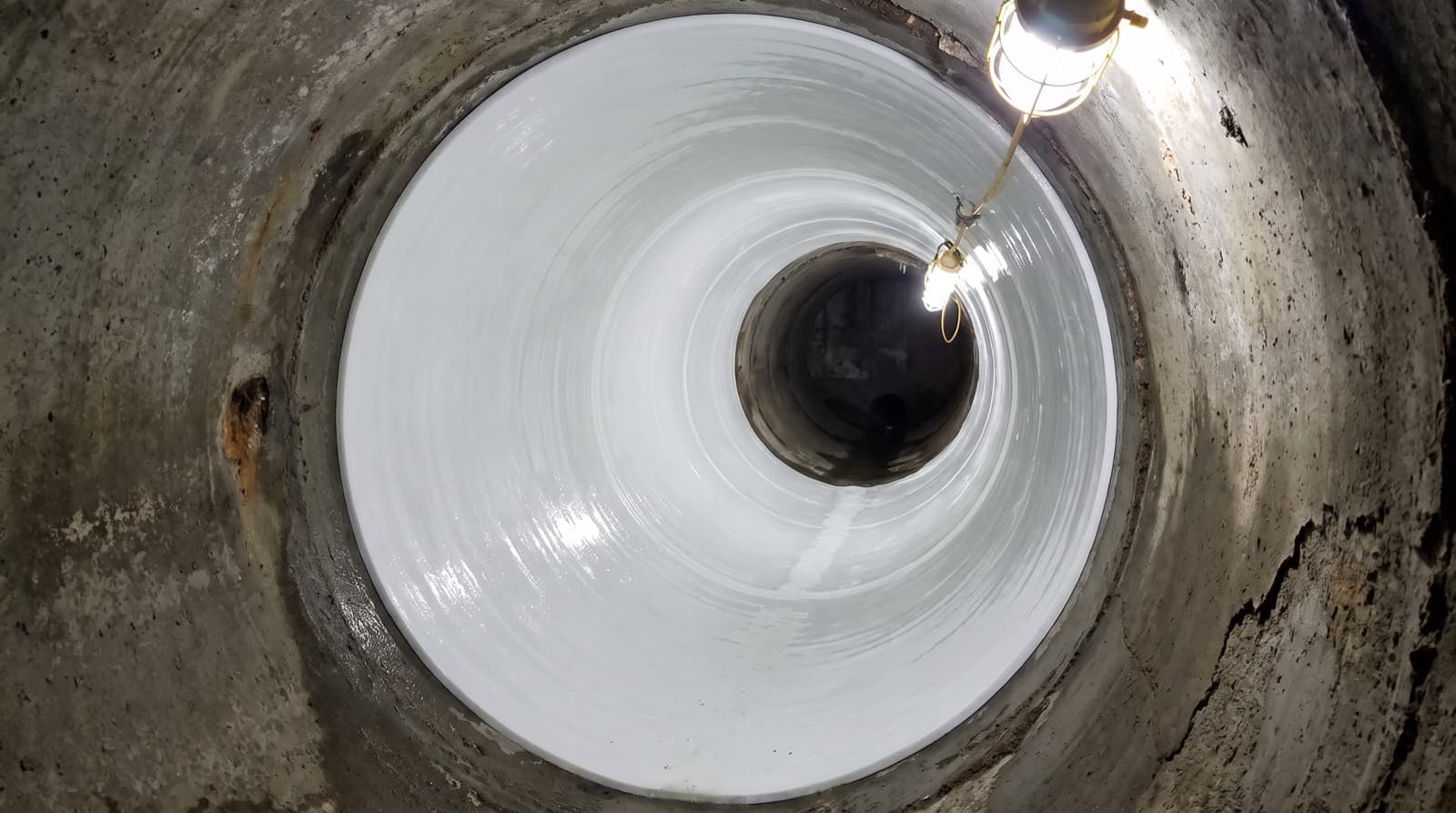
The condition grade says how urgently action needs to be taken – not automatically how. The choice of measure depends on the type of damage. Individual leaking joints or cracks can often be repaired locally with a patch liner, damage spread over the whole pipe run rather with a CIPP liner. Collapsed sections or sags usually require replacement using open-cut construction.
In its condition assessment, Karo Kanaltechnik therefore not only evaluates the grade, but also shows which rehabilitation options are technically possible and in what order they can sensibly be implemented. This turns the inspection report into a concrete, traceable roadmap for maintaining the pipes.
A property management company in St. Gallen had the underground drains of three apartment buildings inspected after the municipality had requested proof of condition as part of the GEP. The result: two pipe runs were given condition grade 3, and one pipe run grade 1 because of a longitudinal crack with incipient fragmentation. The property management company had the grade 1 pipe run rehabilitated without digging using a CIPP liner in the same year. For the two grade 3 pipe runs, a follow-up survey in a few years' time was included in the maintenance plan.