
What are drainage regulations?
Drainage regulations are a law at municipal level. They govern how the wastewater of all properties is collected, discharged and treated, and who bears which obligations and costs for this. Depending on the municipality, they are called wastewater regulations, urban drainage regulations, sewerage regulations or regulations on wastewater disposal – but at their core they mean the same thing.
The regulations are enacted by the municipality, usually by the municipal assembly or the municipal parliament, and are often approved by the canton. The fee rates are often not in the regulations themselves, but in an annex, a tariff or a separate fee ordinance, so that the municipal council can adjust them without having to amend the entire regulations.
For property owners, the regulations are the most important document concerning their own drains. They decide whether damage to the house connection under the pavement is the responsibility of the property or the municipality, whether a camera survey must be submitted before a conversion and how high the connection fee for an extension will be.
Legal basis: federal government, canton, municipality
The drainage regulations stand at the end of a chain of provisions. At the very top is the federal Waters Protection Act (GSchG). It requires polluted wastewater to be treated, properties within the catchment of public sewers to be connected and the owners of wastewater installations to operate and maintain them properly. It also stipulates that the costs of building, operating, maintaining and renewing wastewater installations are passed on to those who cause them through fees or other charges.
The Waters Protection Ordinance (GSchV) supplements the Act, among other things with the obligation for municipalities to draw up a general drainage plan (GEP). The cantons implement federal law with their own introductory acts and assign the task of urban drainage to the municipalities. Finally, in the drainage regulations, the municipality governs how all this is implemented locally.
For the technical execution, many regulations refer to the Swiss standard SN 592 000 on property drainage and to the guidelines of the Swiss Association of Wastewater and Water Protection Professionals (VSA). The regulations themselves therefore rarely contain pipe diameters or gradients, but instead require construction in accordance with the recognised state of the art.
What drainage regulations typically cover
Obligation to connect: properties within the catchment of the public sewer must discharge their polluted wastewater into the sewer. The regulations determine how the connection is to be made, who bears the costs of the connecting pipe and whether several properties may share a common pipe.
Separation of foul water and rainwater: depending on the GEP, the regulations require roof and yard water to be discharged separately from foul water, to infiltrate the ground or to be discharged into a watercourse with a delay. Clean water from land drains, fountains or cooling systems is usually not allowed to enter the foul water pipe, because as infiltration water (extraneous water) it places an unnecessary load on the treatment plant.
Ownership and maintenance: the regulations specify where the private pipe ends and the public one begins, and oblige owners to keep their installations watertight, functional and accessible. This includes underground drains, inspection chambers, separators, pumps and the house connection.
Permits and inspection: new connections, alterations and rehabilitation work generally require a permit. The municipality can carry out acceptance of pipes before they are covered over, request as-built plans, inspect private installations and, if defects are found, order rehabilitation within a deadline. Other common chapters cover discharge bans for substances such as oil, grease, solvents or solids, requirements for commercial businesses and wastewater fees.
Wastewater fees in the regulations
Because the Waters Protection Act requires financing in line with the polluter-pays principle, every set of drainage regulations contains a chapter on fees. A combination of a one-off connection fee and recurring usage fees is common. The connection fee is due when a new building is constructed and frequently also retrospectively when a building becomes larger or more valuable through an extension, an additional storey or a change of use.
Depending on the municipality, the recurring fees consist of a basic fee and a volume-based fee. The volume-based fee is usually based on the fresh water consumed. Some municipalities also charge a fee for rainwater that enters the sewer from sealed surfaces; anyone who lets it infiltrate the ground then pays less. The basis of assessment, rates and exemptions vary widely.
The level of fees can therefore not be quantified in general terms. The current tariff of your own municipality is binding. The federal Price Supervisor also deals with wastewater fees and provides information on the topic on its website. Anyone planning a conversion should clarify any possible additional payment of the connection fee with the building authority at an early stage.
Why every municipality decides differently
The same terms do not mean the same thing everywhere. The most important difference concerns the ownership boundary: in many municipalities, the entire house connection up to where it joins the public sewer belongs to the property, including under the road and pavement. Other municipalities take over the section from the plot boundary or from a specific manhole. Who pays in the event of damage depends solely on this rule.
Municipalities also take different approaches to inspections. Some systematically inspect private pipes district by district as part of their GEP and require all owners to carry out a CCTV drain survey. Others only become active in the case of building applications, new connections or specific indications of damage. The requirements for infiltration, backflow protection and deadlines for rehabilitation are just as varied.
Then there is the organisation: many municipalities operate collecting sewers and the treatment plant jointly in a wastewater association. The association is then responsible for the wastewater treatment plant and the large pipes, while the individual municipality continues to use its regulations to govern the connection of properties, permits and usually the fees as well.
Where can I find my municipality's regulations?
Most municipalities publish their regulations on the municipal website, often in a section such as «Regulations», «Legal collection» or «Collection of laws». Search for «wastewater regulations», «urban drainage regulations» or «drainage regulations» together with the name of your municipality (on German-language sites: Abwasserreglement, Entwässerungsreglement). Pay attention to the date of entry into force and to the separate fee tariff.
Larger cities and cantons also offer information pages on property drainage, for example the City of Zurich, the City of Winterthur or the cantons of Aargau, Lucerne and St. Gallen on their websites. Some cantons provide the municipalities with model regulations; the canton of Valais, for example, provides municipal model wastewater regulations. Model regulations only apply, however, once the municipality has adopted them.
If you cannot find anything or the situation is unclear, the municipality's building authority or civil engineering department can help. They also hold the property drainage plans, provided these were submitted during construction, and can provide information on the GEP and the drainage register (sewer cadastre).
What may be required for a sale, conversion or new connection
For a building application, the municipality also checks the drainage. It may require a drainage plan, proof that existing pipes may continue to be used, a CCTV drain survey of the underground drains and connecting pipes and, for new or rehabilitated pipes, a leak-tightness test. The municipality often attaches a condition to the building permit that damaged sections must be rehabilitated before occupancy or that rainwater must infiltrate the ground in future.
When a property changes hands, there is no nationwide obligation to have its condition inspected; whether the regulations require anything when a property is sold must be checked in each individual case. Regardless of this, the buyers take over the property's pipes together with all obligations under the regulations. A camera survey before the purchase shows whether a rehabilitation order is likely and provides a basis for price negotiations.
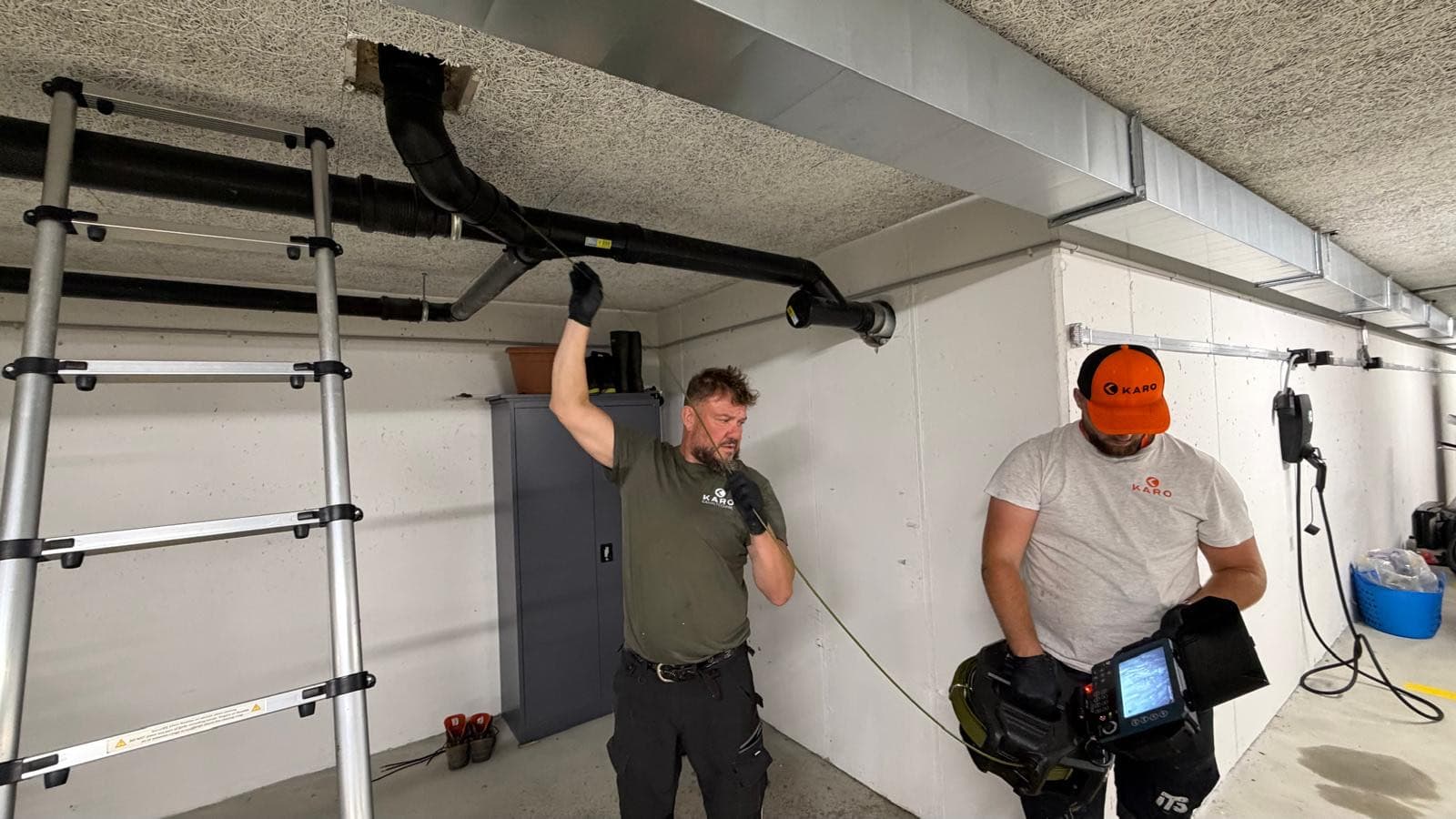
Anyone who receives a request from the municipality should read the required documents carefully: which pipe sections, which report format, which deadline. Karo Kanaltechnik cleans the pipes before the inspection, surveys them with the camera, documents the condition in accordance with SN EN 13508-2 and supplies a report that can be submitted to the municipality.
How owners and managers should proceed
First, obtain the current regulations and the fee tariff of the municipality and read the chapters on the ownership boundary, maintenance, inspections and permits. Second, look for the property drainage plans; if they are missing, the route of the pipes and the manholes can be determined with a camera and locating sonde. Third, know the condition of the pipes before the municipality asks about it.
For property management companies with many properties in several municipalities, an overview per property is worthwhile: responsible municipality, ownership boundary according to the regulations, last inspection, outstanding conditions and deadlines. This makes it possible to bundle inspections and plan rehabilitation work instead of triggering it under time pressure.
When planning costs, the following applies: the fees are set by the municipality, and the work on the private pipes is generally paid for by the owners. Karo charges CHF 160 per hour plus CHF 60 call-out fee (excl. VAT); for the CCTV drain survey, a surcharge from CHF 50 is added. If the municipality requires repairs, depending on the damage pattern, rehabilitation can be carried out without digging, without tearing up the garden or driveway.
A typical case: the owners of a single-family home from the 1970s submit a building application for an extension. In the permit, the municipality requires the existing underground drain and connecting pipe up to the public sewer to be examined by CCTV and the report to be submitted before construction begins, because the drainage regulations assign the house connection to the property. Karo jets the pipes, surveys them with the camera and documents the findings in accordance with SN EN 13508-2. If the report shows leaking joints, the rehabilitation is planned as a trenchless job; the municipality then checks the proof. At the same time, the owners clarify with the building authority whether the extension will trigger an additional payment of the connection fee.