
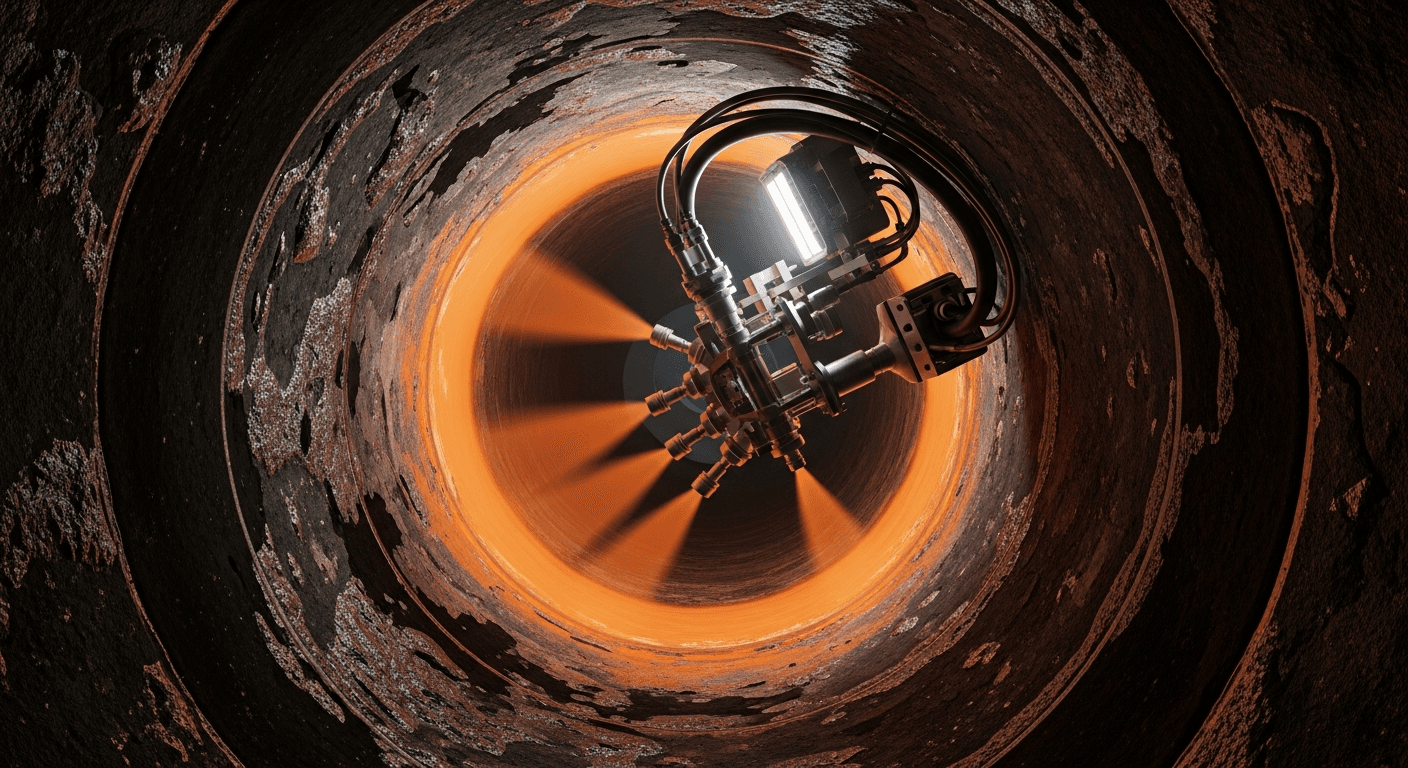
How spray coating works
Before coating, the pipe is thoroughly cleaned and dried so that the material adheres well. A rotating spray head is then drawn through the pipe, applying the liquid coating evenly and in a defined layer thickness to the pipe wall.
The sprayed-on material cures within a short time and forms a continuous, smooth inner layer. It seals fine cracks and porous areas, protects against corrosion and, thanks to its smooth surface, improves the flow. A camera inspection is used to check that the coating has been applied evenly.
When pipe coating is suitable
The method comes into its own in pipes with many bends, branches and changes in cross-section, which are difficult to rehabilitate with a rigid lining tube. Smaller pipe diameters and complex downpipes inside buildings can also be coated well.
Pipe coating is suitable for pipes that are still basically load-bearing and mainly need protection against leaks, corrosion and attack by wastewater. For badly deformed or structurally damaged pipes that have to take on a load-bearing function, on the other hand, a lining tube is the right choice.
Advantages over pipe replacement
Like all trenchless methods, pipe coating avoids digging. Walls, floors, manholes and gardens remain untouched, and the rehabilitation is often completed in a few hours. This is a major advantage, particularly for pipes with many bends in occupied buildings.
The coating adapts flexibly to the pipe geometry and can be applied in several layers to achieve the required thickness. The result is a continuous, seamless protective film that significantly extends the service life of the pipe.
Process and quality control
It always starts with thorough cleaning and a camera inspection that documents the condition of the pipe. The coating only adheres reliably to a clean, dry and sound surface. Loose deposits, grease or residual moisture would impair adhesion.
After application and curing, the result is checked again by camera: the layer must be even, continuous and free of defects. This before-and-after documentation confirms that the work has been carried out properly and serves the owner as proof of the rehabilitated condition of the pipe.
In an old building in Winterthur, the branching cast-iron downpipes were corroded on the inside and slightly leaking in several places. Because of the many bends, a continuous lining tube was not practical. Instead, the inside wall was spray-coated with polyurethane. The pipes have been watertight and protected against corrosion ever since – without a single wall having to be opened up.