
What is an asbestos cement pipe?
Asbestos cement is a composite material made of cement and a proportion of asbestos fibres. The fibres make the material tensile, light and durable, which is why for decades it was popular for pipes, facade panels and corrugated sheets. In drainage systems, asbestos cement is found mainly in underground drains and connection pipes, soil stacks, roof water pipes and ventilation pipes.
In Switzerland, the use of asbestos has been banned since 1990. Pipes installed after that are made of asbestos-free fibre cement or other materials such as plastic, vitrified clay or cast iron. With buildings constructed or converted before this date, on the other hand, you have to expect that some of the pipes contain asbestos.
When is asbestos cement dangerous?
In asbestos cement, the fibres are firmly bound in the cement matrix. An intact pipe that simply carries wastewater therefore releases hardly any fibres into the room air. It becomes problematic as soon as the material is worked on mechanically: drilling, sawing, angle grinding, milling or smashing release fibres that can be inhaled.
Inhaled asbestos fibres can cause serious diseases of the lungs and pleura, often only decades later. Work on components containing asbestos is therefore clearly regulated in Switzerland; SUVA (the Swiss accident insurance fund) specifies which protective measures apply and when a recognised asbestos removal company must be called in. Breaking out old pipes yourself is not a good idea.
Recognising asbestos cement pipes
Asbestos cement pipes are usually grey, have a slightly fibrous, matt surface and are connected with sockets or collars. Visually, however, they cannot be reliably distinguished from asbestos-free fibre cement. Clues are provided by the year of construction, old drawings, markings printed on the pipe or information from earlier renovations.
Only a material sample examined by a specialist laboratory provides certainty. During CCTV drain surveys, the pipe material is recorded in the survey report, as far as it can be identified. Before a renovation in which pipes are drilled into or removed, many cantons in any case require a survey of building pollutants that also covers pipes.
Cleaning and inspecting asbestos cement pipes
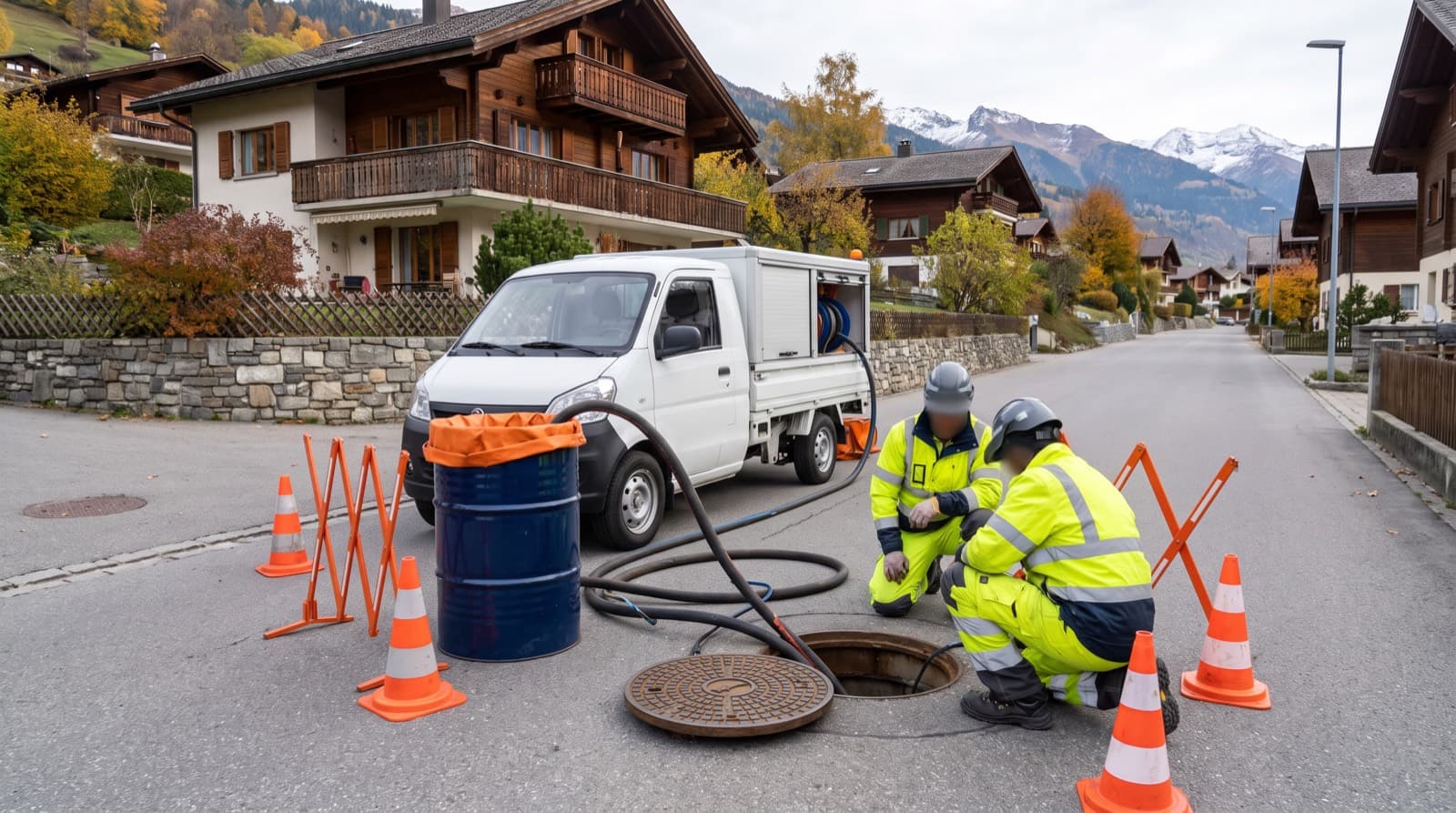
Asbestos cement pipes may be cleaned and inspected, but with adapted technology. High-pressure water jetting with suitable pressure and an appropriate nozzle loosens deposits without attacking the pipe wall. Aggressive mechanical methods such as chain flails or milling, on the other hand, are tricky because they can abrade the surface and release fibres.
That is why every more intensive treatment is preceded by a CCTV drain survey. It shows how badly the pipe is already affected, whether the inner surface is washed out and whether there are cracks or fractures. On this basis it is decided whether to clean, rehabilitate or replace – and which protective measures are needed.
Rehabilitate rather than rip out
For damaged asbestos cement pipes, trenchless rehabilitation is often the safest solution. With the CIPP lining method, a resin-impregnated liner is pulled into the existing pipe and cured. The old pipe stays in the ground or in the wall, is not destroyed and serves as a casing – neither dust nor rubble containing asbestos is produced.
If a pipe does have to be removed, for example during a complete conversion, this is done in accordance with SUVA requirements with protective equipment, low-dust methods and orderly disposal as special waste in line with cantonal requirements. For pipes with sags or too small a diameter, replacement using open-cut construction may be necessary; here too, the asbestos question belongs in the planning from the outset.
A married couple in Aarau wanted to renovate the bathroom of their single-family home built in 1972. During planning it turned out that the soil stack and the underground drain were made of grey fibre cement; a material sample confirmed asbestos. Instead of breaking out the pipes, a CCTV drain survey was carried out first: the soil stack was intact, the underground drain had two cracks. The underground drain was rehabilitated without digging using a CIPP liner, and the soil stack was left in place after gentle cleaning. As a result, no rubble containing asbestos was produced.