
Pipe relining with CIPP liners and spray lining
Soil stack, underground drain or house connection: we rehabilitate defective wastewater pipes from the inside – with a CIPP liner or spray lining, usually without digging and without breaking open walls.
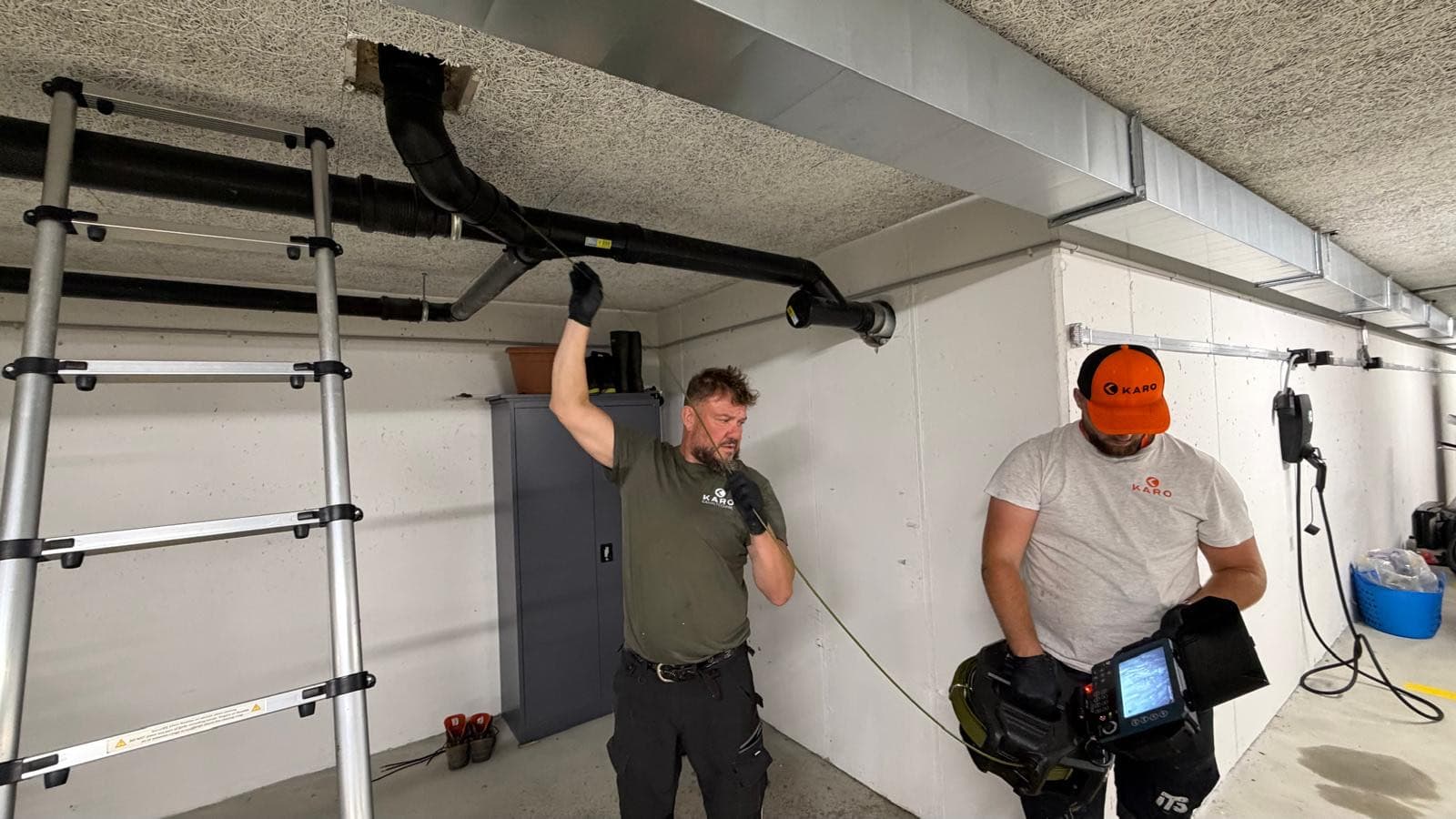
In brief
Pipe relining renews defective pipes from the inside, creating a «pipe within a pipe» rather than removing it. It is needed when soil stacks, underground drains or house connections have cracks or leaking joints. Karo Kanaltechnik relines with CIPP liners or epoxy spray lining from DN 50, without digging or wall openings, and gives up to 10 years' warranty.
Pipe relining: a new pipe inside the old one
Pipe relining renews a damaged wastewater pipe from the inside instead of removing it. Cracks, leaking joints, corrosion or root ingress are bridged by creating a new, leak-tight pipe wall inside the existing pipe – the so-called «pipe within a pipe». Floors, walls, gardens and forecourts generally remain untouched, because we work through existing manholes, rodding eyes and access points.
We use two methods for this. With a CIPP liner (cured-in-place pipe), a resin-impregnated tube is pulled into the cleaned pipe, pressed against the pipe wall and cured. It is suited to longer, straight sections, such as underground drains below the floor slab, house connections and larger sizes. With spray lining, a rotating spray head applies an epoxy resin coating evenly to the inner wall. This works from DN 50 and also where many bends, branches and changes of size push a liner tube to its limits – typical of soil stacks and collecting drains in buildings.
We do not decide which method fits over the phone, but after a CCTV drain survey. It shows the nominal diameter, pipe material, route, connections and every single defect. If only one point is affected, a patch liner is often enough; if the whole pipe run is damaged, we rehabilitate it throughout. Before and after rehabilitation, the pipe is documented with the camera, with findings to SN EN 13508-2. So you can see for yourself what was done.
We give up to 10 years' warranty on our rehabilitation work. We rehabilitate wastewater pipes – foul water, rainwater and combined wastewater – for owners, property management companies, businesses and SMEs in Zurich, Winterthur, St. Gallen, Frauenfeld and throughout German-speaking Switzerland.
Our services at a glance
- CCTV drain survey before rehabilitation: damage, nominal diameter, material and route
- Pipe cleaning with high-pressure water jetting up to 200 bar, chemical-free
- Cutting roots, deposits and displacements with the robotic cutter
- CIPP liners for underground drains, house connections and larger sizes
- Spray lining with epoxy resin for pipes from DN 50
- Rehabilitation of soil stacks and collecting drains inside the building, without opening walls
- Reopening lateral connections after installing a CIPP liner
- Patch liners for individual defects instead of rehabilitating the whole pipe
- Final CCTV drain survey and documentation to SN EN 13508-2
- Up to 10 years' warranty on rehabilitation work
Pricing
- per hour
- CHF 160
- call-out
- CHF 60
- CCTV survey
- from CHF 50
Guide prices for cleaning and camera survey, excl. VAT. We quote the rehabilitation itself based on the findings.
We quote for the rehabilitation after the CCTV drain survey, which is charged as a surcharge from CHF 50. Preparatory cleaning by time and effort: CHF 160 per hour plus CHF 60 call-out, excl. VAT. The quote lists every item before we start.
Areas of application
- Soil stacks and collecting drains in buildings
- Underground drains below the floor slab
- House connections up to the municipal sewer
- Rainwater, foul water and combined pipes
- Pipes below buildings, garages and paved areas
- Wastewater pipes in commercial and industrial premises
On site in your region
With six locations – three of them in Zurich – we reach you quickly:
- Zurich-Wiedikon
- Zurich-Oerlikon
- Zurich city centre
- Winterthur
- St. Gallen
- Frauenfeld
- Thurgau
- Schaffhausen
- all of German-speaking Switzerland
24/7 emergency service
You can reach us around the clock – including weekends and public holidays.
+41 43 588 12 08How it works
From enquiry to completion – transparent and structured.
CCTV drain survey
We survey the pipe with the camera, record every defect with its position and nominal diameter and recommend the right method: CIPP liner, spray lining or patch liner.
Quote & planning
You receive a written quote based on the findings. We agree the date with you or the property management company so that the pipe is out of service for as short a time as possible.
Cleaning & cutting
The pipe is cleaned at high pressure. We remove roots, encrustation and displacements with the robotic cutter so that the liner or coating fits cleanly.
Rehabilitation
Depending on the findings, we pull in a resin-impregnated CIPP liner and cure it, or apply the spray lining in several layers.
Opening connections
After a CIPP liner, we cut the lateral inlets open again. With spray lining, the connections stay open and are coated as well.
Inspection & handover
A final CCTV drain survey shows the result. You receive images, findings and the survey report for your records and for the property file.
Why Karo Kanaltechnik?
Pipe within a pipe
The new pipe wall is created inside the existing pipe – without digging, without broken-open walls and without major reinstatement work.
Two methods
CIPP liners for long, straight runs, spray lining from DN 50 for bends and branches. We choose by the findings, not by preference.
Documented
CCTV drain survey before and after rehabilitation, findings to SN EN 13508-2. You see what was done.
Up to 10 years' warranty
We give up to 10 years' warranty on our rehabilitation work.
Frequently asked questions
Spray lining is a method in which a high-strength epoxy resin coating is applied evenly to the pipe wall from the inside using a rotating head. The coating cures and forms a completely new, seamless pipe within the existing pipe, the so-called «pipe within a pipe». It is particularly suitable for pipes with many bends and branches, such as soil stacks in buildings.
With spray lining technology we rehabilitate pipes from DN 50, i.e. pipes with an inside diameter of just 50 mm. This means that small house connections, vertical drain pipes in buildings and hard-to-reach underground drains can also be renewed. For longer, straight sections and larger sizes we use CIPP liners; the CCTV drain survey before the quote shows which method is suitable.
Depending on the scope, relining is often completed within a day. Larger properties with several stacks or difficult access can take 2 to 3 days. Only the drains of the pipe being worked on at the time are closed. We plan the process with you or the property management company so that disruption for residents remains minimal.
The coating is only a few millimetres thick and has no noticeable effect on the flow. On the contrary: thanks to the smooth, jointless surface, the flow characteristics usually even improve, and fewer deposits can build up at the former joints and cracks. A CIPP liner also reduces the cross-section only slightly.
Professionally carried out rehabilitation with spray lining or CIPP liners is designed for a service life of 50 years and more. The epoxy resins used are chemically resistant, abrasion-resistant and resistant to root ingress. A prerequisite is thorough cleaning before coating; that is why we document the pipe with a camera before and after the rehabilitation in accordance with SN EN 13508-2.
Depending on the method and scope, we give up to 10 years' warranty on our rehabilitation work. The camera footage from before and after the rehabilitation, which you receive together with the report, serves as proof. This allows you to prove the condition of the pipe at any time, whether you are selling or dealing with the property management company or your insurer.
A building's wastewater pipes, i.e. soil stacks, collector pipes, underground drains and house connections, belong to the owner, who also pays for the rehabilitation. In condominium ownership, shared pipes are a matter for the owners' association and are billed according to its regulations. Tenants do not pay for the rehabilitation. Whether insurance covers part of it depends on the policy; wear and tear is usually not covered.
Yes. With three locations in Zurich (Wiedikon, Oerlikon, Zurich city centre) and branches in Winterthur, Frauenfeld and St. Gallen, we reline pipes and house connections throughout the Greater Zurich area, with no digging and often within a day. We work for owners, property management companies, condominium owners' associations, businesses and SMEs.
Enquire without obligation
Fill in the form – we will get back to you within 24 hours.
Need help fast?
Our emergency team is ready around the clock – including Sundays and public holidays.
CIPP liner or spray lining: which method fits?
Both methods renew the pipe from the inside, without digging. They differ in how well they cope with small nominal diameters, tight bends and many branches. Rule of thumb: long, straight runs are a case for the CIPP liner, angled pipes inside the building a case for spray lining. What counts are the findings of the CCTV drain survey – we often combine both in the same property.
Only one defect?
If the pipe is intact apart from one crack or a leaking joint, it does not need to be rehabilitated along its whole length. A patch liner (Pointliner) seals exactly this point.
Whole sewers and main drains?
For collecting sewers, main drains and large sizes outside the building, you will find the methods and process on our drain rehabilitation page.
When is pipe relining needed?
Rehabilitation pays off as soon as a pipe is no longer leak-tight or its wall is losing substance. You rarely see this from the outside; it becomes visible in a CCTV drain survey. Typical findings:
- Cracks and fragments in the pipe wall Pipe collapse →
- Leaking or displaced joints Displaced joint →
- Roots growing into the pipe through joints Root ingress →
- Corrosion and material loss in cast iron and concrete pipes Sewer pipe →
- Recurring blockages at the same point Pipe cleaning →
- Damp patches, odours or wastewater in the ground Leak detection →
When selling, converting or renewing the bathroom pipework, it is worth checking the wastewater pipes at the same time: if the bathroom is redone while the soil stack behind it keeps leaking, the damage will return later at the same point.
How much does pipe relining cost?
A reliable figure is only possible after the CCTV drain survey. The price depends on how many metres are rehabilitated, the nominal diameter of the pipe, how many bends and connections lie along the route, how easily the pipe can be reached and how much cleaning and cutting is needed beforehand. That is why we quote for the rehabilitation in writing, item by item, before we start.
What is fixed is the cost of getting there: the CCTV drain survey costs a surcharge from CHF 50, and we charge for the preparatory cleaning at CHF 160 per hour plus CHF 60 call-out, excl. VAT.
Which guide prices per metre are typical on the market and what drives the price is explained in the guide Drain rehabilitation with a CIPP liner: costs.
The components of your quote
Prices excl. VAT; cleaning is charged by actual time and effort.
The warranty applies to our rehabilitation work, up to 10 years depending on the method.
Technical terms for pipe relining
- CIPP drain linerResin-impregnated tube that is pulled in and cured – the new pipe inside the old one.
- Spray liningCoating that a rotating spray head applies to the inner pipe wall.
- Soil stackThe vertical wastewater pipe that collects wastewater from all floors and leads into the underground drain.
- Underground drainThe pipe in the ground or below the floor slab, from the building to the sewer.
- Nominal diameter (DN)The pipe diameter – it determines which rehabilitation methods are suitable.
- Sewer pipeWhich pipe materials are found in properties and how they age.
- House connection (lateral)The pipe from the property to the municipal sewer – the owner's responsibility.
- Pipe coatingUmbrella term for coatings of the inner pipe wall, for example with epoxy resin.
Guidance on rehabilitation
- Drain rehabilitation with a CIPP liner: cost per metre, factors and process
- Spray lining technology: pipe relining without excavation explained
- Rehabilitating a wastewater pipe without digging: CIPP liner and costs
- CIPP liner vs. patch liner vs. spray lining: which method when?
- Underground drain rehabilitation: no-dig process and costs
Goes well with pipe relining
CCTV drain survey
The basis of every rehabilitation: a camera survey from DN 50, with findings documented to SN EN 13508-2.
Learn morePointliner / patch repair
Only one defect in an otherwise intact pipe? Then a patch liner at exactly this point is often enough.
Learn moreDrain rehabilitation
Trenchless rehabilitation of sewers and main drains – with up to 10 years' warranty on the work.
Learn moreLeak-tightness testing
Shows whether a pipe is leak-tight – before rehabilitation as a finding, afterwards as proof.
Learn morePipe and drain rehabilitation in your region
Process, methods and the specifics of local properties – for Zurich, Thurgau, St. Gallen and Aargau.