
Trenchless drain rehabilitation
Defective drains do not have to be dug up. With modern trenchless methods, we rehabilitate your drainage system quickly, cleanly and cost-effectively.
In brief
Drain rehabilitation is the repair of damaged wastewater pipes, in the trenchless version from the inside and without digging. It becomes necessary when a camera inspection shows cracks, displacements or collapses. Karo Kanaltechnik rehabilitates with CIPP lining, spray lining or patch liners in sizes from DN 50 to DN 800 and gives up to 10 years' warranty.
Drain rehabilitation without digging – economical and sustainable
Drain rehabilitation means making a damaged wastewater pipe leak-tight and structurally sound again. With trenchless drain rehabilitation, this is done from the inside, via existing manholes and rodding eyes – without digging up the garden, forecourt or basement floor. This saves time and reinstatement costs and protects the surroundings.
Rehabilitation becomes necessary when the camera inspection shows cracks, leaking joints, displaced joints, root ingress or fragmentation. Typical signs in everyday life are recurring blockages at the same point, drain smells, damp basement walls or rats in the house. Without a camera image, neither the method nor the price can be determined reliably – which is why every rehabilitation job with us starts with cleaning and a CCTV drain survey.
Depending on the type of damage and the pipe size, we use different methods: CIPP lining (cured-in-place pipe) for pipes damaged throughout, spray lining for building drains and soil stacks from DN 50, or patch liners for individual defects. We then reopen lateral connections with the robotic cutter and seal them in tightly with top-hat profiles.
Every rehabilitation job is documented by a final camera inspection, supplemented on request by a leak-tightness test. Depending on the method and scope, we give up to 10 years' warranty on rehabilitation work.
For drain rehabilitation in Zurich, we are close at hand with three locations – Wiedikon, Oerlikon and Zurich city centre – and know local conditions from old buildings to municipal networks. We also carry out rehabilitation in Winterthur, St. Gallen, Frauenfeld and throughout German-speaking Switzerland – for private properties, property management companies, businesses and municipalities.
Our services at a glance
- Cleaning and CCTV drain survey as the basis of every rehabilitation job
- CIPP lining (cured-in-place pipe) for main drains from DN 150
- Spray lining for building drains from DN 50
- Patch liner and Pointliner repair for single defects
- Robotic cutting and reinstatement work, top-hat profiles at connections
- Rehabilitation of all sizes from DN 50 to DN 800
- Quality control by a final camera inspection
- Occupied building: drains closed for only a few hours
- Up to 10 years' warranty on rehabilitation work
- Comprehensive advice on the best rehabilitation method
Pricing
- per hour
- CHF 160
- call-out
- CHF 60
- CCTV survey
- from CHF 50
Guide prices for cleaning and camera survey, excl. VAT. We quote the rehabilitation itself based on the findings.
We give a binding quote for the rehabilitation as soon as the camera image is available: the price depends on length, size, type of damage and number of connections. We charge for the preparatory cleaning by time and effort (CHF 160 per hour plus CHF 60 call-out, excl. VAT); the camera inspection afterwards costs a surcharge from CHF 50.
Areas of application
- Main drains and trunk sewers
- House connections
- Underground drains below buildings
- Soil stacks and building drains
- Rainwater and combined drains
- Industrial wastewater pipes
On site in your region
With six locations – three of them in Zurich – we reach you quickly:
- Zurich-Wiedikon
- Zurich-Oerlikon
- Zurich city centre
- Winterthur
- St. Gallen
- Frauenfeld
- Thurgau
- Aargau
- Schaffhausen
- all of German-speaking Switzerland
24/7 emergency service
You can reach us around the clock – including weekends and public holidays.
+41 43 588 12 08How it works
From enquiry to completion – transparent and structured.
Cleaning & CCTV survey
High-pressure water jetting, then a camera survey with a report to SN EN 13508-2: which defect is where?
Plan & quote
We choose the method according to the type of damage and size and give a binding quote – before work starts.
Rehabilitation
Cutting away obstructions, installing the liner or applying the coating, reopening connections.
Acceptance
Final camera inspection, a leak-tightness test if required, and handover with documentation and warranty.
Why Karo Kanaltechnik?
Less effort than digging
No excavation, no reinstatement of surfaces and gardens: trenchless methods are often cheaper than digging up – and the construction time is considerably shorter.
Protects the surroundings
No digging, no destroyed surfaces. Gardens, forecourts and buildings remain untouched.
Quick to complete
Many rehabilitation jobs are completed within one day – residents can stay in the building.
Durable and documented
Professionally installed liners are designed for a service life of 50 years and more – with an acceptance report and our warranty.
Frequently asked questions
Trenchless methods avoid excavation work entirely. This means: no destruction of roads, gardens, forecourts or parts of buildings, a considerably shorter construction period and, in most cases, significantly lower overall costs, because excavation and reinstating the surface are no longer needed. In addition, residents can usually stay in the building as normal during the rehabilitation.
Professionally installed liners are designed for a service life of 50 years and more. The materials used, glass-fibre fabric, epoxy resins and polymers, resist chemical and mechanical stress and also seal the pipe against root ingress. What matters is thorough cleaning beforehand, the right choice of method and a final camera check.
Depending on the method and scope, we give up to 10 years' warranty on rehabilitation work. Quality is documented by a final camera inspection and, if required, a leak-tightness test, with findings recorded in accordance with SN EN 13508-2. You receive the footage from before and after the rehabilitation so that you can see for yourself what was done and prove the warranty at any time.
Private pipes on the property, i.e. underground drains and house connections up to the public sewer, are the property owner's responsibility. Exactly where the private pipe ends is set out in the municipality's drainage regulations. In rented properties the owner pays for the rehabilitation. Building insurance generally does not cover age-related damage; check individual cases with your insurer, and the camera footage will help.
In most cases, yes. Trenchless rehabilitation is possible even with cracks, displacements and partial collapses. Where there are major obstacles, a combination of robotic cutting and lining can be the solution. Excavation is only necessary if the pipe has completely lost its structure or has collapsed entirely; we carry out these civil works as well.
Yes, the building can usually be used without restriction during the rehabilitation. Only the affected drains have to be closed for a few hours while the liner is installed and cures. We coordinate the process with you or the property management company and inform the residents in advance so that disruption remains minimal.
Yes. From our three Zurich locations in Wiedikon, Oerlikon and Zurich city centre, as well as our branches in Winterthur, Frauenfeld and St. Gallen, we carry out trenchless drain rehabilitation throughout the Greater Zurich area, for private properties, property management companies, businesses and municipalities. It is always based on a CCTV drain survey, so that we can choose the right method and give a reliable quote.
Enquire without obligation
Fill in the form – we will get back to you within 24 hours.
Need help fast?
Our emergency team is ready around the clock – including Sundays and public holidays.
Which rehabilitation method when?
The right method follows from the camera image: how many defects, how far apart, what size, how many bends and connections. Trenchless works in most cases. Only if the pipe has collapsed or lies in the wrong position does it have to be dug up.
| Method | Suitable for | How it works | Limit |
|---|---|---|---|
| CIPP liner (lining) | Many cracks, leaking joints or root ingress along a whole pipe run from manhole to manhole. | A resin-impregnated tube is pulled in or inverted and cures with heat or UV light into a new pipe inside the old one. | The old pipe must still hold its shape; the cross-section becomes a few millimetres smaller. |
| Patch liner / Pointliner | Individual defects in an otherwise intact pipe: a crack, a displaced joint, a leaking connection. | A short, resin-impregnated sleeve is moved to the defect on a packer and pressed against it until it has cured. | No longer worthwhile if the defects lie close together – a continuous liner is then more economical. |
| Spray lining | Building drains, soil stacks and underground drains with small sizes from DN 50, many bends and branches. | A rotating head applies epoxy resin evenly to the pipe wall in several layers – a seamless coating even through bends. | Missing pieces of pipe or large holes must be bridged beforehand. |
| Pipe bursting | The pipe has become too small or is so badly damaged that a liner no longer finds any support. | A bursting head breaks open the old pipe in the ground and, in the same pass, pulls in a new pipe of the same or larger size. | Needs a launch pit and a reception pit and enough distance from other pipes. |
| Open-cut construction | Collapsed sections, reverse gradient, a wrong position or a completely new pipe route. | The pipe is exposed, replaced and relaid, after which the surface is reinstated. | The most costly option: excavation, surfacing and garden often account for the larger part of the costs. |
Every liner involves robotics: beforehand the robotic cutter removes roots and protruding connections, and after lining it reopens the lateral inlets; a top-hat profile seals the transition between the main pipe and the connection. You can read the detailed comparison in our guide CIPP liner, patch liner or spray lining.
From the CCTV survey to acceptance
Drain rehabilitation without digging always follows the same sequence. Before any rehabilitation, the camera findings and a binding quote are in place.
Enquiry and documents
You describe the problem to us. If available, a drainage plan of the property and earlier camera findings help – so that we know where manholes and rodding eyes are located.
Cleaning the pipe
Without a clean pipe wall there is no reliable camera image. We jet the pipe chemical-free at high pressure up to 200 bar and remove deposits.
About drain cleaningCCTV drain survey
The camera travels along the pipe and records every defect with its position in metres. We prepare the report to SN EN 13508-2, the standard for coding drain defects.
About CCTV drain surveysRehabilitation plan and quote
The method follows from the findings: patch liners for individual points, CIPP liners for whole pipe runs, spray lining for narrow building drains. You receive a binding quote with the warranty period before we start.
Preparation
We cut away roots, hard deposits and protruding connections with the robotic cutter. We agree with the residents which drains cannot be used for a few hours, and when.
Rehabilitation
Installing the liner or applying the coating, curing, after which we reopen lateral connections and seal them in with top-hat profiles.
Acceptance and documentation
A second camera survey shows the result, followed by a leak-tightness test if required. You receive the findings before and after, the report and the warranty – the basis for the property management company, insurance or municipality.
About leak-tightness testing
How long does it take?
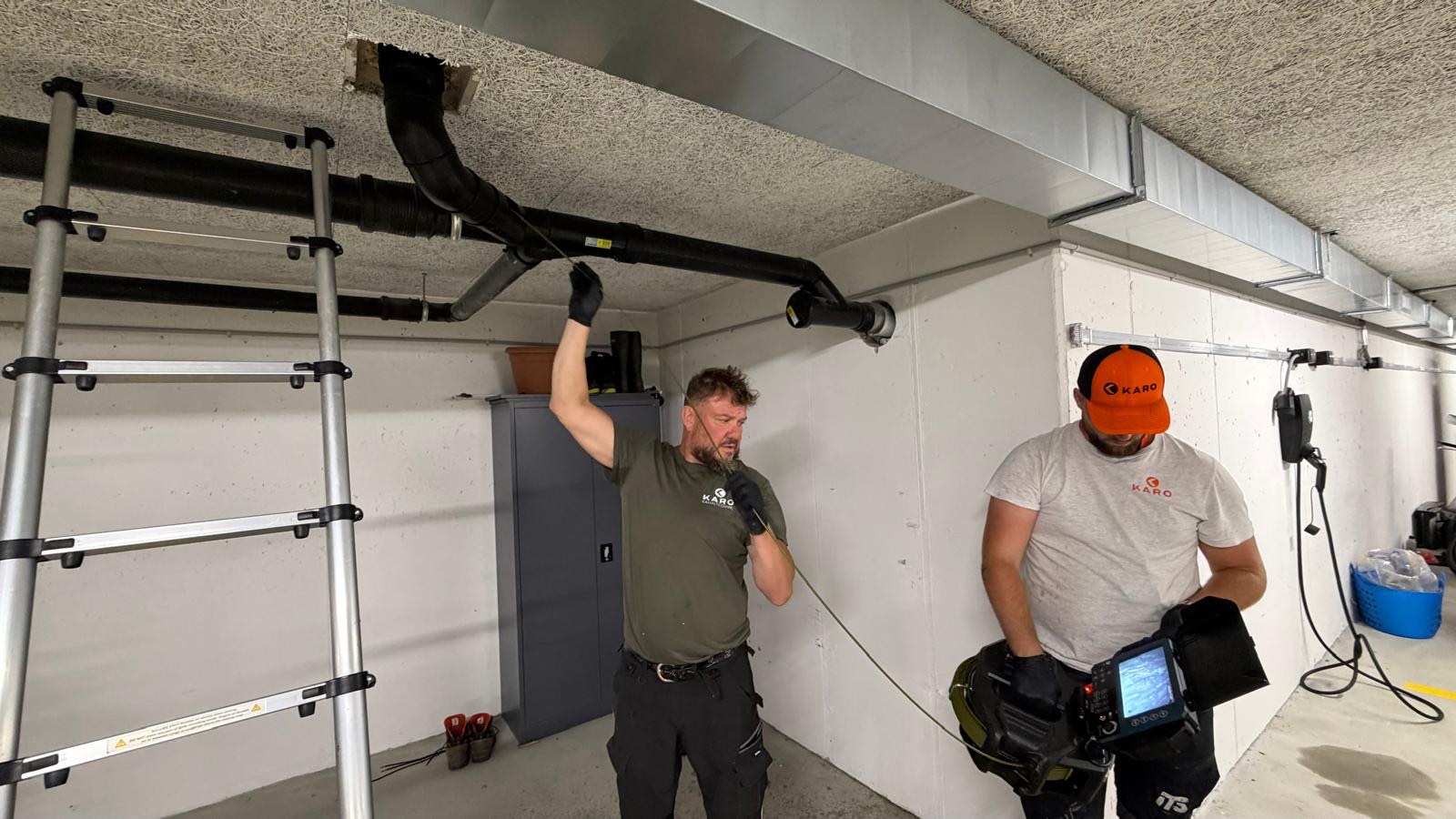
Many rehabilitation jobs on building drains are done in one day. Several pipe lines or pipes that are hard to access take longer – the planned duration is stated in the quote. Residents stay in the house; individual drains are closed only while the liner cures.
Drain rehabilitation: what the costs depend on
We do not give a price per metre without a camera image – it would be a guess. We give a binding quote for the rehabilitation as soon as the findings are available. The rates for the preparatory work are known: cleaning by time and effort at CHF 160 per hour plus CHF 60 call-out, and the camera inspection afterwards with a surcharge from CHF 50 (all prices excl. VAT).
Length of the pipe
CIPP liners and spray lining are calculated by the running metre, patch liners per defect.
Nominal diameter (DN)
A building drain of DN 100 needs less material and smaller equipment than a trunk sewer of DN 300.
Type of damage
Two cracks are repaired faster than a pipe full of displacements, roots and fragments.
Lateral connections
Every connection must be cut open after lining and sealed in with a top-hat profile.
Access
Easily accessible manholes and rodding eyes save time; if there is no access, it has to be created.
Preparatory work
Only the camera image shows how much cleaning and cutting is needed beforehand.
Compared with digging, trenchless methods do away with excavation, disposal and the reinstatement of surfacing, garden or basement floor. How big the difference is depends on the surface above the pipe.
Warranty: up to 10 years
Depending on the method and scope, we give up to 10 years' warranty on rehabilitation work. The exact period is stated in the quote before you sign.
The warranty is based on the documentation: camera findings before the rehabilitation, a final survey afterwards and, if required, a leak-tightness test. This means there is always a record of the condition in which the pipe was handed over.
Who pays for drain rehabilitation?
- Owners: The pipes on the plot up to the connection to the public sewer generally belong to the owners. Where exactly the boundary lies is set out in the municipality's drainage regulations.
- Rented properties: Rehabilitation is a matter for the owners as landlord, not the tenants; it is usually organised through the property management company.
- Insurance: Ageing and wear and tear are usually not insured. Consequential damage such as water damage may be covered depending on the policy – ask your insurer before rehabilitation starts. Our camera report serves as evidence.
- Condominium ownership: Shared pipes are common parts; the owners' meeting decides on the rehabilitation.
General information, not legal advice. The regulations, contract and policy in the individual case are decisive.
More about drain rehabilitation
Background on methods, process and costs from our knowledge hub.
Trenchless drain rehabilitation: process, benefits and costs
What is possible without digging, how long it takes and what the price depends on.
Read articleCIPP liner, patch liner or spray lining?
The three trenchless methods compared directly: area of use, limits, effort.
Read articleCIPP liner technology in detail: how a drain liner works
From impregnating the tube to curing – CIPP liner technology step by step.
Read articlePatch liner (Pointliner): localised drain rehabilitation explained
When a sleeve can permanently seal a single crack.
Read articleUnderground drain rehabilitation: no-dig process and costs
Pipes below the floor slab: how they are rehabilitated without digging and without breaking open the basement.
Read articleCCTV drain survey: process and benefits
Why the camera comes before every rehabilitation job and what the report contains.
Read articleDrain rehabilitation in your region
What applies in your region, from construction methods and pipe age to notifying the municipality:
Technical terms for drain rehabilitation
Briefly explained in the drain technology glossary:
- Drain rehabilitation
- CIPP drain liner
- Patch liner / Pointliner
- Spray lining
- Pipe coating
- Pipe bursting
- Open-cut construction
- Top-hat profile
- Robotic cutter
- Drain repair
- Displaced joint
- Root ingress
- Fragmentation (shattered pipe)
- Condition grades (VSA)
- SN EN 13508-2
- Nominal diameter (DN)
- Underground drain
- House connection (lateral)
- Maintenance obligation (private drains)
- Drainage regulations (municipal)
Related services
CCTV drain survey
Camera survey with a report to SN EN 13508-2 – the basis of every rehabilitation job.
Learn morePipe relining
Spray lining and CIPP liners for building drains and soil stacks from DN 50.
Learn morePointliner / patch repair
Sealing individual cracks and displaced joints in a targeted way.
Learn moreManhole rehabilitation
Repairing leaking or damaged inspection chambers.
Learn moreLeak-tightness testing
Verification after rehabilitation, for example for the municipality or a sale.
Learn moreCivil works
If digging is needed after all: excavation, pipe laying and reinstatement.
Learn more