
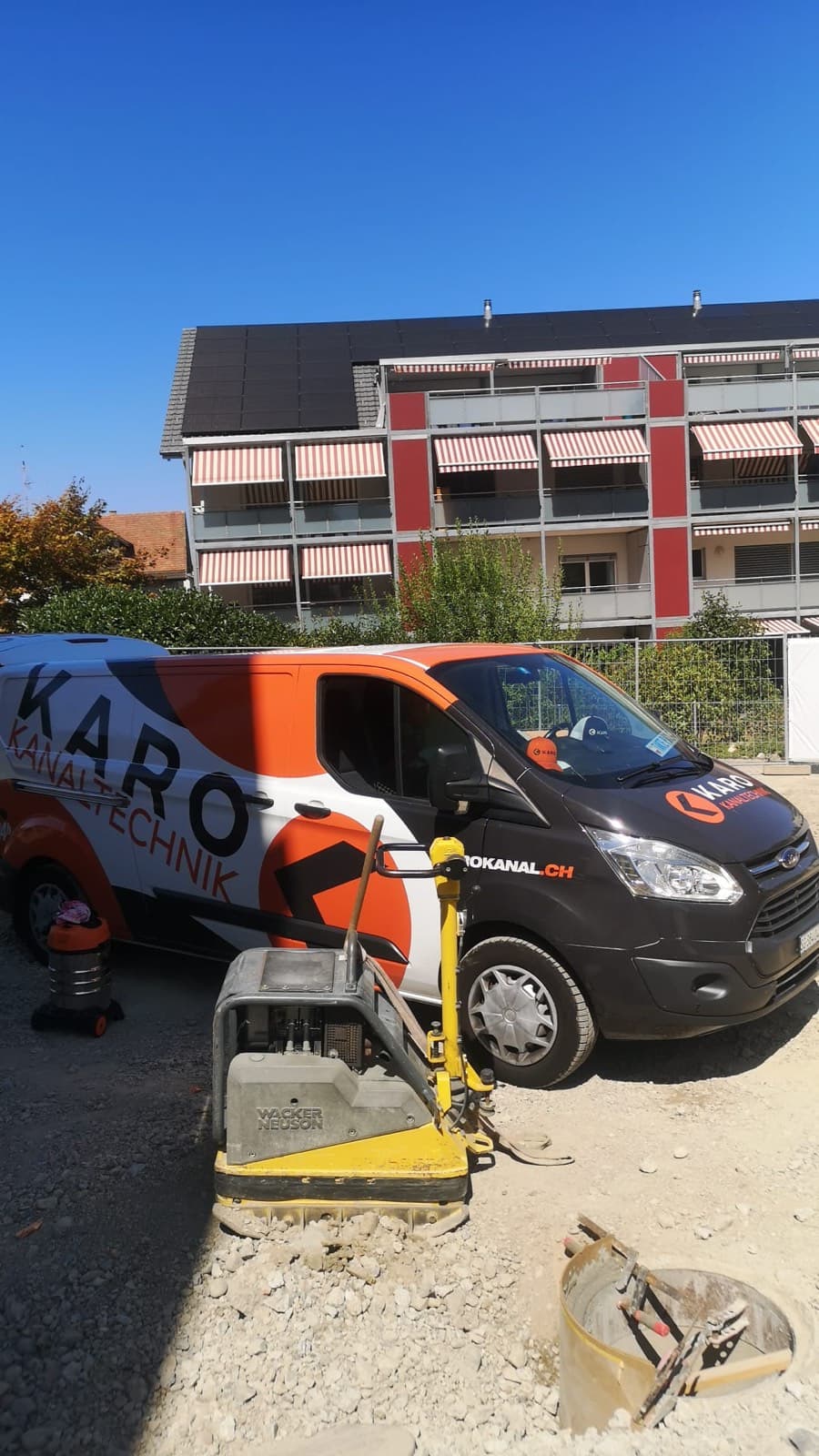
What is open-cut construction?
In open-cut construction, a trench is excavated above the pipe until the pipe is exposed. The damaged section is then removed and replaced with a new pipe, or the pipe is relaid along its entire length. Finally, the trench is backfilled in layers, compacted and the surface is reinstated.
For a long time this was the only way to repair drains. Today, a lot of damage is rehabilitated from the inside without digging. Open-cut construction nevertheless has an established place: it is the method that can actually change the route, level and diameter of a pipe – something no CIPP liner can do.
When open-cut construction is necessary
If a pipe has collapsed or is so badly deformed that neither a camera nor a liner can get through, replacement is usually the only option. The same applies to sags and reverse falls: a CIPP liner follows the existing pipe and takes on its faults. To correct the gradient, the pipe has to be re-bedded.
Other reasons are a cross-section that is too small, for example when more flats are connected, rerouting the pipe for an extension, or reconnecting misconnections in a separate system. New manholes, separators or infiltration systems are also built using open-cut construction. For new buildings, it is the norm anyway.
How open-cut rehabilitation works
The first step is a CCTV drain survey with pipe locating, so that it is clear exactly where and how deep to dig. Before excavation, the utility plans are obtained and, if necessary, permits are applied for, for example if public land is affected. The trench is then excavated and shored depending on its depth.
The new pipe is placed on carefully prepared bedding, laid with the correct gradient and haunched at the sides. The requirements for bedding, laying and testing are described in the standard SN EN 1610; for property drainage, the requirements of SN 592 000 also apply. Before backfilling, the pipe is generally subjected to a leak-tightness test.
Open-cut or trenchless: the comparison
Trenchless methods such as CIPP liners, patch liners or spray lining rehabilitate the pipe from the inside. They are usually faster, cause less noise and dirt and leave gardens, surfacing and floors untouched. That is why they are often the first choice for cracks, leaking joints, root ingress or corrosion.
Open-cut construction involves more work, because excavation, removal, backfilling and reinstatement of the surface are also required. On the other hand, it does not depend on the condition of the old pipe and allows any change of position, level and diameter. Which method is suitable depends on the findings – a combination often makes sense too: trenchless over long stretches, open-cut at a single problem spot.
What owners should look out for
Good planning is crucial for work using open-cut construction. This includes clarifying whether trees, walls or other pipes are in the way, coordinating with neighbours on shared pipes and finding out whether the municipality requires a permit or an acceptance inspection. With older buildings, it must be checked whether the old pipes contain asbestos.
Karo Kanaltechnik carries out civil works for wastewater pipes itself – from locating, excavation and pipe laying through to the leak-tightness test and reinstatement of the surface. This keeps responsibility in one pair of hands, and trenchless and open-cut sections can be properly coordinated with each other.
At a single-family home in Frauenfeld, the underground drain beneath the forecourt had collapsed over a length of about one metre; wastewater regularly backed up into the basement. The camera could not get past the break, so a CIPP liner was not possible. After pipe locating, the Karo Kanaltechnik team opened only a short trench above the damaged spot, replaced the broken section with a new pipe on fresh bedding and tested the pipe for leak-tightness. The rest of the section was intact and was left untouched.