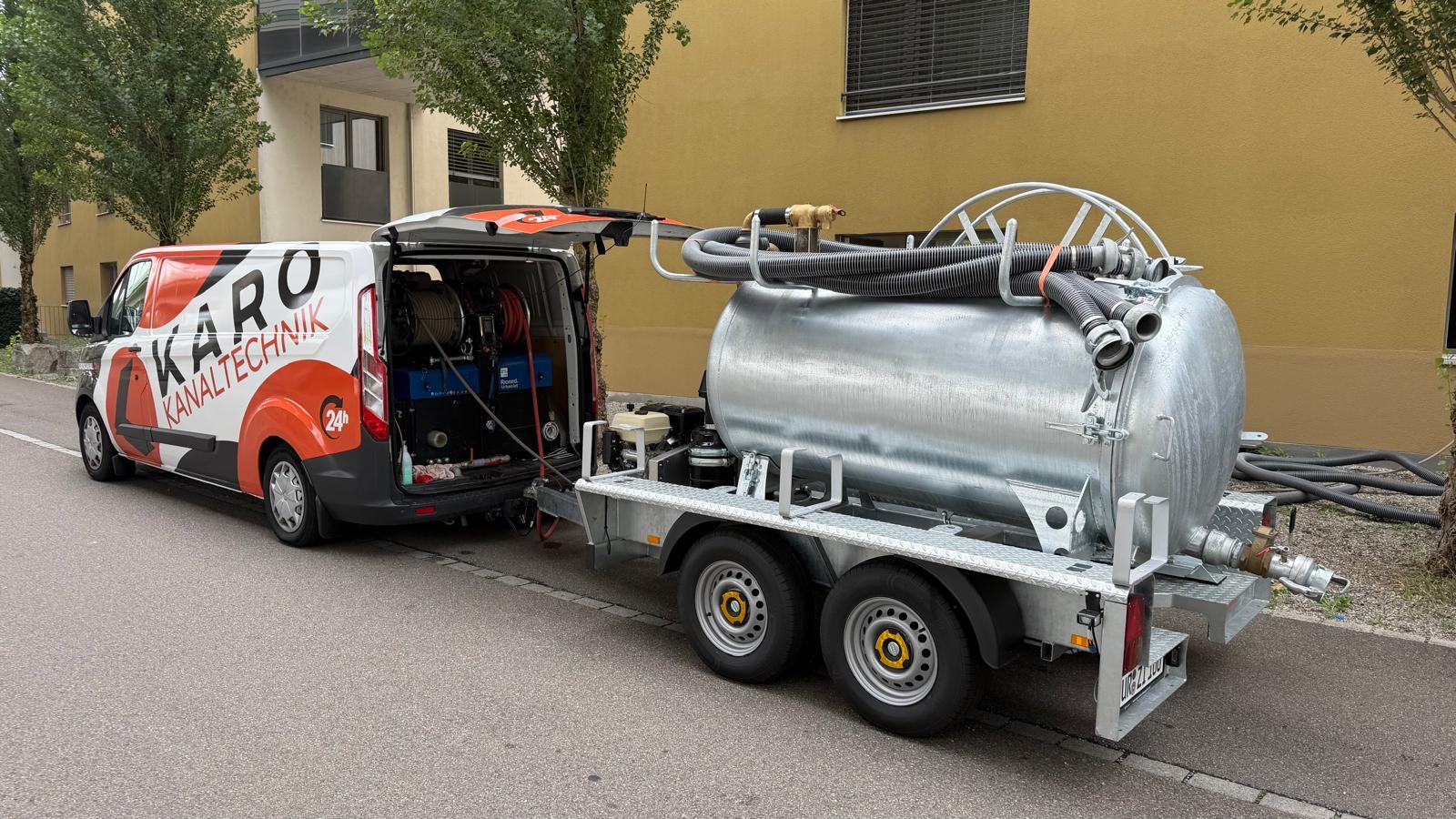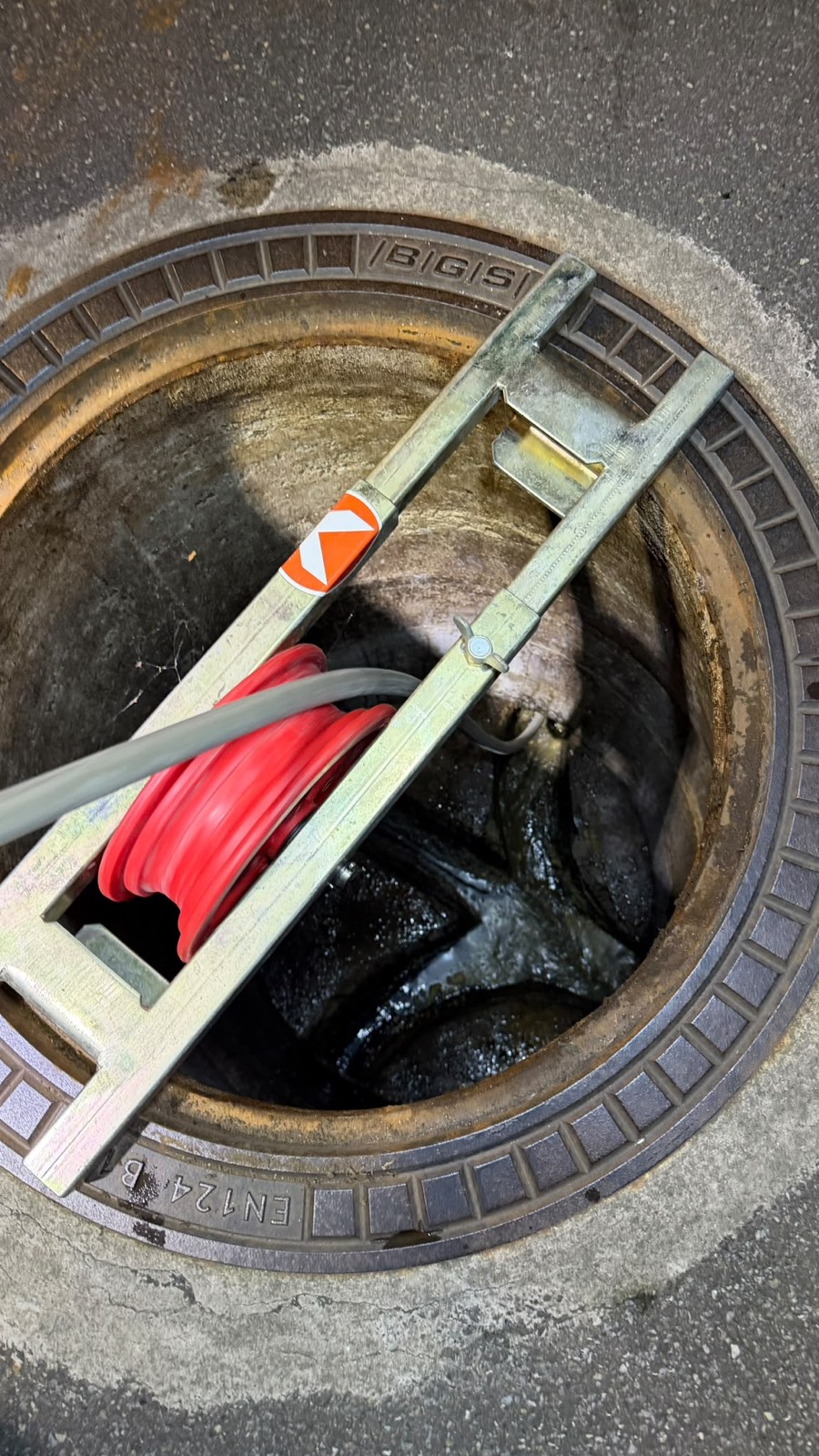
In high-pressure water jetting, water is forced into the drain at a pressure of around 120 to 200 bar through special nozzles. The rearward-facing water jets pull the hose through the pipe on their own, loosening grease, deposits, roots and blockages from the pipe wall as they go. The loosened dirt is then flushed to the manhole with the returning water and vacuumed up. The method cleans pipes thoroughly without damaging them and is now the standard in professional drain cleaning.
How is the pressure generated?
The heart of every high-pressure water jetting operation is a powerful high-pressure pump, usually mounted on a jetting truck or jetting vehicle. It draws water from a large tank and accelerates it to the required operating pressure. The water reaches the nozzle at the end of the hose via a reinforced high-pressure hose. What matters is the interplay between pressure and water volume: it is not the highest pressure that cleans best, but the right combination of pressure, flow rate and a suitable nozzle for the pipe in question.
What role do the nozzles play?
The nozzle is the actual tool of high-pressure water jetting, and it comes in many designs. A standard jetting nozzle has several rearward-facing holes whose jets propel the hose forward and rinse the pipe wall. For stubborn deposits, rotating nozzles are used, whose jet rotates in a circle and removes encrustations mechanically.
For root ingress, special root-cutting nozzles or chain flails are used to break up the roots. For heavy grease build-up, so-called penetrating nozzles with a forward-facing front jet help to break through. The specialist chooses the nozzle to suit the pipe diameter, material and type of soiling, because the wrong nozzle either cleans inadequately or puts unnecessary strain on the pipe.
How does high-pressure water jetting work?
First, access to the drain is opened, usually via a manhole or a rodding eye. The technician chooses the appropriate nozzle and inserts the high-pressure hose. As it is fed in, the hose pulls itself forward by the recoil force of the nozzle to the end of the section to be cleaned or to the blockage.
The hose is then slowly pulled back, and it is precisely in this phase that the actual cleaning takes place: the water jets flush the loosened deposits in the direction of flow to the manhole. If necessary, the process is repeated several times until the pipe is clear. A subsequent camera survey often checks the result and documents the clean condition of the drain.
Why does pulling back clean, and not feeding in?
A common misconception is that the drain is cleaned as the hose is inserted. In fact, feeding in only serves to bring the nozzle to the end of the section or to the blockage. The recoil jets are deliberately directed backwards so that they propel the hose forward without pushing the deposits deeper into the pipe. Only when the hose is slowly pulled back do the jets work against the pipe wall and flush the loosened dirt in the direction of flow to the manhole.
This principle ensures that the dirt is removed in a controlled way and not merely moved elsewhere. An experienced technician adjusts the retraction speed so that every section of pipe is exposed to the water jet for long enough. Pulling back too quickly leaves residues, too slowly wastes time and water. Having the right feel for this is what distinguishes professional cleaning from working with simple hire equipment.
Which pipes is the method suitable for?
High-pressure water jetting can be used in many ways. It is suitable for house connections, underground drains, public sewers, rainwater and stormwater pipes and soil stacks in apartment buildings. Blocked floor drains, gully pots and channels can also be cleaned with it. With very old or already damaged pipes, the specialist adjusts the pressure to protect the pipe fabric, which is why a prior condition check can make sense. Plastic, vitrified clay, cast-iron and concrete pipes each have different load limits, which an experienced firm knows and takes into account.
What are the benefits of high-pressure water jetting?
The biggest benefit is thoroughness: unlike a drain snake, which only breaks through, high pressure cleans the entire pipe wall all the way round. As a result, the pipe stays clear for longer and its flow capacity is fully restored. In addition, the method works purely mechanically with water, needs no aggressive chemicals and is therefore environmentally friendly. Used regularly, high-pressure water jetting is effective in preventing blockages.
Another plus is that it can be combined with diagnosis. Because the pipe is clean after flushing, a CCTV drain survey can follow immediately, documenting the condition and revealing any structural damage. This gives the customer a clean pipe and certainty about its condition in a single operation. The flexible high-pressure hose also reaches hard-to-access pipes with tight bends, which would hardly be possible with rigid tools.
How often should you have high-pressure water jetting done?
There is no fixed interval, because the need for cleaning depends on use and the type of pipe. House connections and underground drains in a single-family home often go several years without cleaning, provided there is no structural damage. Pipes in apartment buildings, in restaurants or in commercial kitchens, on the other hand, put more strain on the pipe and should be cleaned regularly, in some cases annually. Soil stacks and heavily used drains also benefit from preventive cleaning.
A practical rule of thumb: if you notice that water is draining more slowly or that gurgling noises occur, you should not wait until the drain is completely blocked. Preventive high-pressure water jetting at sensible intervals is considerably cheaper and less stressful than an emergency call-out for a completely blocked pipe. Property management companies therefore often rely on a maintenance contract with fixed cleaning dates for drain maintenance, which reliably prevents blockages.
What does high-pressure water jetting cost?
The costs depend on the pipe length, degree of soiling and access. As a guide, there is an hourly rate of about CHF 160 per hour plus a flat call-out fee of around CHF 60, although these guide prices can vary by plus/minus 15 per cent. A simple cleaning of a house connection is often done in one to two hours. If high-pressure water jetting is combined with a CCTV drain survey, the customer receives not only a clean pipe but also certainty about its condition.
Is your drain blocked, or would you like to have deposits removed as a preventive measure? Karo Kanaltechnik cleans pipes professionally and gently with modern jetting vehicles. For acute blockages, you can reach our 24/7 emergency service around the clock on +41 43 588 12 08.