
What does rainwater (Meteorwasser) mean?
The Swiss term (Meteorwasser) comes from ‘meteor’ in its original sense of an atmospheric phenomenon and covers all water that falls as precipitation. In Swiss drainage practice it refers to the water that runs off sealed surfaces: roofs, terraces, forecourts, driveways, car parks and roads.
Rainwater is distinguished from foul water, meaning wastewater from kitchens, bathrooms, WCs and businesses. This distinction matters because the two types of water are treated differently. Foul water has to be treated in a wastewater treatment plant; clean rainwater should return to the natural water cycle wherever possible.
Rainwater is therefore not a special case but arises on every property: a single-family home with a roof, garage driveway and garden patio produces rainwater every time it rains, and a commercial site with a large flat roof and car park correspondingly more. What matters is not the volume alone, but where the water comes from, what it picks up along the way and where it is allowed to flow.
Polluted and unpolluted rainwater
Not all rainwater is clean. Roof water from ordinary roofs is generally regarded as unpolluted. Water from busy roads, car parks, loading areas or metal roofs, on the other hand, can contain pollutants such as tyre abrasion, oil or heavy metals.
Whether rainwater may be infiltrated, whether it needs pre-treatment or whether it belongs in the foul sewer is assessed by the canton and municipality. An important basis in practice is the VSA guideline ‘Wastewater management in wet weather’, which describes how source surfaces and pollution levels are assessed.
As a rule of thumb: the less a surface is driven on, used for storage or washed, the cleaner its runoff is likely to be. Roof water from tiled, fibre-cement or green roofs and water from garden paths and patios is usually unproblematic. Larger uncoated metal surfaces of copper, zinc or lead, car parks with frequent turnover, loading and storage areas and works yards need a closer assessment. Water from car and machinery wash bays no longer counts as rainwater but as polluted wastewater and belongs in the foul sewer, depending on the business via a separator.
Infiltrate or discharge: what does the canton require?
In short: clean rainwater must be infiltrated wherever local conditions allow. This is set out in Article 7 paragraph 2 of the Water Protection Act (GSchG): unpolluted wastewater is to be infiltrated in accordance with the instructions of the cantonal authority. If local conditions do not allow this, it may be discharged into a surface watercourse, with retention measures where possible. In practice, connection to the sewer system only comes into question when both options are ruled out; the details are set by the canton and municipality.
This results in a clear order of priority that applies in practice to new builds, conversions and renovations: infiltrate first, ideally through a vegetated soil layer; where that is not possible, discharge into a watercourse with a delay; and only if both are ruled out, into the sewer. Anyone building a house, resurfacing a driveway or renewing the underground drains has to answer this question in the drainage application.
How this order is applied in detail is regulated by cantons and municipalities. The canton of Zurich summarises its requirements on zh.ch under ‘Building rules on infiltration’, the canton of Aargau on ag.ch under ‘Rainwater and infiltration’, and the canton of Bern at its Department of Construction and Transport under ‘Site drainage’ (Grundstücksentwässerung). The canton of Basel-Landschaft has its own information sheet on infiltrating rainwater on contaminated sites. These pages are binding and are kept up to date; together with your municipality’s drainage regulations and the general drainage plan (GEP, Genereller Entwässerungsplan), they are what counts for your plot.
For owners this means: before a roof water pipe is reconnected, a driveway is tarmacked or an infiltration system is built, it is worth calling the municipal building office. The municipality will tell you whether rainwater has to be infiltrated on the plot, whether retention is required and which documents the application needs. An infiltration system built without a permit may later have to be removed, and so may a connection to the wrong pipe.
When rainwater may not be infiltrated
Infiltration is the norm, but it is not permitted or sensible everywhere. Typical grounds for exclusion are groundwater protection zones around drinking water abstraction points, contaminated sites listed in the cantonal register, where infiltrating water could release pollutants from the soil, and polluted source surfaces whose water would first need to be treated.
There are also technical limits: clay or rocky ground barely absorbs water, a high groundwater table leaves too little distance to the base of the system, and on slopes additional water in the ground can threaten stability. Infiltration too close to the building is also risky, because the water would otherwise sit against the basement wall. Whether infiltration is possible is usually clarified by a percolation test or a geological report as part of the planning application.
If infiltration is not allowed, many municipalities require retention: a basin, a storage chamber or a retention roof holds the rainwater back during heavy rain and releases it slowly through a flow restrictor. This relieves the sewer network, even if the water ends up flowing into a pipe after all.
The path of rainwater: from the roof to infiltration
On a typical property, rainwater passes through several components, and each of them can become a bottleneck. From the roof it flows into the gutter and down through the roof water pipe, i.e. the downpipe. At the foot of the downpipe there is usually a silt trap (Schlammsammler): a chamber with a deepened collection sump in which sand, moss and leaves settle before the water flows on.
From the silt trap, the rainwater pipe leads, often via an inspection chamber, either to an infiltration system in the garden, to a retention system with a flow restrictor, or to the connection to the public rainwater or combined sewer. Surface water from driveways and forecourts is added via channels and road gullies, which should also have a silt trap.
This chain only works if every link is clear. A full silt trap passes sand on into the pipe, a narrowed pipe backs water up as far as the gutter, and a silted-up infiltration system leaves water standing in the chamber. Anyone with rainwater problems should therefore look at the whole route and not just the point where the water visibly escapes.
Where does rainwater go?
The Water Protection Act (GSchG) requires unpolluted wastewater to be infiltrated wherever possible. Typical solutions are infiltration swales, soakaway chambers and gravel trenches. If the ground or groundwater protection does not allow infiltration, the water is discharged – often with a delay via a retention system – into a watercourse or a rainwater pipe.
In a separate system there is a dedicated pipe for this that does not lead to the treatment plant. In a combined system, rainwater flows together with foul water in one sewer to the treatment plant. Which system applies in your municipality and how your property must be connected is set out in the general drainage plan (GEP) and in the drainage permit.
Using rainwater instead of just draining it away
Some of the rainwater can also be used before it infiltrates or runs off. Rainwater tanks and cisterns collect roof water for watering the garden, for cleaning yards or, with a separate pipe network, for flushing WCs. This saves drinking water and reduces the peak load on pipes and infiltration during heavy rain.
Two points are important here: the rainwater network must be completely separate from the drinking water network, and every storage tank needs an overflow that leads cleanly into the infiltration system or the rainwater pipe when the tank is full. The overflow and the inlet filter of the tank also belong to regular maintenance, otherwise leaves and sludge back the water up.
Rainwater pipes need maintenance
Many owners assume that nothing can go wrong in a rainwater pipe because only clean water flows through it. In practice the opposite is true: leaves, sand, moss and grit are washed along and settle in silt traps, bends and shallow pipe sections.
Then there is root ingress, because rainwater pipes often run close to trees and hedges and carry exactly the water that roots are looking for. A blocked rainwater pipe leads to overflowing gutters, water in light wells and damp basement walls during heavy rain. Regular jetting and camera checks prevent this.
Silt traps at the foot of roof water pipes and upstream of infiltration systems are particularly vulnerable. When they are full, sand and fines get into the pipe or into the ground beneath the infiltration system, which gradually becomes blocked as a result. An annual inspection after leaf fall and emptying with a vacuum tanker keep the entire rainwater drainage working and significantly extend the service life of soakaways.
Warning signs of a blocked rainwater pipe
A blocked rainwater pipe almost always shows itself first when it rains. Typical signs are gutters that overflow even though they are clean, water pushing out of joints or rodding eyes at the foot of the downpipe, gurgling noises in drains, puddles on forecourts that no longer dry out, and water in light wells or basement stairwells.
With infiltration systems, the clearest sign is a water level that stays in the chamber for days after rain. This points to a silted-up base or a blocked inlet. The sooner the cause is found, the more likely it is that cleaning will be enough; if the condition is left, damp walls, damage to the facade or replacement of the infiltration system are the likely result.
Cleaning, inspection and costs at Karo
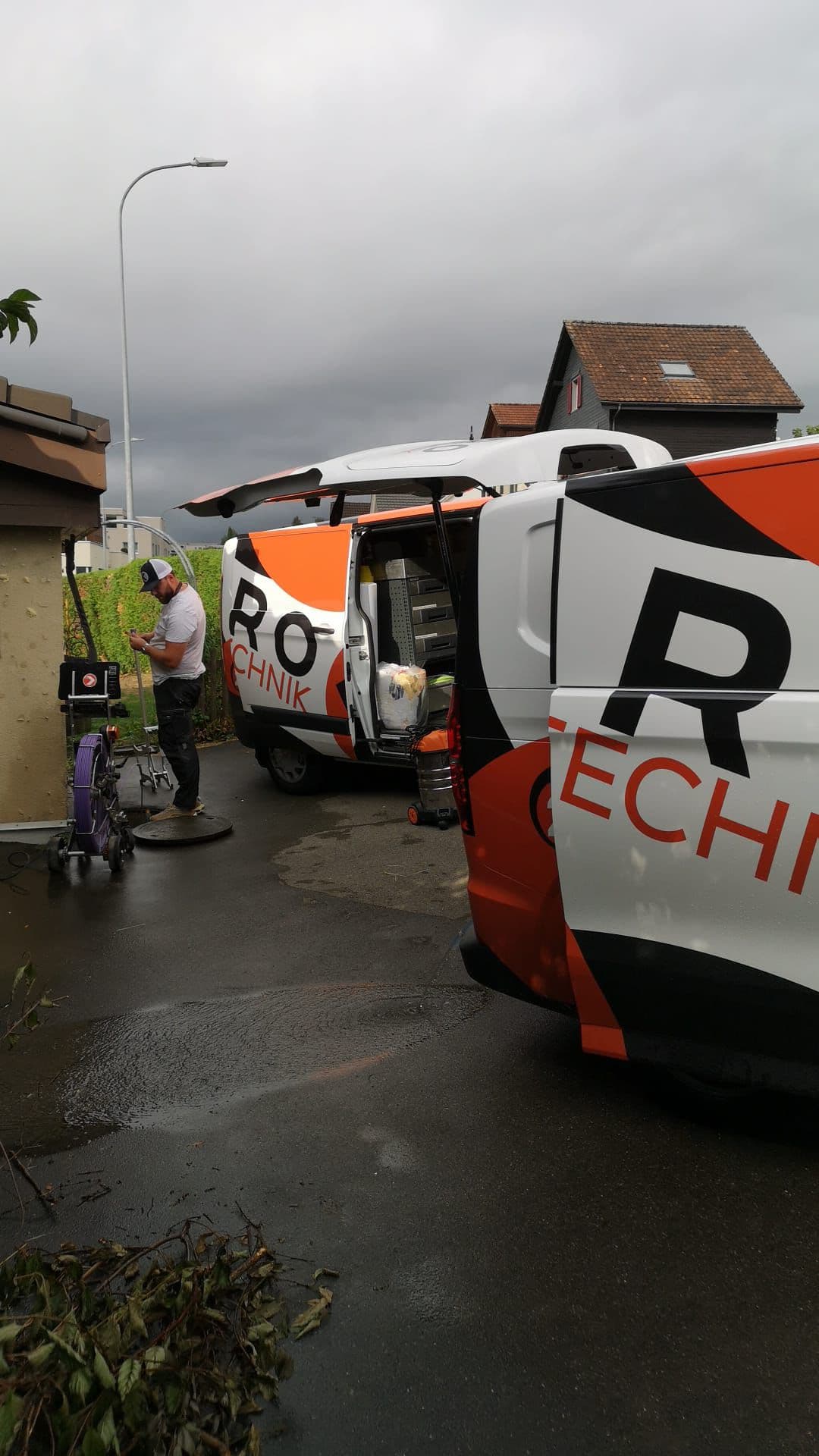
Karo Kanaltechnik cleans rainwater pipes with chemical-free high-pressure water jetting at up to 200 bar. The nozzle loosens sand, sludge and deposits and flushes them to the next manhole, where they are vacuumed out. Silt traps and gully pots are emptied and roots removed mechanically if necessary. A CCTV drain survey then shows whether the pipe is clear and intact; the findings are documented in accordance with SN EN 13508-2.
Work is charged by time: CHF 160 per working hour and a CHF 60 call-out fee, plus a surcharge from CHF 50 for the CCTV drain survey, all prices excl. VAT. One hour on site including call-out therefore costs CHF 220 excl. VAT or CHF 237.82 incl. 8.1% VAT. A typical job at a single-family home usually comes to around CHF 150 to 400; this is a guide figure, and the exact effort depends on pipe length, degree of soiling and accessibility.
An inspection at least once a year makes sense, ideally after leaf fall in autumn or before the wet season. Having the silt trap, pipe and infiltration system checked in one appointment saves call-outs and reveals weak points before the next thunderstorm exposes them.
Avoiding misconnections
In a separate system it is crucial that foul water does not get into the rainwater pipe – and vice versa. A wrongly connected WC or washing machine on the rainwater sewer pollutes a watercourse directly. A roof connected to the foul water pipe, on the other hand, places an unnecessary load on the treatment plant.
Such misconnections often arise during conversions. A camera survey, dye tests or a smoke test can establish which pipe leads where. Many municipalities check connections as part of the GEP and require owners to correct misconnections.
Owners’ obligations
The private rainwater pipes on the plot, together with silt traps, inspection chambers, infiltration and retention systems, generally belong to the owner, who is responsible for their operation and maintenance. This includes cleaning, repairing damage and correcting misconnections, as well as providing evidence to the municipality if it requires an inspection.
Exactly where the private pipe ends and the public one begins is set out in the municipality’s drainage regulations. Changes to the drainage, such as a new connection, an additional sealed surface or a new infiltration system, generally require a permit. An up-to-date CCTV recording and a current drainage plan make such applications easier and are also in demand when the property is sold.
A municipality in the Zurich Oberland asked an owner in Hinwil to have the drainage of his house checked because foam had been found in the stream below the property. Karo surveyed the pipes with a camera and carried out a dye test. Result: the drain of a laundry room added later had been connected to the rainwater pipe instead of the foul water pipe. After the plumber rerouted the connection, a second camera survey confirmed correct separation.