
What does displaced joint mean?
Wastewater pipes consist of individual pipe lengths connected by sockets: the spigot end of one pipe sits in the widened end of the next, sealed by a sealing ring or, in old pipes, by mortar or tarred hemp. As long as the pipes lie exactly on one axis, the transition is smooth and watertight.
If one of the pipes shifts sideways, upwards or downwards, this is called a displaced joint or pipe offset. It can amount to just a few millimetres and be harmless, or become so large that a clear step forms in the pipe invert. In damage coding according to SN EN 13508-2, the offset is recorded as a separate type of defect, stating its size.
Causes of displaced joints
The most common cause is ground movement. Settlement after construction, poorly compacted pipe trenches, changing groundwater levels or slope movements shift the pipes over the years. Traffic loads and vibrations from nearby construction work can also play a role.
Then there are installation errors: inadequate pipe bedding, spigot ends not pushed in far enough or missing sealing rings. In very old pipes with rigid mortar joints, the seal cracks with the slightest movement. And, not least, roots that have grown in push the joint further and further apart over time.
What are the consequences of a displaced joint?
The step in the pipe invert slows the wastewater down. Solids, paper and grease get caught and form a plug over time. Recurring blockages at the same spot are therefore a typical sign of an offset. At the same time, the joint is usually no longer watertight.
Wastewater escapes into the ground through the gap – endangering soil and groundwater, which is exactly what the Water Protection Act aims to prevent. Conversely, when groundwater is high, infiltration water enters the sewer, and moisture-seeking roots find their way into the pipe. If nothing is done, the bedding can be washed out and the pipe may later break.
How a displaced joint is detected
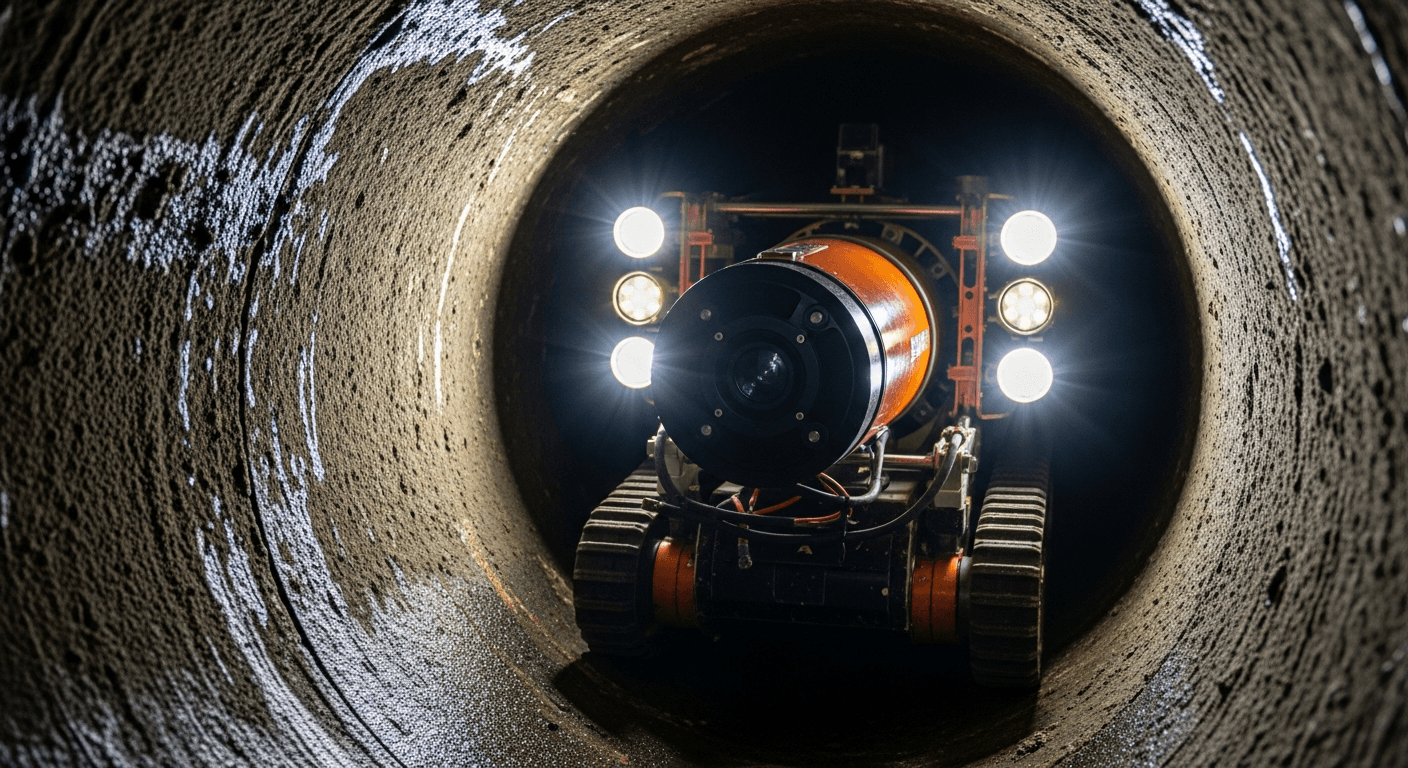
A displaced joint cannot be seen from the outside. It is discovered during a CCTV drain survey: the camera shows the step at the joint, often together with deposits, roots or water entering through the gap. Modern cameras with a pan-and-tilt head make it possible to examine the gap closely and record its position to the metre.
In the report, the defect is coded and assessed. According to the VSA guideline ‘Maintenance of sewer systems’, it feeds into the condition grade of the pipe run, which indicates how urgently action is needed. A leak-tightness test can additionally clarify whether the pipe is leaking.
Rehabilitation: patch liner, CIPP liner or replacement
Small to medium offsets can be repaired trenchlessly. A patch liner, also known as a Pointliner, is brought to the defect on a packer, pressed against the pipe wall and cures there. It bridges the gap and seals the joint permanently. Beforehand, deposits and roots are removed and protruding edges smoothed with a robotic cutter if necessary.
If a pipe has many offsets, a continuous CIPP liner is often more economical. Only if the offset is so large that the cross-section is severely restricted, or if the gradient is no longer correct, does the pipe have to be replaced using open-cut construction.
In a housing estate in Wettingen, the underground drain regularly blocked about eight metres downstream of the inspection chamber. The camera survey showed a clear displaced joint there with roots in the gap – probably the result of settlement in the pipe trench. The team removed the roots with the robotic cutter, smoothed the edge and installed a patch liner. Since then the wastewater has flowed freely, and the subsequent leak-tightness test confirmed that the joint is watertight.