
What is root ingress?
Plant roots seek water and nutrients. A wastewater pipe offers both in abundance: moisture, warmth and organic matter. Even a tiny gap at a joint through which water vapour or moisture escapes attracts fine root tips. They grow through the opening into the pipe and branch out there in the flowing wastewater.
Over time, a dense root mass forms that partly or completely fills the cross-section. In a CCTV drain survey it can be seen as a beard-like tangle at the joint. In damage coding according to SN EN 13508-2, root ingress is recorded as an obstruction, stating its extent.
How do roots get into the pipe?
Roots do not make the hole themselves; they exploit existing weak points. Typical examples are old cement or vitrified clay pipes with mortar or tarred-hemp joints whose seals have become brittle. Displaced joints, fine cracks, poorly integrated connections and rodding eyes with leaking covers are also entry points.
Pipes near trees and hedges are particularly affected, for example poplars, willows, birches or thuja hedges, but also shrubs with shallow roots. Drainage pipes with their slots are naturally vulnerable. Once inside the pipe, the roots keep growing and push the joint further apart.
Consequences of roots in the pipe
The first consequence is usually a creeping blockage: paper and solids get caught in the root mass and the flow slows down until water backs up in the basement. Because the roots grow back, the problem often returns within months after simple cleaning.
The structural damage is more serious. Thicker roots widen joints, burst pipes and destroy the bedding. Wastewater escapes from the pipe into the ground, and conversely soil and groundwater get into the pipe. If root ingress goes untreated for a long time, the pipe is often so badly damaged in the end that it needs costly rehabilitation.
Removing roots: cutting and jetting
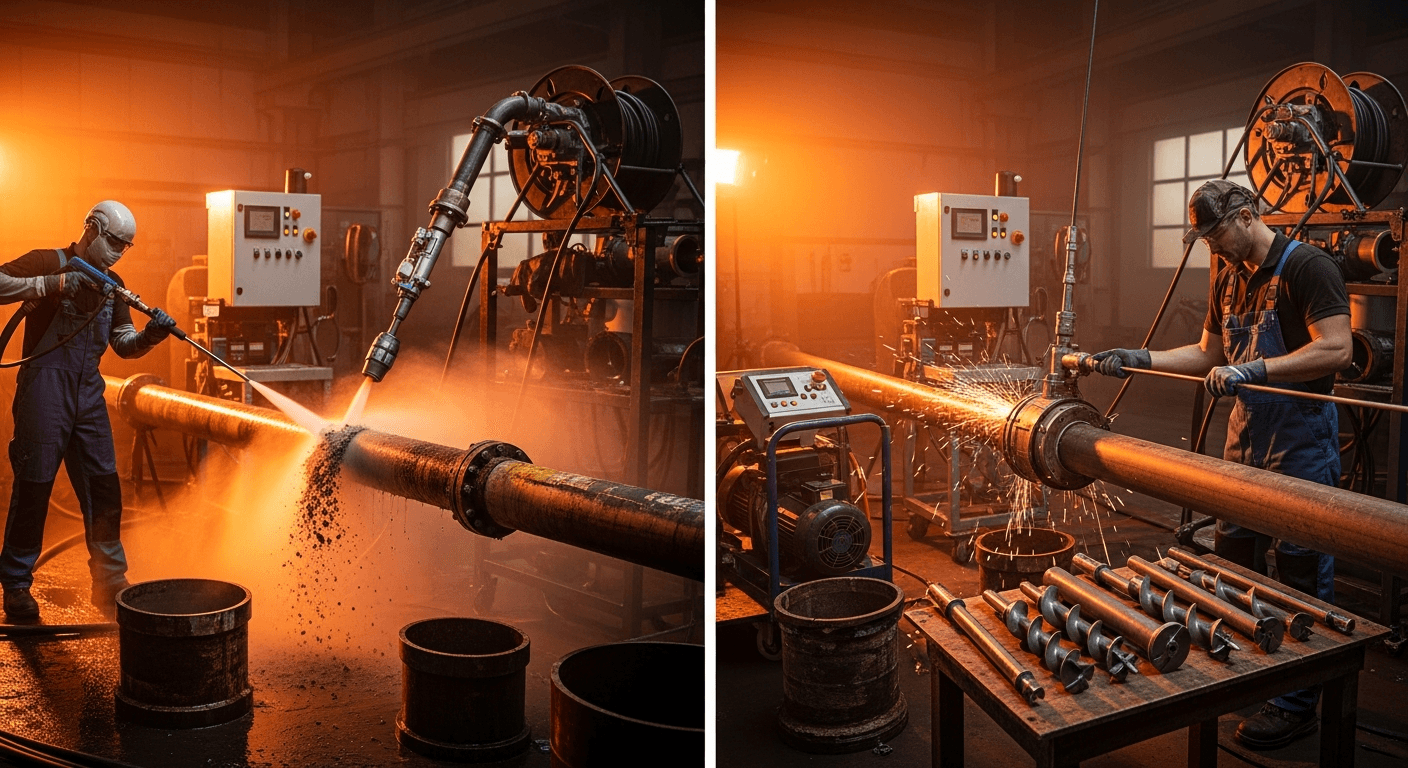
Fine roots can be removed with high-pressure water jetting and a suitable nozzle. Dense and woody root masses are removed by a robotic cutter or a cutting tool on a drain snake, which cuts the roots flush with the pipe wall without damaging the pipe. The work is monitored by camera.
Chemical root removers from the shops are not a good solution: they work unreliably, pollute the wastewater and do not remove the cause. After cutting, it is important to check by camera where the roots have entered and how badly the pipes are damaged.
The lasting solution: sealing the entry points
Anyone who only cuts the roots will see them again. The only lasting fix is to close the entry points. Individual leaking joints are sealed with a patch liner; where there are many defects, a continuous CIPP liner rehabilitates the entire pipe run. Both methods form a seamless inner skin through which roots can no longer grow.
When planting new trees, it is worth allowing enough distance between trees and pipes or using root barriers. Properties with many trees benefit from regular inspections so that new ingress is detected early.
At a single-family home in Muri bei Bern, wastewater backed up in the basement drain every few months. Several rounds of jetting only helped briefly each time. The camera survey showed four joints with dense root ingress in the underground drain running along an old thuja hedge. The team cut out the roots with the robotic cutter and then rehabilitated the 14-metre pipe run with a CIPP liner. Since then the pipe has been clear, and the roots no longer have a way into the pipe.