
The CCTV drain survey is the most important diagnostic tool in modern drain technology. Using special crawler cameras, we can assess the condition of your pipes from the inside — without turning a single spadeful of earth. This guide shows the process step by step: what happens on site, how the camera footage becomes a standards-compliant report, how long the appointment takes, what it costs and in which cases municipalities require a survey.
If you first just want to know what the terms mean: CCTV drain survey, sewer CCTV and camera inspection all refer to the same method. We describe the service itself, with prices and a worked example, on the page CCTV drain survey.
What is a CCTV drain survey?
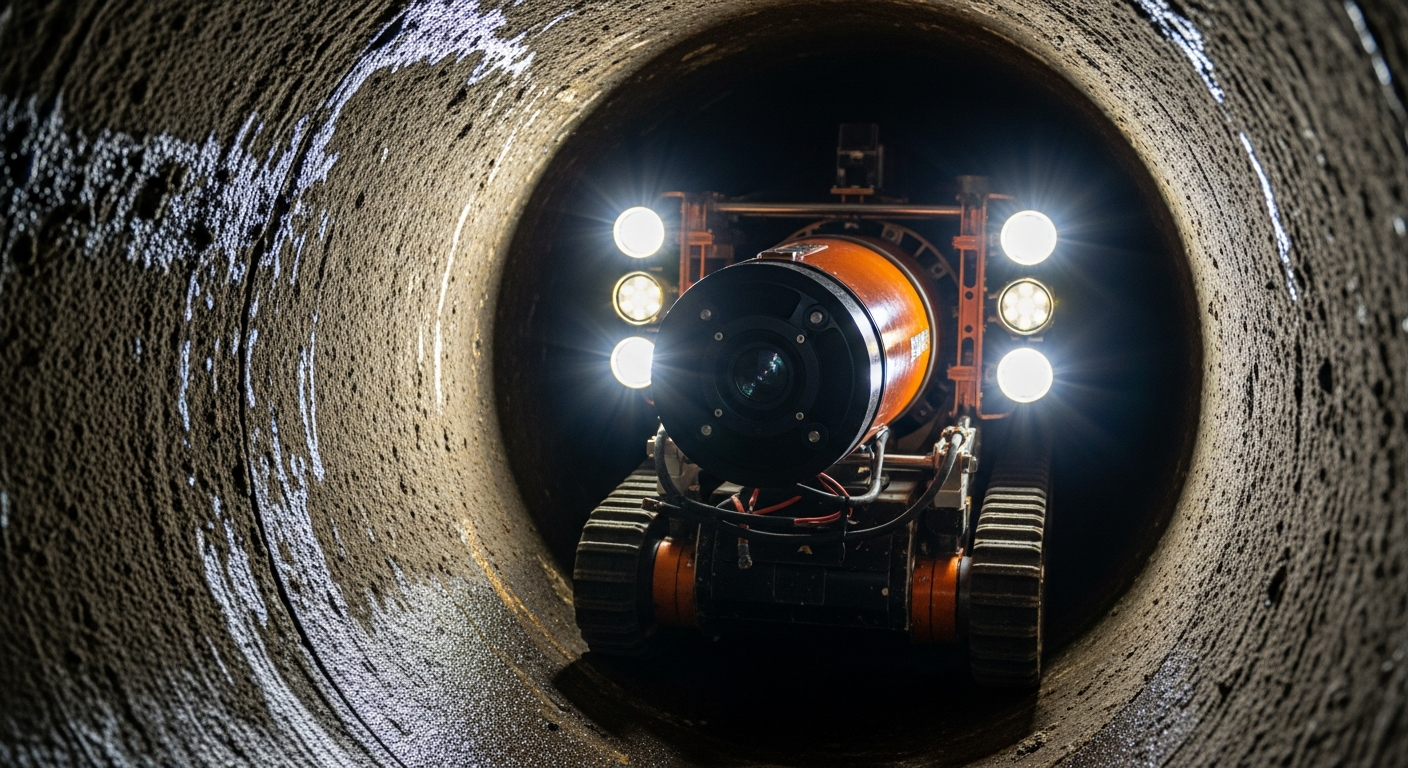
In a CCTV drain survey, a high-resolution camera mounted on a self-propelled crawler is inserted into the drain. The camera transmits live images to a monitor so that the technician can assess the condition of the pipe in real time. Modern systems feature 3D GPS locating, which allows the exact position of defects to be determined.
Which camera system is used depends on the pipe diameter. In narrow household pipes, a drain camera on a push rod is fed in by hand; in underground drains and collector pipes, a remote-controlled camera crawler with a pan-and-tilt head is used, which can also show branches and joints from the side. Karo Kanaltechnik inspects pipes from DN 50 upwards.
What is checked?
The survey systematically records: cracks and fractures in the pipe wall, displaced joints and leaking connections, root ingress, deposits and blockages, corrosion damage, deviations in alignment and settlement, as well as the general state of wear of the pipe material.
Many of these findings have their own cause and their own solution. A displaced joint occurs when two pipe sections shift against each other, often due to ground settlement. Roots grow into the pipe through the open gap; root ingress is therefore often the cause of recurring blockages. Longitudinal cracks from which pieces break out are known as fragmentation; hard limescale and grease crusts on the pipe wall are called encrustation. When groundwater enters through a leak, this is referred to as infiltration water.
- Structural defects: longitudinal and circumferential cracks, fragmentation, fractures, deformation and corrosion of the pipe wall.
- Leaking connections: displaced joints, open gaps, dislodged sealing rings and defective connections.
- Operational defects: root ingress, deposits on the pipe invert, grease and limescale crusts, foreign objects.
- Alignment and gradient: sagging pipe sections, reverse gradients and spots where water stands.
- Infiltration water: groundwater entering the pipe, which indicates a leak.
- Inventory: position of branches, bends and connections, pipe material and nominal diameter.
How a survey works
The process is divided into four steps: first, the pipe is pre-flushed at high pressure to ensure a clear view. The camera is then inserted and the pipe is surveyed systematically. During the run, the technician documents every anomaly with still images and GPS coordinates. Finally, you receive a detailed condition report with an assessment to SN EN 13508-2.
Looked at more closely, these four steps contain six work stages. It is above all the locating, the coding of the defects and the final recommendation that make the difference between a video and a basis on which you can make decisions:
The CCTV drain survey in 6 steps
Step 1: 1. Open the access point and flush the pipe
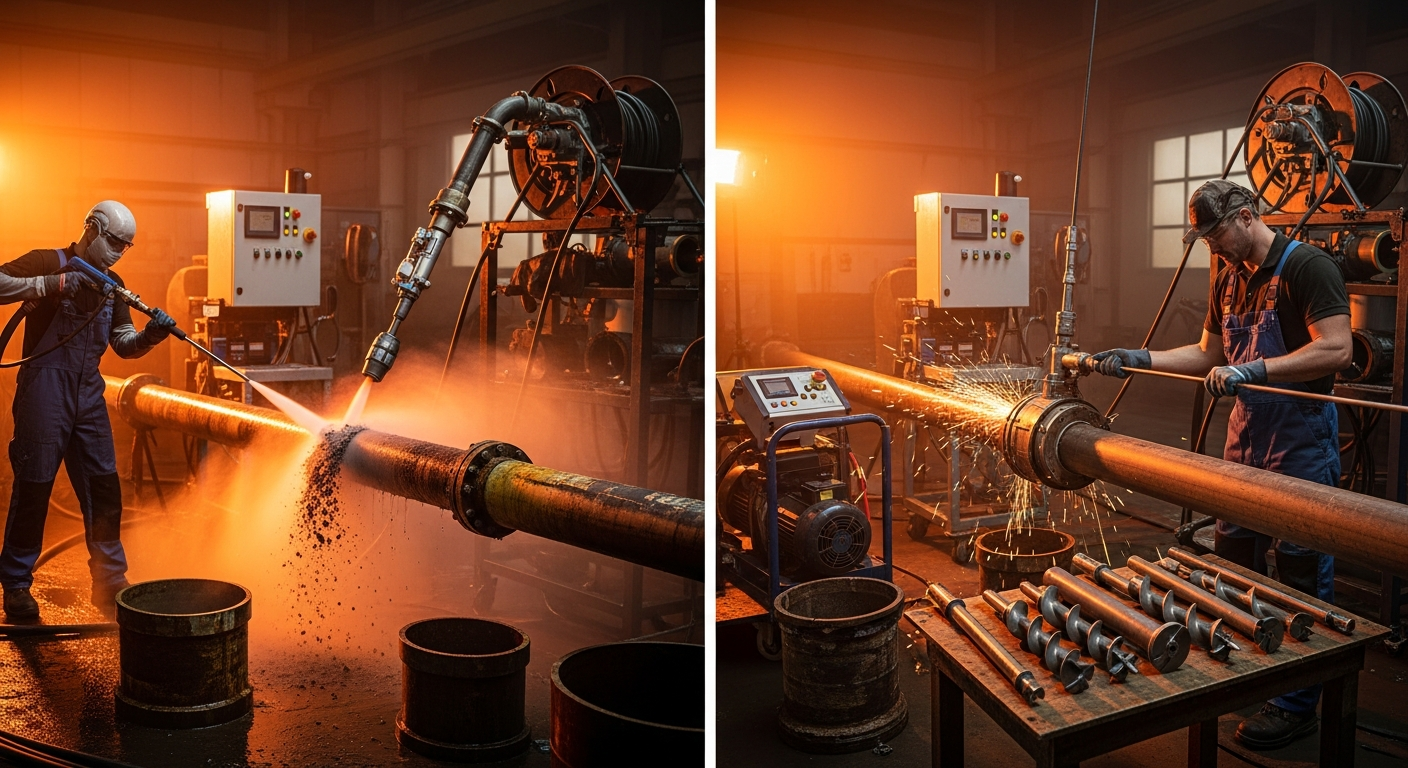
The technician opens the access point, usually an inspection chamber, a rodding eye or a floor drain. If the pipe is dirty, it is flushed beforehand at high pressure, at Karo without chemicals and at up to 200 bar. Only a clean pipe wall reveals cracks and displacements; deposits would hide defects.
Step 2: 2. Insert the camera and run it through the pipe
Depending on the diameter, a push-rod camera is fed in or a camera crawler is used. The camera travels slowly and steadily through the pipe run, i.e. the section between two manholes or openings. A counter continuously measures the distance from the starting point, and the image appears live on the monitor.
Step 3: 3. Locate defects
Every anomaly is recorded with its metre mark. A transmitter in the camera head also allows the spot to be located from above, with depth and GPS coordinates on request. This makes it clear later on which paving slab, flower bed or driveway the defect lies under.
Step 4: 4. Code the findings to SN EN 13508-2
Each observation is given a standardised code, for example BAB for a crack, BAJ for a displaced joint or BBA for roots, together with its severity, position on the pipe circumference and location. This means every specialist firm describes the same defect in the same way, and the report remains readable for engineering consultancies and municipalities.
Step 5: 5. Produce a report with video and images
You receive the video recording of every pipe run surveyed, still images of the relevant defects and the observation log with codes and metre marks, digitally on a storage medium or as a download. The condition grade according to VSA is derived from the coded findings.
Step 6: 6. Derive a recommendation
Finally comes the question of what needs to be done: monitor, clean or rehabilitate, and in what order. The recommendation sets priorities and, where rehabilitation is needed, names the appropriate method. This makes it possible to compare rehabilitation quotes and plan budgets.
The pre-cleaning in step 1 is no minor matter. High-pressure water jetting removes grease, sand and root remnants that would otherwise obscure the image. If the survey follows on from drain cleaning, there is no second call-out; the camera check is then charged as a surcharge on the cleaning.
Where the pipe runs when no plans are available is shown by pipe locating: the transmitter in the camera head is tracked on the surface with a receiver. This is also the way to find a covered-over inspection chamber or a built-over rodding eye again.
From coding to condition grade
The standard SN EN 13508-2 only governs how a finding is described. It does not say how serious it is. In Switzerland, the assessment is regulated separately: according to the VSA guideline «Erhaltung von Kanalisationen» (maintenance of sewer systems), the coded defects of a pipe run are combined into one of the condition grades 0 to 4.
| Condition grade (VSA) | Meaning | Need for action |
|---|---|---|
| 0 | Pipe collapsed, collapse imminent or flow no longer guaranteed | immediate |
| 1 | Severe defects, such as large cracks with fragmentation or severe deformation | short term |
| 2 | Moderate defects | medium term |
| 3 | Minor defects | long term, as part of maintenance planning |
| 4 | No relevant defects | none |
Not every finding calls for immediate action. The value of the report lies precisely in distinguishing between monitoring, cleaning and rehabilitation. Light deposits are removed by cleaning; a single crack can be repaired locally; continuous defects along the whole pipe run usually point to trenchless drain rehabilitation with a liner. Anyone wanting the entire drainage network of a property or municipality assessed receives, with a condition assessment, a grading of all pipe runs with priorities.
What is in the survey report?
A report to SN EN 13508-2 essentially consists of two parts. The header contains the master data of each pipe run: location, start and end point, direction of survey, pipe material, profile, nominal diameter and date. This is followed by the observation log, in which every finding is listed with its position in metres, code and still image. A graphic representation of the pipe run shows all findings along the pipe at a glance.
- Video of every pipe run surveyed, handed over digitally
- Still images of the relevant defects with a short description
- Observation log with codes to SN EN 13508-2 and position in metres
- Classification of each pipe run into a VSA condition grade
- Route and depth of the pipe, as a site plan on request
- Recommendation on what to do first
The documents belong to you. You can pass them on to the property management, insurer, municipality or another specialist firm, for example to make rehabilitation quotes comparable. If the pipe is surveyed again years later, the codes can be compared spot by spot: you can see whether a crack has grown or whether roots have returned.
How long does a CCTV drain survey take?
For a normal house connection, the appointment usually takes one to two hours, including pre-cleaning and an initial assessment on site. It takes longer if several pipe branches are surveyed, the pipe is heavily soiled or an access point first has to be found and uncovered. The written report with coding follows after the appointment.
There is little for you to do: ensure access to the manhole or rodding eye, move vehicles out of the driveway and describe where and when problems occur. These details steer the camera specifically to the critical sections. During the survey, as little water as possible should flow in the building so that the image stays clear.
What does a CCTV drain survey cost?
The costs vary depending on the pipe length and accessibility. Billing is based on time and effort: working time, call-out and, following a cleaning, the surcharge for the camera check. For larger properties or municipal networks, billing is per linear metre. Important: investing in a survey can prevent costly consequential damage from undetected problems.
If we check a pipe with the camera following cleaning, this costs a surcharge from CHF 50. On top of this come working time at CHF 160 per hour and a CHF 60 call-out, all excl. VAT. One hour of cleaning with a camera check and call-out therefore gives a guide price of CHF 270.– excl. VAT, or CHF 291.87 incl. 8.1% VAT. The actual time and effort is billed. The guide CCTV drain survey costs explains all cost factors in detail.
| Item | Karo guide price (excl. VAT) |
|---|---|
| Camera check following a cleaning | Surcharge from CHF 50 |
| Working time | CHF 160 per hour |
| Call-out (one-off) | CHF 60 |
| Example: 1 hour of cleaning + camera check + call-out | CHF 270.– (CHF 291.87 incl. VAT) |
| Stand-alone survey with report, single-family home | based on time and effort, quote in advance |
| Larger properties, municipal networks | Quote by pipe runs and linear metres |
When is a survey worthwhile?
A CCTV drain survey is recommended before buying a property, for acceptance after new construction, in the case of recurring blockages, before planned rehabilitation work, and as part of regular maintenance every 5 to 10 years. The earlier a problem is detected, the cheaper and simpler it is to fix.
Warning signs that point to a defect in the pipe are a drain smell in the basement, gurgling drains, damp walls near pipes and sunken paving slabs above the pipe. If a blockage keeps coming back despite flushing, there is often a structural cause behind it. After rehabilitation, the final survey proves that the work has been carried out properly; whether a pipe is also watertight is shown by the leak-tightness test.
When do municipalities require a CCTV drain survey?
In Switzerland, owners are responsible for private wastewater pipes, in many municipalities including the house connection up to the public sewer. The legal basis is the Waters Protection Act; what this means in practice is described under maintenance obligation. When proof of condition is required is regulated by the canton and municipality, usually in the municipal drainage regulations; urban drainage is planned via the general drainage plan (GEP).
Typical occasions on which municipalities require a camera inspection of private pipes are:
- New construction, conversion or extension with a building permit, often as acceptance of the new pipes
- New connection or change to the connection to the public sewer
- Rehabilitation or renewal of the public sewer in your own street
- Inspection of property drainage as part of the GEP, for example when there is infiltration water in the network
- Specific suspicion of a leaking private pipe
Whether and at what intervals an inspection is mandatory differs from municipality to municipality. Your municipality's regulations are binding; if in doubt, the building department can provide information. Clarify in advance which documents are required: the norm is documentation coded to SN EN 13508-2 with a log; a video alone is usually not sufficient. For property managers and municipalities, we have summarised the requirements on the pages for property management companies and municipalities.
CCTV drain surveys at Karo Kanaltechnik
Before the survey, Karo Kanaltechnik cleans without chemicals using high pressure of up to 200 bar, inspects pipes from DN 50 upwards with a pan-and-tilt camera and 3D GPS locating, and documents every finding to SN EN 13508-2. You see the images directly on the monitor and receive an initial assessment while still on site. You can read more about the technology of the camera systems in the guide Camera inspection of drains; you can calculate a guide price online via our enquiry.