
What is a foul water pump?
A foul water pump is a centrifugal pump that can move water containing solid particles. In most cases it is a submersible pump: the housing with the electric motor stands directly in the water, the pump draws water in at the bottom through a base or a grille, and at the top a pressure outlet carries the water away through a hose or a fixed pipe. The surrounding water cools the motor in the process.
In everyday language, the term is often used interchangeably with «wastewater pump». Technically, the distinction is worth making: a foul water pump is intended for water that carries sand, soil, leaves or small stones, for example from a flooded basement, an excavation pit, a light well or a pump chamber for seepage water. Wastewater containing faeces, toilet paper and sanitary products is a different kind of load and belongs in a sewage pump or lifting station designed for it.
Foul water pumps come as mobile units that you carry down to the basement when needed, and as permanently installed pumps in a pump sump or chamber. Both work on the same principle; the difference is whether the pump waits for an emergency or automatically removes water day after day.
Foul water or clear water pump: the difference
Clear water pumps are built for clean or only slightly dirty water, such as rainwater from a cistern or water from a pool. Their impeller has narrow channels and works very efficiently, but can hardly cope with solids. If sand or sludge gets in, the impeller wears quickly or the pump becomes blocked.
Foul water pumps have a larger free passage. They are often fitted with an open impeller or a vortex impeller that sits recessed in the housing. The water is set into a swirling motion, and solids pass through the pump without coming into direct contact with the impeller. This costs some efficiency but makes the pump considerably more robust.
In practice this means: if you have to pump water containing soil and leaves out of the basement after a storm, you need a foul water pump. A clear water pump is the wrong choice for this, even if the water looks clean at first glance – sand almost always collects on the basement floor and is carried along during pumping.
Submersible pump, lifting station, compact lifting unit: types at a glance
The mobile foul water submersible pump is the best-known type. When needed, it is placed at the lowest point, connected via a hose to a drain or to the outside, and runs until the water has been pumped out. It is suitable for use after storms, after burst pipes or for emptying chambers and pits.
Permanently installed foul water pumps stand in a pump sump or chamber and drain, for example, a light well, a basement drainage system or a floor drain that lies lower than the underground drain. They work automatically via a float switch and need a permanently laid pressure pipe.
A lifting station goes one step further: it consists of a sealed, odour-tight collecting tank, one or more pumps, a control unit with alarm and a pressure pipe with a backflow loop. For wastewater containing faeces, lifting stations to the SN EN 12050 series of standards are intended. Compact lifting units sit directly behind a single WC or washbasin. The key difference from a simple foul water pump is therefore not the pump itself, but the closed system around it.
Particle size, flow rate and delivery head: what matters
The most important figure for a foul water pump is the maximum particle size, i.e. the largest diameter of a solid that the pump will still let through. Manufacturers state it in millimetres. If the particle size is too small for the job, stones or leaves lodge in the intake area, and the pump draws in air or runs hot.
The flow rate indicates how much water the pump can move per hour – but only at a low delivery head. The higher the water has to be pumped and the longer and narrower the hose, the less arrives at the end. The maximum delivery head on the rating plate is the point at which the pump just about builds up pressure but delivers practically nothing. What counts when choosing a pump is therefore the performance curve: how much does the pump deliver at the height that actually has to be overcome in your own basement?
Other points are the suction depth (how far the pump can lower the water level, important for shallow puddles), the housing material (plastic or stainless steel), the length of the power cable and whether the pump is designed for continuous operation. For larger quantities of sludge and sand, for example in a silted-up chamber, any handy pump reaches its limits; that is where a suction tanker is used.
Float switch and level control
For a pump to work automatically, it needs level control. The most widespread is the float switch: a float hangs on a cable or slides along a rod. When the water rises, the float lifts and switches the pump on; when the water level falls, it switches off again. Other models work with pressure sensors or electronic probes.
The float needs room to move. If it rests against the chamber wall, gets stuck in sludge or the cable becomes tangled, the pump stops – or it keeps running without water and overheats. Many faults that look like a pump defect are in reality a jammed float.
For permanently installed pumps, a separate high-water alarm is advisable, which reports independently of the pump when the water level in the chamber rises above the normal level. That way a failure is noticed before water enters the basement.
Use for water in the basement and flooding
After heavy rain, a burst pipe or during flooding, the foul water pump is the most important tool for drying out a basement. Before it is used, the rule is: switch off the power in affected rooms if water can reach sockets or appliances, and do not enter the basement as long as it is unclear whether cables are live.
The pump is placed at the lowest point, ideally on a firm base so that it does not suck in sludge directly. The water should be directed to where it will not flow back – not into a floor drain that is itself overflowing. During flooding it can also make sense to wait before pumping until the groundwater level falls: if a basement is pumped dry while the water outside is high, the groundwater presses on the walls and floor from outside.
If the water does not come from outside but from the floor drain or the toilet in the basement, it is usually backflow from the sewer or a blockage in the underground drain. In that case pumping only helps in the short term: as long as the pipe is blocked, water keeps flowing in. Here the cause in the pipe has to be dealt with, for example with high-pressure water jetting.
Limits of the foul water pump: when a lifting station is needed
A simple foul water pump is not a permanent substitute for properly planned drainage. As soon as toilets, showers, washing machines or kitchens below the backflow level are drained regularly, a lifting station with a sealed tank, a backflow loop and, depending on use, suitability for faecal matter is required. An open pump sump with a submersible pump would spread odours and offer no protection during a backflow.
The pipe layout is also decisive. The pressure pipe of a permanently installed pump should be routed above the backflow level before it joins the underground drain. If it is connected directly at the bottom, water from the sewer can be pushed back through the pump into the basement during a backflow. A backflow valve alone does not fully solve the problem, because it closes during a backflow and then no longer lets the pump's water drain away either.
Which solution is right for a particular building follows from the planning of the property drainage to SN 592 000 and the municipality's drainage regulations. For conversions in the basement, it is worth clarifying this question early with a sanitary planner rather than improvising with a pump afterwards.
Servicing and care
Permanently installed foul water pumps often run only rarely for months on end – and fail precisely when you need them. A simple check before the rainy season helps: open the chamber, lift the float and check whether the pump starts and the water actually drains away. This also shows whether the non-return valve in the pressure pipe is tight.
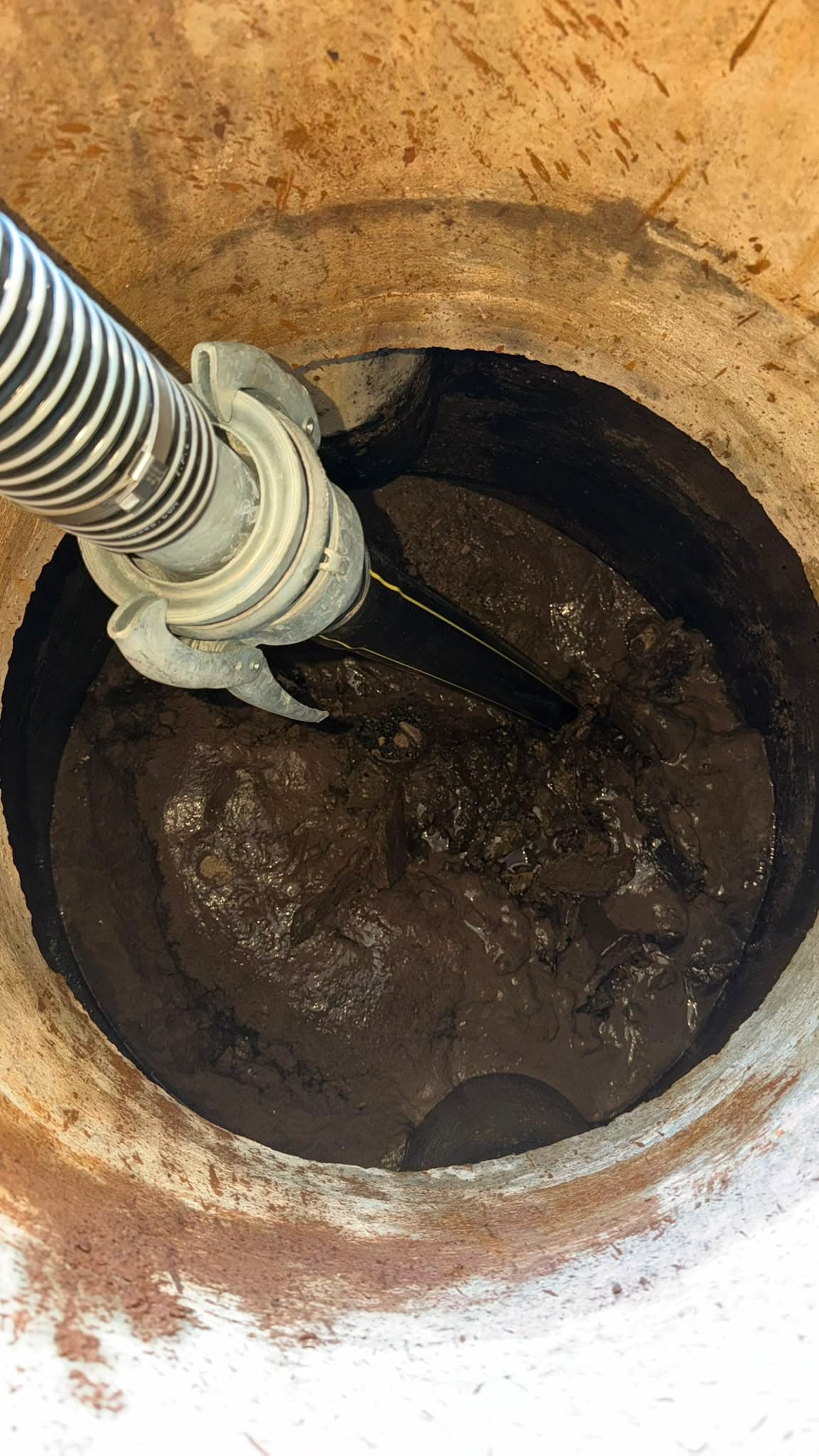
Over time, sand, sludge and leaves settle on the chamber floor. They block the intake grille, hamper the float and shorten the service life of the impeller. A silted-up pump chamber should therefore be sucked out and cleaned regularly; at the same time the inflows, for example from drainage or light wells, can be flushed. For mobile pumps, it is enough to rinse them through with clean water after each use and store them dry.
Stricter servicing recommendations apply to lifting stations; the SN EN 12056 series of standards contains information on this, providing for shorter intervals in commercial use. Servicing the pump technology itself is a matter for the manufacturer or a plumber; cleaning the chamber and pipes is done by a drain cleaning company.
When the pump fails: backflow and emergencies
If a permanently installed pump fails, the water in the chamber rises until it enters the basement via floor drains or the manhole cover. This is particularly critical during heavy rain, when a lot of water is flowing in at the same time and the public sewer system is under pressure. Common causes are a jammed float, a blocked impeller, a tripped motor protection switch or a power cut.
In an emergency: do not let any more water in, i.e. do not use the washing machine and showers in the basement, check the pump's power supply and switch off the electricity if electrical appliances are at risk. A mobile foul water pump can lower the water level temporarily. If the water keeps rising nonetheless, or comes back up from floor drains and toilets, there is usually a blockage or backflow in the pipe that a specialist firm has to clear.
In such cases, Karo Kanaltechnik pumps out chambers, jets the inflow and outflow pipes at high pressure and, if necessary, inspects the pipe with the camera. Karo does not sell pumps itself; replacing or repairing the pump technology is a matter for a plumber or the manufacturer.
A typical case from the Zurich area: in a single-family home, a permanently installed foul water pump drains the light well and the basement drainage. After a thunderstorm there is suddenly water in the basement, even though the pump has power. When the pump chamber is opened, it turns out that sand and leaves have filled half the chamber and the float switch is stuck in the sludge. The water is first lowered with a mobile submersible pump, then the Karo team sucks the chamber empty, cleans it at high pressure and flushes the inflow pipe from the drainage. Afterwards the pump switches reliably again. To stop this happening again, it is advisable to check the chamber before every autumn.