
What is drainage?
Drainage means removing water from the ground. Around a house, it refers to a network of perforated or slotted pipes laid at the foot of the basement walls. Rain soaks into the ground, hillside water flows in from the side, and in clayey or dense soils this water builds up against the basement wall. The drainage takes it up before it can build up pressure and carries it away in a controlled manner.
It is important to distinguish it from waterproofing: waterproofing on the basement wall prevents water from penetrating the masonry. Drainage ensures that not much water stands in front of the wall in the first place. The two work together. If the drainage fails, the waterproofing suddenly has to withstand water pressure that it is often not designed for – the result is damp walls, efflorescence and, in the worst case, water in the basement.
Drainage is not a wastewater pipe in the true sense. It does not carry foul water from the kitchen, bathroom or toilet, only water from the ground. Nevertheless, it is part of the property drainage and, like any pipe, needs maintenance: its holes and slots take in not only water but, over time, fine soil as well.
How house drainage is built
The most common form on a single-family home is the perimeter drain. Here the drainage pipe runs all the way around the building, at the level of the foundations and with a slight gradient towards the outlet. This allows it to capture water from all sides. For houses on a slope, drainage on the uphill side, where the hillside water arrives, is sometimes enough; area drainage under the floor slab is found mainly in new buildings with high water inflow.
Around the pipe is a filter pack of washed gravel. It directs the water to the pipe and holds back coarser soil particles. A filter fleece (geotextile) separates the gravel from the surrounding soil so that fine particles are not washed into the pack. In front of the basement wall there is often also a drainage layer, such as a dimpled membrane or drainage boards, through which the water travels vertically down to the pipe.
Inspection or flushing chambers are located at the corners of the building and at changes of direction. They are the access points through which the drainage can later be reached with the jetting hose and the camera. At the lowest point, a drainage chamber collects the water and passes it on to the outlet pipe. Without such chambers, drainage can only be cleaned and checked to a very limited extent.
Drainage pipe and drainage chamber
The drainage pipe is usually a plastic pipe made of PVC or PE, often corrugated and frequently coloured yellow. Slots distributed around the circumference let the water in. Some pipes are additionally wrapped in coconut fibre or fleece, which act as a filter. Older drainage systems also consist of clay or concrete pipes with open butt joints through which the water enters.
Because the pipes are perforated and often corrugated, they are more delicate than smooth wastewater pipes. The pressure therefore has to be adjusted during cleaning; a full-power jet could damage corrugated pipes or wash out the gravel pack through the slots.
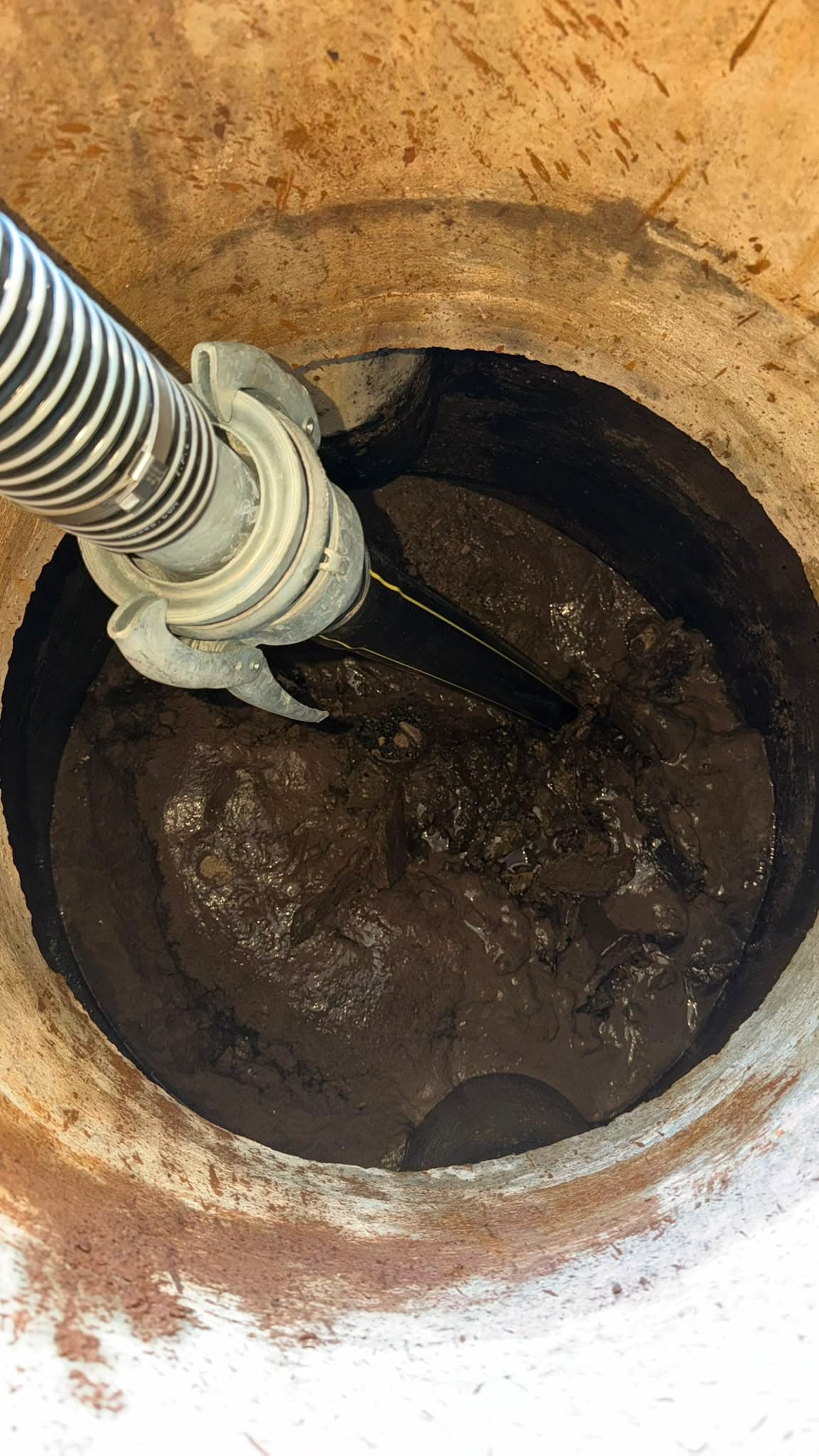
The drainage chamber – often also called an inspection, flushing or collection chamber – is a vertical chamber made of concrete or plastic rings. It usually has a recessed base in which sand and sludge are meant to settle before the water flows on. This sump must be sucked out regularly; if it is full, the sludge gets into the outlet pipe. If the drainage lies lower than the pipe into which it is meant to discharge, a pump chamber is needed to lift the water.
Where does the drainage water go?
Drainage water is clean water from the ground. Swiss water protection law requires unpolluted wastewater to be allowed to soak away wherever possible. Where the soil allows, the drainage therefore leads the water into an infiltration system, for example a soakaway chamber or a land drain, which returns it to the subsoil.
Where infiltration is not possible, for instance with dense soils or high groundwater, the water is discharged into the rainwater pipe. In a separate system, it then flows into a watercourse together with the rainwater from the roof. In a combined system, it ends up in the sewer system and, as so-called infiltration water, puts a load on the wastewater treatment plant, even though it does not need treating at all. Many municipalities therefore no longer permit new drainage connections to the foul or combined sewer; what applies in each individual case is set out in the municipality's drainage regulations.
One point that is often overlooked: if the drainage is connected to a pipe that surcharges during heavy rain, water can flow backwards into the drainage. Instead of relieving the foundations, the drainage then brings water to the house. Backflow protection or a pump with a non-return valve prevents this.
How to recognise blocked drainage
Drainage rarely fails suddenly, but gradually. Typical signs are damp patches at the bottom of the outer basement wall, white salt efflorescence, flaking paint, a musty smell and water that pushes into the basement at the foot of the wall or through floor joints after heavy rain. Outside, the problem shows up as waterlogging in front of the house or as puddles that remain for days.
A good test is to look into the drainage chambers after rain: if the water in the chamber stands higher than the pipe outlet, it is not draining away. If the chamber is dry even though it has rained heavily, perhaps no water is arriving any more because the pipes upstream are choked. A rust-brown, slimy coating in the chamber indicates ochre build-up.
The causes are usually the same: fine sand and sludge are washed in with the water and settle in the pipes and in the chamber. In iron-rich soils, iron ochre precipitates – a rust-brown mass that clogs up the slots and pipe cross-section. Tree roots grow in through the openings, and leaves and dirt get caught at corners or corrugations. A CCTV drain survey provides certainty: the camera shows whether the pipe is silted up, affected by ochre, root-infested or broken.
How often drainage should be jetted
There is no fixed interval for all houses; it depends on the soil, the terrain and the age of the installation. In iron-rich soils prone to ochre, a check every one to two years makes sense. With sandy or clayey soils without ochre, a longer interval is often sufficient if the chambers are checked in between. The findings of the first CCTV drain survey are the most reliable guide to the right rhythm.
During jetting, the pipe is cleaned with water section by section from the chambers. Karo works chemical-free with high pressure of up to 200 bar; with drainage pipes, the pressure is deliberately reduced and a suitable nozzle is chosen so that sludge and ochre are loosened without damaging the pipe. Whatever has been loosened is flushed back to the chamber and sucked out. The camera then shows whether the pipe is clear; documentation follows SN EN 13508-2.
A check also makes sense whenever something has changed: after building work in the garden, after planting large trees close to the house, after a storm with water in the basement or when buying an older property.
Costs
The cost of jetting drainage depends mainly on the length of the pipe, the number and accessibility of the chambers and the degree of contamination. Heavy ochre build-up needs more passes than light silting. Karo charges by time and effort: CHF 160 per hour plus CHF 60 call-out fee, excl. VAT. One hour including call-out therefore costs CHF 220 excl. or CHF 237.82 incl. 8.1% VAT.
A surcharge from CHF 50 is added for the CCTV drain survey. It is almost always worthwhile, because it shows whether jetting is sufficient or whether a pipe is broken or root-infested. If the location of the drainage chambers is unknown or they have been covered over, the job takes longer; an existing drainage plan for the property therefore saves time and money. For a quote, a short description of the situation helps, ideally with details of where the chambers are.
A typical case from our service area: a single-family home from the 1980s stands on a slope in the Zurich Oberland. After every prolonged rainfall, a damp band appears at the bottom of the uphill basement wall and the paint is flaking. In the drainage chamber at the corner of the house, the water stands above the pipe outlet, and there is rust-brown sludge at the bottom. The CCTV drain survey shows a perimeter drain heavily affected by ochre; the slots are blocked over long stretches, but no pipe is broken. The pipe is jetted from both chambers at reduced pressure, the sludge is sucked out of the chambers and the result is documented with a second survey. Because of the iron-rich soil, a check every one to two years is recommended.