
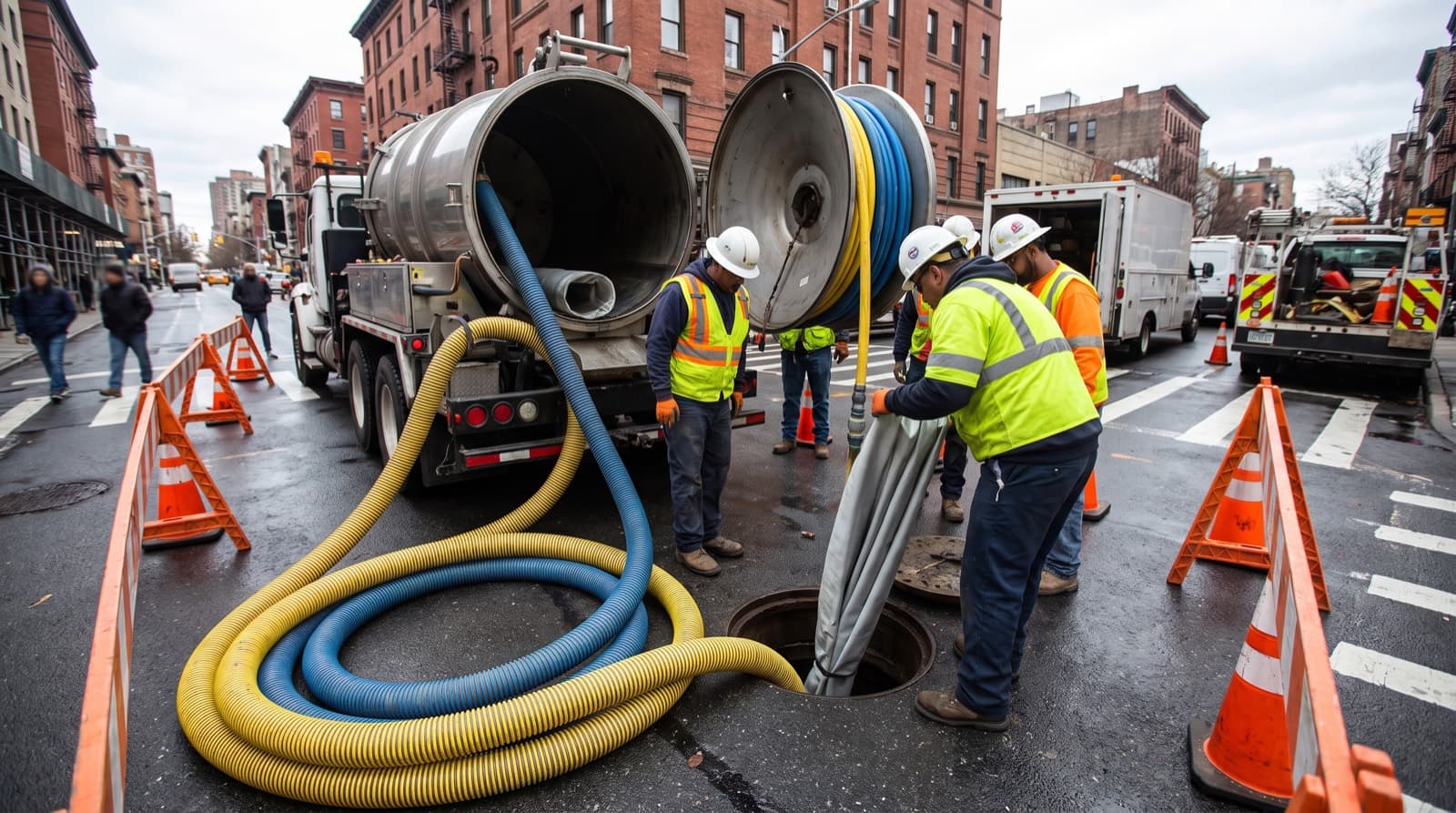
What is pipe bursting?
With pipe bursting, an old pipe is not repaired but replaced by a new pipe along the same route. Unlike a CIPP liner, which forms a new inner skin inside the old pipe, the old pipe is destroyed in the process. The method is therefore classed as a trenchless renewal method and not as a renovation method.
The name comes from the bursting of the old pipe. In German-speaking Switzerland it is known by a German term (Berstlining). It is used for wastewater pipes as well as for water and gas pipes.
How the method works
First, a launch pit and a reception pit are excavated; existing manholes can often be used. From the reception pit, a pulling line, such as a rod string or cable, is pushed through the old pipe to the launch pit. There the bursting head is attached, with the new pipe fixed to it.
A pulling machine draws the bursting head through the old pipe. Blades or rollers on the head break the pipe open, and an expander cone pushes the fragments outwards into the soil, creating space for the new pipe, which is pulled in immediately behind. For brittle materials such as vitrified clay, concrete or fibre cement, static pulling is used; with some systems, impacts assist the advance. Finally, the house connections are reconnected and the pipe is tested for leak-tightness.
When is pipe bursting suitable?
Pipe bursting comes into its own when a pipe is too badly damaged for renovation: with fragmentation, severe deformation or many fractures. It is also a good choice when the cross-section has become too small, for example because more wastewater is produced or the pipe no longer meets today’s requirements, because the new pipe can be larger than the old one.
Further advantages are the minimal disruption at the surface and the new pipe with few joints and full load-bearing capacity. Compared with an open trench, gardens, driveways, trees and roads are largely protected, and construction time is usually shorter.
Limitations of the method
Bursting displaces soil. If other utility lines, foundations or sensitive structures are very close, they can be damaged. Before work starts, all pipes in the vicinity must therefore be known, for example from the utility register and through pipe locating.
Things become difficult with many bends, strongly varying gradients and rocky ground. Because the new pipe follows the route of the old one, gradient errors cannot be corrected with it. In addition, each lateral connection needs a small pit to connect it to the new pipe. For pipes with a great many connections, a CIPP liner may therefore be more economical.
Pipe bursting, CIPP liner or open-cut construction?
Which method is right depends on the condition of the pipe, the diameter, the surroundings and the connections. If the pipe is still structurally sound enough and the cross-section is sufficient, a CIPP liner is usually the least disruptive solution. If it is too badly damaged or too small, pipe bursting is an option. Only if this is also ruled out, for example because of an incorrect gradient, does open-cut construction remain.
The basis for the decision is a CCTV drain survey with a condition assessment. Experienced specialists compare the methods and set out the pros and cons for the specific situation.
At a farmhouse in the Emmental, the old cement pipe between the house and the inspection chamber was broken along its entire length and also too small for the planned extension with two additional flats. A CIPP liner would have reduced the cross-section further. Instead, the pipe was renewed by pipe bursting: from a small pit by the house, the machine pulled a larger polyethylene pipe into the old route. The orchard above the pipe was left untouched.