
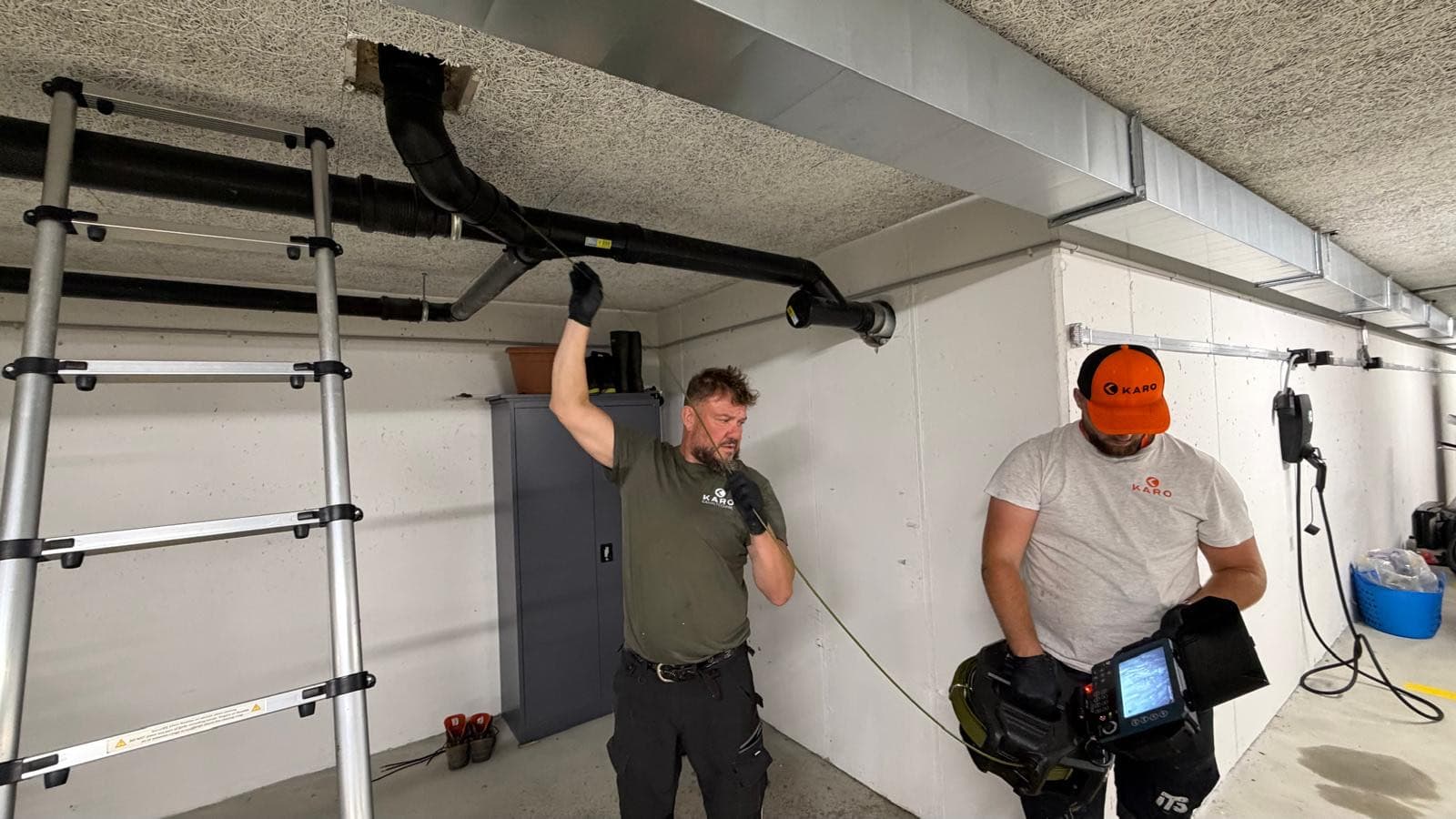
What is a drain camera?
A drain camera is a camera system for the inside of pipes. A small, pressure-tight camera head with its own LED lighting is inserted into the pipe and transmits the picture via a cable in real time to a monitor outside the pipe. A distance counter continuously measures how far into the pipe the camera has already gone. This means you know where every finding is located and can later clean, locate or repair the spot precisely.
In everyday language, several terms are used side by side. «Drain camera» and «inspection camera» refer to the device, «sewer inspection camera» mostly to the larger systems for underground drains and sewers. The procedure in which a pipe is systematically surveyed with such a camera and documented is called a camera inspection or CCTV drain survey. The drain camera is therefore the tool, and the camera inspection the work done with it.
A professional device has only the basic principle in common with an endoscope camera from an electronics shop. The difference lies in the image quality, the light output, the length and stiffness of the push rod, the tightness of the head, the locating function and, above all, the recording, which is what makes a standard-compliant evaluation possible in the first place.
Types: push-rod camera, crawler and satellite camera
Which drain camera is used is decided primarily by the pipe diameter, known as the nominal diameter. Other factors are the length of the run, the number of bends and the question of which opening you use to get into the pipe: a drain in the building, a cleaning access or an inspection chamber.
The push-rod camera is the device for small and medium-sized domestic pipes. The camera head sits on a flexible but pressure-resistant push rod wound onto a reel. The technician pushes the camera through the pipe by hand, including through bends and branches. Karo Kanaltechnik uses push-rod cameras for pipes from DN 50, i.e. from an internal diameter of 50 millimetres. This makes it possible to survey kitchen and bathroom pipes, soil stacks and underground drains in the house.
The crawler, often also called a camera tractor or sewer robot, is built for larger diameters. The camera sits on a remote-controlled wheeled chassis that travels through the sewer by itself, pulling a cable from a cable reel behind it. Crawlers are used in underground drains, collector pipes and public sewers, where a push-rod camera reaches its limits because of the length or friction.
The satellite camera is a combination of the two: a crawler travels along the main sewer to the junction of a house connection and from there pushes a smaller camera into the side pipe. This allows a connection to be checked from the public sewer without having to enter the property. For homeowners, this is of interest above all when the municipality surveys its sewers and examines private connections at the same time.
Camera head: fixed head, pan-and-tilt head and lighting
Simple drain cameras have a fixed head: the camera always looks straight ahead in the direction of travel. That is enough to find a blockage or to see whether a pipe is clear. It is often not enough for a precise assessment, because a crack in the pipe wall or a poorly integrated connection can only be seen at an angle and distorted from the front.
A pan-and-tilt head can be rotated and tilted by the operator. This allows the camera to look directly at the pipe wall at a suspicious point, into a branch or all the way round the circumference. Karo Kanaltechnik works with high-resolution pan-and-tilt cameras with a 360° view, so that damage such as cracks, displaced joints or root ingress is not only detected but can also be assessed properly.
Just as important as the optics is the light. Inside the pipe it is completely dark, wet walls reflect, and steam or spray cloud the picture. Good cameras have adjustable LED lighting and image self-levelling that keeps the picture horizontal even when the cable twists in the pipe. This makes the recordings readable and comparable.
Locating: sonde in the camera head and 3D GPS
A picture from inside the pipe is only worth half as much if you do not know where the spot is on the ground. Many drain cameras therefore have a transmitter, known as a sonde, in the camera head. On the surface, a receiver picks up the signal and shows where the head is at that moment and how deep it is. The spot is marked on the ground. This procedure is called pipe locating and is the prerequisite for any targeted repair.
For CCTV drain surveys, Karo Kanaltechnik also works with 3D GPS locating. This records the position and depth of the pipe. Damage such as cracks, displaced joints, root ingress or corrosion can thus be located precisely, even under buildings and paved areas. This is particularly valuable when there are no up-to-date plans of the property drainage or the pipe runs differently from what is drawn.
The practical benefit: instead of breaking up an entire forecourt, you know to the metre where a defect is. Depending on the damage, it can then be fixed trenchlessly, for example with a patch liner. Where digging is necessary after all, the excavation stays small.
Recording and evaluation according to SN EN 13508-2
Initially, a drain camera only shows a live picture. For this to become a reliable finding, the survey has to be recorded and evaluated. Professional systems save the video together with the distance reading and make it possible to capture a still image with a description at every anomaly.
In Switzerland, the findings are not written up freely but recorded according to the standardised coding system of SN EN 13508-2. Every crack, every displacement and every connection is given a code with its position in the pipe and its severity. On this basis, the damage is classified into condition grades, which show how urgent a measure is. Only this coding makes recordings comparable over years and between different companies.
Karo Kanaltechnik documents CCTV drain surveys in compliance with SN EN 13508-2. The client receives the video data digitally on a USB stick or as a download, together with a report containing still images of the relevant defects, the damage classification and a recommendation for action. These documents serve as the basis for rehabilitation decisions, for the municipality or for negotiations when buying a property.
Hiring or buying a drain camera: what a hire unit can do
Simple pipe and inspection cameras can be hired by the day from DIY stores and hire shops or bought for personal use. For DIY enthusiasts they are a useful aid: you can see whether a drain is blocked behind the trap, whether an object is lying in the pipe or whether roots have grown into a garden pipe. A live picture is often enough for these questions.
The limits soon become apparent. Hire units usually have a fixed head and a short, rather thin cable that gets stuck in bends and longer underground drains. There is often no locating sonde, so you know that there is damage but not where it is in the ground. If the pipe is full of water or the wall is coated with grease and deposits, you will see little without cleaning first.
Above all, however, a hire unit does not provide standard-compliant documentation. There is no coding according to SN EN 13508-2 and no condition grades, and such recordings are generally not sufficient as evidence for the municipality, an insurer or a buyer. If you only want to know why the washbasin will not drain, a hired camera will get you further. If you have to make a rehabilitation decision, report damage to an insurer or meet a requirement imposed by the municipality, you need a professional inspection.
When a professional inspection is worthwhile
A professional survey with a pan-and-tilt head, locating and a report is worthwhile for recurring blockages, for odours or damp with no apparent cause, before buying or selling a property, before conversions and as acceptance after rehabilitation. A standard-compliant survey is also required when the municipality demands a condition check as part of drainage planning.
At Karo Kanaltechnik, the camera is often used directly after cleaning: first the pipe is cleared with a drain snake or chemical-free high-pressure water jetting at up to 200 bar, then the camera shows whether structural damage lies behind the blockage. The CCTV surcharge starts at CHF 50, the work is charged at CHF 160 per hour, plus a call-out fee of CHF 60 (all prices excl. VAT).
How the survey works step by step, what technology is used and what the result is good for is explained in our guide «CCTV drain survey: procedure, technology and benefits». The service itself is described on the «CCTV drain survey» page under our services.
In the underground car park of an apartment building in Winterthur, a floor drain keeps draining slowly. The property management company had already had the pipe looked at with a hired inspection camera. All that could be seen was water in the pipe, nothing more, because the thin cable got stuck after the first bend. Karo Kanaltechnik first jets the collector pipe clear at high pressure and then inserts a push-rod camera with a pan-and-tilt head via the cleaning access. After a few metres, the picture shows a displaced joint where sludge is collecting. The sonde in the camera head marks the spot on the ceiling of the floor below. The property management company receives the video, the report and a recommendation and can plan the repair precisely without exposing the whole pipe.