
What does the nominal diameter DN mean?
DN stands for «Diameter Nominal» (German: Nennweite, Nenndurchmesser). The number after the letters is not an exact measurement, but a rounded reference number that matches pipes, fittings, manholes and valves to one another. It corresponds roughly to the internal diameter in millimetres: a DN 100 pipe has a clear bore of around 100 mm, a DN 150 pipe around 150 mm. The abbreviation is written without a unit, i.e. «DN 100» and not «DN 100 mm».
The advantage of this reference number is comparability. A vitrified clay pipe, a concrete pipe and a plastic pipe with the same nominal diameter have walls of different thicknesses and therefore slightly different dimensions, but they belong to the same size class and can be connected with suitable adaptors. For planners, plumbers and drainage technicians, DN is therefore the common language when it comes to wastewater pipes – on plans, in quotes and in inspection reports.
Nominal diameter, external diameter and internal diameter
Anyone who measures for themselves quickly comes across an apparent contradiction: many plastic pipes are marked not with the nominal diameter, but with the external diameter. In Switzerland, wastewater pipes made of PE (polyethylene) and PVC are usually designated by external diameter and wall thickness, for example «110 × 4.3». Such a pipe has an internal diameter of just over 100 mm and therefore corresponds to DN 100. Accordingly, a PE pipe with an external diameter of 56 mm belongs roughly to DN 50, and a PVC pipe with an external diameter of 160 mm roughly to DN 150.
This also explains typical search queries such as «PVC pipe diameter 90» or «PE pipe diameter 90»: as a rule, these mean the external diameter of 90 mm. Depending on the wall thickness, the internal diameter is then just over 80 mm; in the trade, such pipes are assigned to the size class DN 80 to DN 90. In practice: anyone who wants to replace, extend or connect a pipe needs the external diameter. Anyone who wants to know how much wastewater will pass through or which tool will fit inside needs the internal diameter – and the nominal diameter connects both worlds.
For older pipes made of vitrified clay, concrete, cast iron or asbestos cement, the nominal diameter is often noted on the drainage plan, sometimes also on the pipe itself. If there is no plan, the CCTV drain survey helps: the inspection report records the dimension of each section, because it is part of the basic data of a CCTV recording.
Typical nominal diameters in a house: washbasin, WC, soil stack, underground drain
The pipes of a property become larger and larger from the drain towards the sewer, because they collect more and more wastewater. The following values are typical orders of magnitude in residential buildings; the binding dimensions are determined in each individual case by planning in accordance with SN 592 000 and the municipality's regulations.
Washbasins and bidets are usually connected with small connecting pipes of DN 40 to DN 50. Showers, bathtubs, kitchen sinks and washing machines are typically at DN 50; in the kitchen, a slightly larger pipe is often chosen because grease and food residues narrow the cross-section over time. Because of the solids, the WC needs a considerably larger connecting pipe; pipes with an external diameter of 90 or 110 mm are common, i.e. around DN 80 to DN 100.
The soil stack, also called the downpipe for wastewater, carries the wastewater from all floors vertically downwards and is usually DN 100 in residential buildings. In the basement or beneath the floor slab, the underground drain takes the wastewater from several soil stacks and carries it out of the building; it is generally between DN 100 and DN 150. The connecting pipe to the public sewer and the public collecting sewers are then larger still – road sewers reach nominal diameters of several hundred millimetres.
Why the nominal diameter is decisive for cleaning
Every cleaning tool has a range in which it works. A drain snake must be thin enough to get through the trap and bends, and at the same time strong enough to clear a blockage. For the small connecting pipes of washbasins and showers, thin snakes are therefore used; for WC pipes and soil stacks, thicker ones with larger tool heads. If the snake is too thin, it coils up in the pipe; if it is too thick, it does not get round the first bend.
The same applies to the jetting nozzle in high-pressure water jetting. Its size and the arrangement of the jets must match the nominal diameter: a small pipe needs a compact nozzle that can pass through bends; a DN 150 underground drain needs a nozzle whose rear-facing jets cover the entire circumference of the pipe and flush the loosened material back to the manhole. Karo Kanaltechnik cleans without chemicals at high pressure of up to 200 bar, using nozzles and tools matched to the respective cross-section.
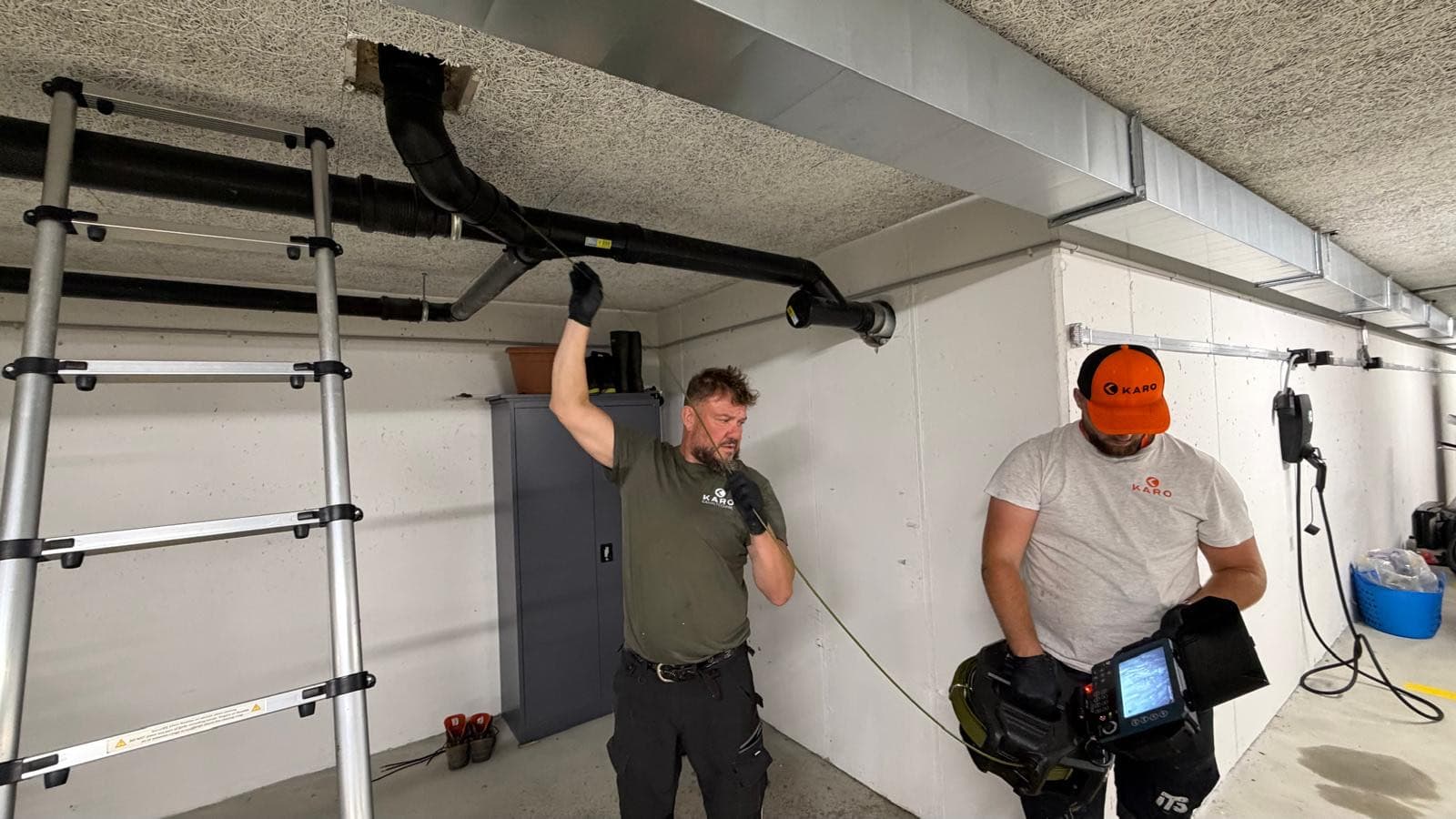
The range is wide: in pipe cleaning inside buildings, Karo works in pipes from DN 50 to DN 200, and in drain cleaning from DN 50 to DN 800. The camera also depends on the nominal diameter. Push-rod cameras can enter the pipe from DN 50; for larger dimensions, crawler cameras with a pan-and-tilt head are used. Anyone who knows the nominal diameter when making an enquiry therefore helps the team to arrive with the right equipment straight away.
Nominal diameter and rehabilitation: which method fits which pipe
In trenchless rehabilitation, the nominal diameter often determines which methods can be considered at all before the site visit. A CIPP liner has to be pulled or inverted into the pipe, a patch liner is brought to the damaged spot by a packer, and for spray lining a spray head has to travel through the pipe. Each of these devices needs a minimum cross-section and has an upper limit.
Karo Kanaltechnik rehabilitates pipes from DN 50 to DN 800. Karo uses the Pointliner, a glass-fibre-reinforced patch liner for localised damage such as cracks or displaced joints, in dimensions from DN 100 to DN 600. CIPP lining for entire pipe runs is used in main pipes from DN 150. For small building pipes, soil stacks and connecting pipes from DN 50, where a CIPP liner is often difficult to install because of tight bends and many branches, spray lining is suitable; it applies an epoxy resin layer directly to the inner wall of the pipe.
It is also important how the nominal diameter changes along a pipe. If the dimension changes between two manholes, for example from DN 100 to DN 150, the liner must accommodate this transition or be installed in two sections. The inspection report in accordance with SN EN 13508-2 shows such changes as well as bends and branches and is therefore the basis of every rehabilitation quote.
Loss of cross-section due to liners and coatings
Every rehabilitation from the inside introduces new material into the old pipe – and this material takes up space. A CIPP liner or patch liner has its own wall thickness, and a coating a certain layer thickness. This reduces the internal diameter, and because the cross-sectional area grows with the square of the diameter, even a small difference has a noticeable effect.
A sample calculation shows the order of magnitude: if a DN 150 pipe is lined with a liner of 4 mm wall thickness, around 142 mm remains inside. The area is then about 90 percent of the original, so the loss of cross-section is around 10 percent. In a small DN 50 pipe, the same 4 mm would already cost almost 30 percent of the area. That is precisely why thin coatings instead of thick liners are used in small dimensions.
Less cross-section does not automatically mean less discharge capacity. A new, smooth and seamless inner surface slows the water down less than a rough, encrusted old pipe with offsets, and this can offset part of the loss. Whether the rehabilitated pipe is still sufficient for the connected drains is nevertheless a question that must be clarified before rehabilitation – especially for pipes that are already running at their limit or to which additional flats are to be connected in future.
How to find out the nominal diameter of your pipe
The simplest way is via the documents: on the drainage plan of the property, the material, nominal diameter and gradient are usually entered for the pipes. If there is no plan, it helps to look at visible pipes in the basement or the underground car park, because plastic pipes usually have the external diameter printed on them. For buried pipes and underground drains beneath the floor slab, the only option is usually a camera survey, which documents the dimension of each section.
You do not need to know the nominal diameter to make an enquiry to Karo. It is enough to describe which drain is affected – washbasin, WC, basement drain or yard manhole. This already gives a good idea of the dimension, and the equipment in the vehicle covers the usual sizes found in a house. If a camera inspection is then requested, a surcharge from CHF 50 is added to the job, and you receive the measured dimensions together with the condition findings.
A typical case from an apartment building in the Winterthur area: on the ground floor, the WC and shower back up again and again. The camera survey from the inspection chamber shows that the DN 150 underground drain changes at one point into an old DN 100 pipe section – a leftover from an earlier conversion – and that a joint is displaced at exactly that spot. The narrowing explains the recurring blockages. First, the pipe is jetted with a nozzle suitable for both dimensions. For the rehabilitation, the team uses the report to check which method can handle the change in dimension: the displaced joint in the DN 100 section can be sealed with a Pointliner, and the rest of the underground drain remains untouched. The owners receive images and dimensions and can weigh this against the cost of renewing the short section.