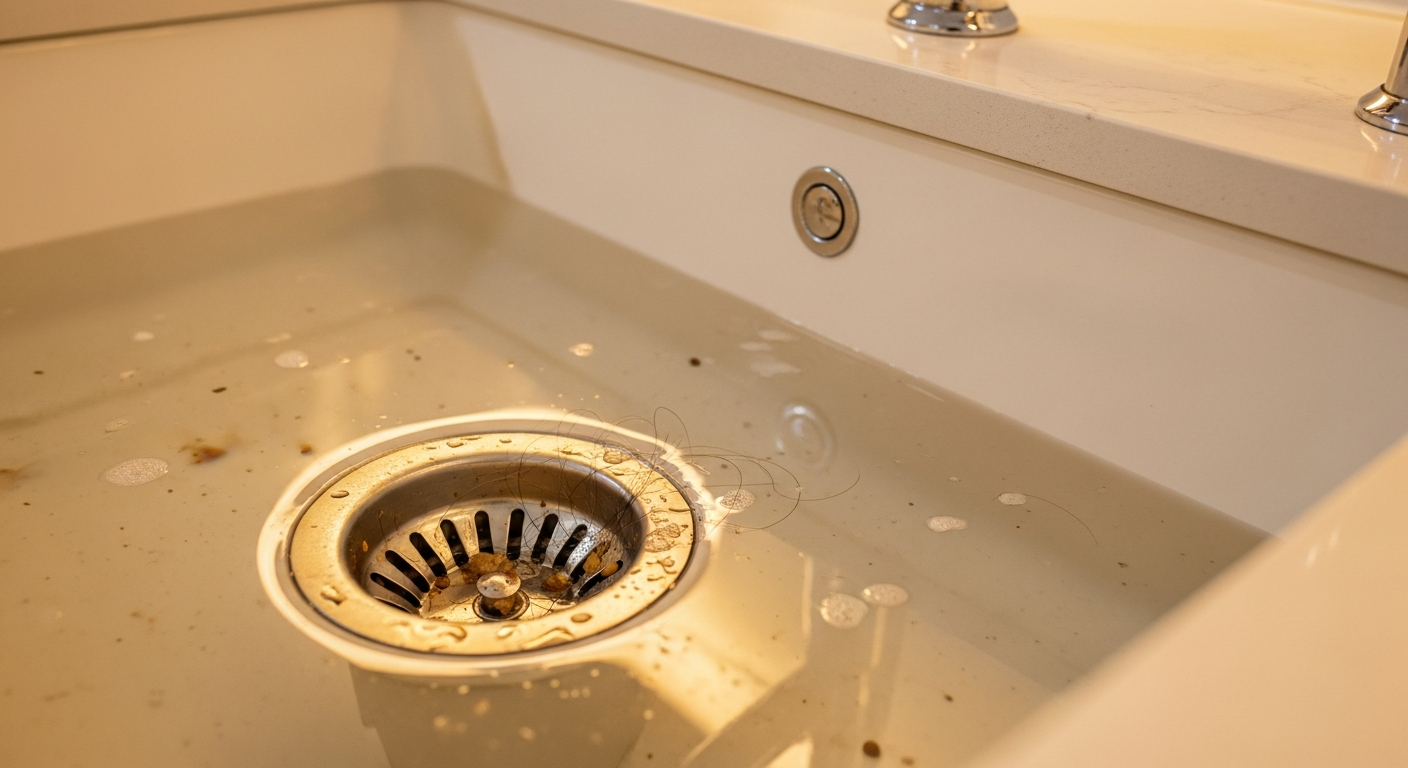

If the shower, bath or washbasin is blocked, there is almost always a plug of hair, soap residue and limescale right in the waste valve or in the trap behind it. This blockage sits close to the surface and in most cases can be cleared without chemicals: take out the strainer and stopper, remove the hair, clean the trap or use the plunger. Only when several drains slow down at the same time or water comes up somewhere else is the problem deeper in the pipe, and then professional pipe cleaning is the right way forward.
In this guide we go through each of the three bathroom drains separately, because they are built differently and block in different places: the washbasin with its waste valve and trap, the shower with a floor drain or shower channel, and the bath with its waste and overflow set. For each drain you will find the typical causes, a step-by-step solution, the right tool and the most important ways to prevent blockages.
Why do bathroom drains block so often?
Every day a mixture goes down the bathroom drains that mats together particularly well. Hair is the main culprit: it catches on edges, on the stopper and on the lift rod, forms a net and holds on to everything that comes after it. Soap, shower gel, shampoo and conditioner leave a greasy film that combines with the hair to form a tough plug. In areas with hard water, the soap also reacts with the lime in the water to form what is known as lime soap, a grey, sticky coating that hardens over time and narrows the cross-section of the pipe.
Then there are things that do not belong in the drain at all: cotton buds, dental floss, contact lenses, caps or hair ties. Toothpaste residue and stubble often end up in the washbasin, and sand and dirt in the shower after sport or gardening. Finally, the design plays a role: bathroom drains have smaller cross-sections than the pipes further down, and many shower drains are built shallow so that they fit into the floor. A shallow gradient and tight bends slow the water down, and wherever water flows slowly, something settles.
- Hair: mats together on the stopper, the strainer and in the trap
- Soap, shower gel and care products: form a greasy film
- Limescale and lime soap: hard, grey deposits where the water is hard
- Foreign objects: cotton buds, dental floss, caps, hair ties
- Sand and dirt: settle in the shallow shower drain
Blocked washbasin: causes and solution
With a washbasin, the blockage is usually in one of two places: in the waste valve directly under the basin and in the trap below it. Many washbasins have a waste valve with a lift rod or a stopper that opens and closes when pressed. Hair wraps itself around precisely this stopper and the mechanism behind it. If the water only drains slowly and you hear gurgling, this is usually the reason. If there is also an unpleasant smell, organic residue has collected in the trap and is decomposing.
Worth knowing: the washbasin has an overflow, a small opening at the top of the basin. If you use the plunger, you must hold this overflow firmly shut with a damp cloth, otherwise the pressure escapes there and the plunger has no effect.
Step 1: Remove and clean the stopper
Pull the stopper out upwards or unscrew it. On models with a lift rod, it can often only be removed once the lift rod under the basin has been unhooked. Remove hair and residue with a cloth.
Step 2: Clear the waste valve from above
Use a narrow plastic hook or an old toothbrush to pull the visible hair out of the valve. Do not use sharp metal objects, as they scratch the surface.
Step 3: Use the plunger
Leave some water in the basin, seal the overflow with a damp cloth, position the plunger and pump vigorously several times. Then pull it off sharply.
Step 4: Unscrew and clean the trap
Place a bucket underneath, loosen the union nut by hand, remove the trap, rinse it out and check the seals.
Step 5: Flush through with hot water
Refit the trap, tighten the nuts hand-tight and run a few litres of hot water through. Then check that the connections are watertight.
We show in detail how to unscrew the trap step by step, clean it and refit it so that it is watertight in our guide to cleaning a trap. If the washbasin is still blocked afterwards even though the trap is clean, the blockage is in the wall connection or in the pipe behind it. There you can only make progress with a drain snake inserted into the wall opening.
Blocked shower: floor drain and shower channel
There are two types of shower drain. The classic one is the round or square floor drain with a cover grate, under which there is a removable insert that acts as the trap. In level-access showers you more often find a shower channel, an elongated channel with a cover, which holds a hair strainer and a trap insert. In both cases, hair and soap residue collect almost entirely in this insert, because it sits just below the grate.
The big advantage: you can reach the spot where the blockage usually is without tools. Typical signs are standing water while showering, a slurping noise as the water drains away and a smell from the drain. If, on the other hand, the water in the shower rises when the washing machine next door pumps out or someone flushes the toilet, the cause is not in the floor drain but further down in the shared pipe.
Step 1: Remove the cover
Lift off the grate or channel cover. Some are simply laid in place, others are fixed with a small screw.
Step 2: Pull out the insert
Pull out the hair strainer and the trap insert. On many models it is push-fitted and can be released with a slight twist.
Step 3: Remove hair and sludge
Wearing gloves, remove the hair and residue and clean the insert with a brush under warm water. Limescale can be softened by soaking in vinegar water.
Step 4: Check the waste pipe
Look into the open hole and pull out any hair you can reach with a plastic hook. If necessary, use the plunger carefully while the insert is removed.
Step 5: Refit the insert correctly
Fit the cleaned insert back fully and fill the drain with water. If the insert is missing or sits crooked, sewer smells get into the bathroom.
A tip from experience: the trap insert is not a part you can leave out after cleaning because the water drains faster without it. Its water seal holds back the gases from the sewer system. You can read more about how a floor drain is built and why it needs water in the trap in the glossary under floor drain.
Blocked bath: waste and overflow
The bath has a waste and overflow set: at the bottom the waste outlet with a stopper, and at the top in the side of the bath the overflow, often with a rotary handle that opens and closes the stopper via a cable. Both openings lead into a shared pipe and from there into the trap under the bath. Hair collects on the stopper and its holder, and soap residue and bath additives form a coating below it. Because the bath releases a lot of water at once, any narrowing is particularly noticeable here: the water stands in the bath for a long time and only drains slowly.
Unlike the washbasin, the bath trap is often not directly accessible because the bath is built in or panelled. Some baths have an access opening in the panel, but many do not. That is why, with a bath, you almost always work from above.
Step 1: Remove the stopper
Pull out or unscrew the stopper and remove hair and residue. On sets with a rotary handle, the stopper can usually simply be lifted off upwards.
Step 2: Seal the overflow
Hold the overflow opening firmly shut with a damp cloth or tape over it. Without a seal, the pressure escapes through the overflow when you plunge.
Step 3: Use the plunger
Leave a few centimetres of water in the bath so that the plunger cup is completely covered, and pump vigorously several times.
Step 4: Help it along with the snake
If the plunger does not help, insert a small hand snake through the waste outlet and push it forward slowly while turning until the resistance gives way.
Step 5: Flush through thoroughly
Run hot water from the shower head through the waste outlet and watch whether the water drains away quickly again.
Which cause at which drain? An overview
| Drain | Most common cause | Where is the blockage? | First step |
|---|---|---|---|
| Washbasin | Hair, soap, toothpaste, limescale | Waste valve and trap under the basin | Clean the stopper, unscrew the trap |
| Shower with floor drain | Hair, soap sludge, sand | Trap insert under the grate | Lift the grate, clean the insert |
| Shower with channel | Hair, soap sludge | Hair strainer and insert in the channel | Remove the cover, clean the strainer |
| Bath | Hair, bath additives, lime soap | Stopper, waste set, trap under the bath | Clean the stopper, seal the overflow, plunge |
| Several drains at once | Deposits in the shared pipe | Collecting pipe or soil stack | Call a specialist contractor |
The right tools
For most bathroom blockages you do not need special tools. More important than lots of equipment is using the right thing in the right order and not using force, because bathroom drains, seals and plastic pipes are delicate.
- Rubber gloves, a bucket and a few old towels
- A narrow plastic hook with barbs to pull hair out of the valve and drain
- A plunger (force cup) with a flat rim for washbasin, shower and bath
- A small hand snake for blockages beyond the trap
- An old toothbrush and vinegar water for limescale on the insert and stopper
We explain how the plunger works physically and why the overflow has to be sealed in the glossary under plunger. We advise against chemical drain cleaners: they often only partly dissolve a plug of hair, attack seals and older pipes and are dangerous to skin and eyes when handled. If some of the product is left standing in the trap afterwards, any further cleaning becomes riskier. We ourselves work without chemicals, using drain snakes and high-pressure water jetting.
Prevention: strainer, habits, regular cleaning
The most effective measure against blocked bathroom drains costs next to nothing: a drain strainer. A fine strainer in the shower and bath catches hair before it gets into the drain. If you empty it briefly after every shower, you prevent the most common reason for blocked bathroom drains. With the washbasin, it helps to take the stopper out and clean it every few weeks.
- Use a hair strainer in the shower and bath and empty it regularly
- Put hair in the bin after combing or shaving, do not rinse it down the washbasin
- Cotton buds, dental floss and sanitary products always go in the bin
- Take out and clean the shower trap insert every few weeks
- Briefly flush with hot water after bathing or showering
- Dissolve limescale on the stopper and insert with vinegar water before it hardens
In an apartment building it is also worth having the shared pipes flushed as a preventive measure. You cannot see deposits in the collecting pipe from the flat, but over the years they make themselves felt when several households suddenly complain about slow drains.
When the blockage is in the soil stack
Not every bathroom blockage is in the bathroom. The washbasin, shower, bath and toilet drains run into a shared pipe and from there into the soil stack, the vertical pipe that carries the wastewater from all floors down to the basement. If this is narrowed, plunging and cleaning the trap in the flat no longer help, because the obstruction is metres further down. The following signs indicate that the cause lies deeper:
- Several bathroom drains are slow at the same time, even though they have been cleaned
- When the toilet is flushed or the washing machine pumps out, water rises in the shower or bath
- One drain gurgles while another is being used
- In an apartment building, neighbours below or above you have the same problem
- The sewer smell persists even though all the traps are filled with water
In these cases you should not keep working with chemicals or wire, but call a specialist contractor. Depending on access, we clean the stack with a drain snake or with chemical-free high-pressure water jetting at up to 200 bar and, on request, check with a camera whether the pipe is damaged. If a toilet is affected, you will find the right immediate measures in our guide Blocked toilet: what to do?; for a kitchen drain, the guide to the blocked kitchen drain will help.
What does cleaning by Karo Kanaltechnik cost?
For a blocked washbasin, shower or bath, expect approx. CHF 40 in labour with us, plus the call-out fee of CHF 60. We charge CHF 160 per working hour, all prices excl. VAT. If the blockage is cleared in this time, that comes to around CHF 100 excl. VAT for a single bathroom drain. If the blockage is further down, for example in the soil stack, we charge the actual time spent at the hourly rate. A job in a single-family home usually costs CHF 150 to 400. If you would like the pipe checked with a camera after cleaning, a supplement from CHF 50 applies.
If you rent, the question often arises of who pays the bill. That depends on where the blockage is and who caused it. We have put together the details in the guide Blocked drain: who pays?. You will find further immediate measures for all drains in our 5 quick tips for a blocked drain. And if nothing drains any more and water threatens to overflow, you can reach our emergency service.
Conclusion
A blocked washbasin, shower or bath is in most cases a hair problem right at the drain and can be solved in a few simple steps: take out the stopper or insert, remove the hair, if necessary clean the trap or use the plunger, sealing the overflow as you do so. With a hair strainer and a little routine, it need not come to that at all. If several drains are affected or water rises somewhere else, the cause is in the pipe, and then professional pipe cleaning is a better option than further attempts with chemicals or wire.