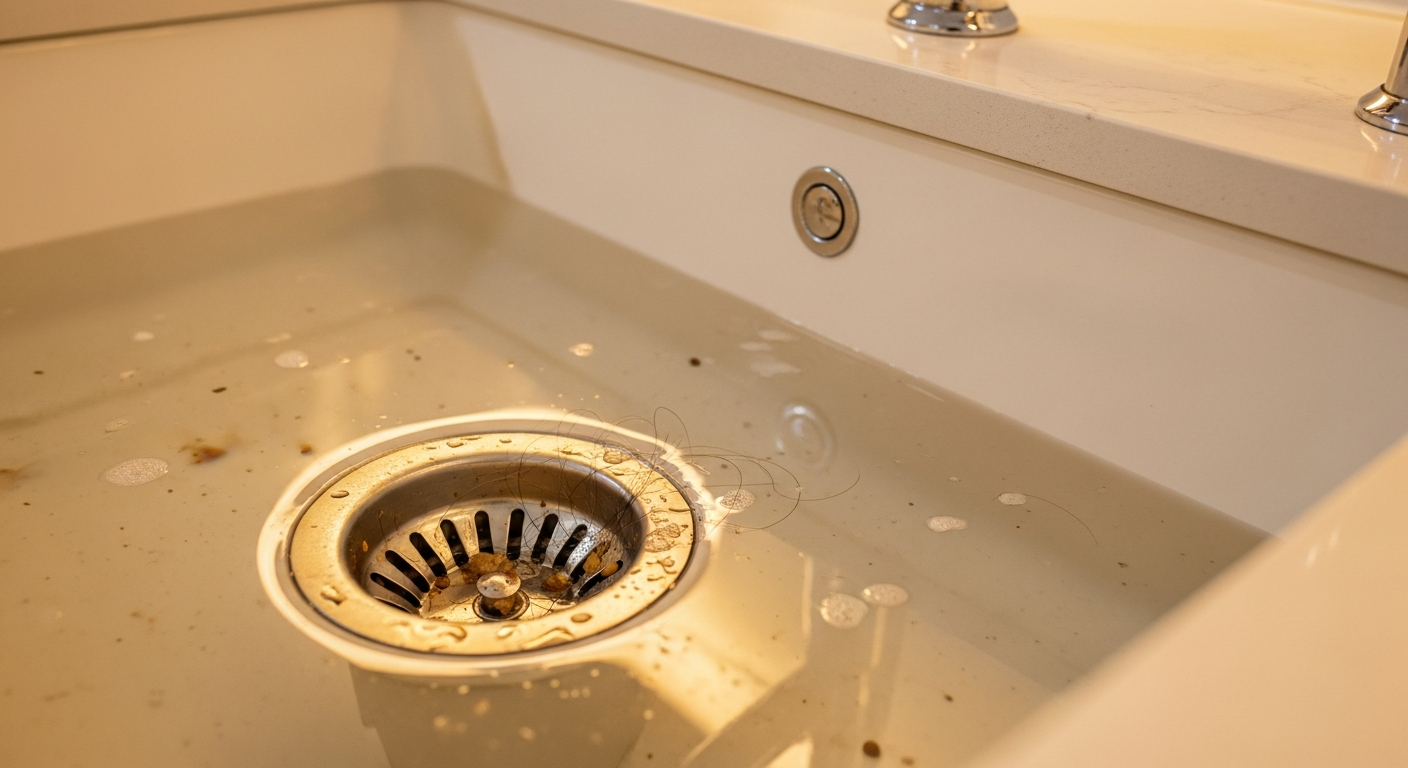

Who pays for a blocked drain in a rented flat depends on where the blockage is and who caused it. Under Swiss tenancy law, the landlord must keep the flat in a fit condition (Art. 256 of the Swiss Code of Obligations, CO). Minor cleaning that is part of ordinary upkeep, on the other hand, is done by tenants themselves and at their own expense (Art. 259 CO), for example cleaning a trap or clearing a plug of hair with the plunger. If a specialist firm with a drain snake or high-pressure equipment is needed, or if the blockage is in a shared pipe, the landlord generally bears the cost – unless the tenant demonstrably caused the blockage through careless use.
This guide explains the principle clearly, shows typical cases from the washbasin to the underground drain, what applies in condominium ownership, how a CCTV drain survey proves the cause and what property management companies can do to avoid disputes in the first place. It does not replace legal advice: what counts is always your tenancy agreement, the house rules, where applicable the regulations of the condominium owners' association, and the specific individual case.
The principle: upkeep is the landlord's job, minor cleaning the tenant's
The Code of Obligations divides the duties clearly. The landlord hands over the flat in a condition fit for its intended use and must keep it in that condition for the entire tenancy. This includes wastewater from the kitchen, bathroom and toilet draining away reliably. The wastewater pipes are part of the property drainage, and the owner is responsible for operating and maintaining it – more on this in the glossary entry on the maintenance obligation.
The exception is what is known as minor upkeep. Defects that can be remedied by minor cleaning or repairs required for ordinary upkeep are dealt with by tenants themselves in line with local custom. For drains, this typically means: cleaning the strainer and plug, removing hair from the shower drain, unscrewing and rinsing the trap under the washbasin or clearing a superficial plug with the plunger. The law does not specify an amount in francs. Some tenancy agreements set their own limit; whether such a clause applies in an individual case is for specialist advice centres to assess.
According to the prevailing view, minor upkeep ends where specialist knowledge or special equipment is needed. If a drain cleaning firm has to come out with a drain snake, a drain cleaning machine or high-pressure water jetting, it is generally no longer minor cleaning within the meaning of the law – and the costs then lie in principle with the landlord.
The polluter-pays principle: when tenants do pay
Tenants must use the flat with care (Art. 257f CO). If someone causes a blockage through improper use, the landlord can pass on the cost of clearing it to them. Typical examples are wet wipes, cotton buds, sanitary products or cat litter in the toilet, frying fat and deep-frying oil in the kitchen drain, food scraps and coffee grounds in the sink, or building rubble, tile adhesive and plaster after the tenant's own renovation work.
The question of proof is important: anyone wishing to pass on the costs must generally be able to prove that the tenant actually caused the blockage. In an apartment building with shared pipes, this is hardly possible without evidence. A blockage due to the pipe ageing, too shallow a gradient, deposits built up over years, roots growing in or pipe damage is not the tenant's fault. Such causes are borne by the owner.
- Wet wipes, cotton buds, sanitary products or cat litter in the toilet: the person responsible may be liable.
- Frying fat, deep-frying oil and food scraps in the kitchen drain: the person responsible may be liable.
- Building rubble, mortar or tile adhesive after the tenant's own renovation: the person responsible may be liable.
- Hair and soap residue in the trap: minor upkeep, generally the tenant's responsibility.
- Deposits built up over years, root ingress, pipe damage, too little gradient: the landlord's responsibility.
Where is the blockage? Three typical cases
In practice, the location of the blockage often already decides the question of cost. That is why it is worth briefly checking whether only a single drain is affected or whether several drains are slowing down, gurgling or pushing water back at the same time.
First: only one drain in the flat is affected, such as the washbasin or shower, and the plug is in the trap or just behind it. This is the classic case of minor upkeep, which tenants deal with themselves. Our guide Blocked drain: first aid shows how to do this without chemicals. If that does not help and a specialist firm is needed, the question of who caused it arises.
Second: the blockage is in the flat's connecting pipe or in the soil stack, the vertical pipe to which several flats are connected. A typical sign: when someone showers in the flat above, water rises in the washbasin or shower in the flat below. A soil stack serves all households, so the landlord is almost always responsible here – unless the cause can be attributed to a specific flat.
Third: the blockage is outside the flat, in the underground drain below the basement, in the inspection chamber or in the house connection up to the public sewer. These pipes are part of the property. Cleaning and repair are the owner's responsibility; tenants generally have nothing to do with it. Exactly where the private pipe ends and the municipal sewer begins is set out in the municipality's wastewater regulations.
| Situation | Who usually pays? | Note |
|---|---|---|
| Hair or soap in the trap of the washbasin or shower | The tenant | minor upkeep under Art. 259 CO |
| Single drain, specialist firm with drain snake needed, no misuse | The landlord | maintenance obligation under Art. 256 CO |
| Blockage demonstrably caused by wet wipes, fat or building rubble | The person who caused it | proof required, e.g. a report from the specialist firm |
| Soil stack, several flats affected | The landlord | in an apartment building the cause usually cannot be traced |
| Underground drain, manhole, house connection | The owner | municipal boundary as per wastewater regulations |
| Condominium ownership, shared pipe | The owners' association | split according to the regulations or ownership shares |
Report rather than wait: the tenant's duties
Tenants must report defects that they are not required to remedy themselves to the landlord (Art. 257g CO). If you ignore a slowly draining drain or a recurring sewer smell for weeks and greater damage results, such as water damage in the flat below, you can be liable for this additional damage. So report problems early and preferably in writing, by email or via the property management company's portal.
In a genuine emergency – water is overflowing, wastewater is pushing up out of the floor drain, the flat below is affected – limiting the damage comes first. Try to reach the landlord, property management company or caretaker first. If that is not possible, it is generally justifiable to arrange what is needed to limit the damage; whether and to what extent the costs are reimbursed depends on the individual case. Document the situation and the time with photos and keep the specialist firm's job report. For urgent cases, the Karo Kanaltechnik emergency service can be reached around the clock.
Step 1: Do not keep flushing
Do not flush the toilet again, do not pour any more water into the affected drain and, if necessary, close the isolation valve on the cistern.
Step 2: Can you clear it yourself?
Clean the trap or use the plunger. No aggressive chemical cleaners; they often fail to dissolve the plug and can attack pipes.
Step 3: Inform the landlord
Report the defect in writing, with the date, the drains affected and photos. If several flats are affected, mention the neighbours as well.
Step 4: Specialist firm via the property management company
As a rule, the property management company commissions the pipe cleaning. Only call an emergency service yourself if no one can be reached and damage is imminent.
Step 5: Keep the job report
The job report records where the blockage was and what caused it. It is the basis for the question of cost.
The proof: what the CCTV drain survey shows
Whether a blockage was caused by misuse or by the condition of the pipe can often only be answered with certainty using a camera after cleaning. During a CCTV drain survey, a drain camera travels through the pipe and shows deposits, roots, cracks, displaced joints or objects that do not belong in the wastewater. Karo Kanaltechnik documents the findings in accordance with the SN EN 13508-2 standard, with images and the position in the pipe. Our glossary explains what a CCTV drain survey can do technically.
The survey report has advantages for everyone involved: the landlord can prove who caused the blockage if wet wipes or fat really did block the stack. Conversely, tenants can show that, for example, a sagging pipe or root ingress was the cause. And the property management company gets an objective basis for deciding whether rehabilitation is needed after cleaning. Karo charges for a camera check as a supplement from CHF 50 on top of the cleaning.
What does it cost to clear a blockage?
Karo Kanaltechnik charges for pipe cleaning by time spent: CHF 160 per working hour plus CHF 60 call-out, excl. VAT. Guide figures for a single drain are approx. CHF 40 for a washbasin, shower or bath and approx. CHF 80 for a kitchen or toilet, each plus the call-out. A blocked washbasin therefore costs around CHF 100 excl. VAT or CHF 108.10 incl. 8.1% VAT, and a toilet around CHF 140 excl. VAT or CHF 151.34 incl. VAT. A typical job in a single-family home costs around CHF 150 to 400, and a full hour including call-out CHF 220 excl. VAT or CHF 237.82 incl. VAT. You can find all the details on the page drain cleaning costs and under pipe cleaning.
These amounts also show why a dispute about the costs is rarely worthwhile: for a single drain, the sums involved are manageable. It only gets expensive if a blockage is ignored for a long time, wastewater backs up and causes water damage, or if cleaning reveals pipe damage that has to be rehabilitated. As a rule, these follow-on costs are borne by the owner – or the insurer.
And the insurance?
Insurance does not always cover the cost of simply unblocking a drain. Whether building insurance, building water insurance or additional cover also pays for pipe cleaning depends on the policy in question. Consequential damage is different: if water overflows and damages parquet flooring, walls or the flat below, building water, contents or personal liability insurance may pay, depending on the case. If the tenant culpably caused the damage, their personal liability insurance often examines whether to cover it. Report damage promptly to your own insurer and clarify the cover directly with them. What to do in an emergency is described in our guide Burst water pipe: what to do and who pays?.
Condominium ownership: exclusive right or common part?
In condominium ownership, there is a second level. Under the Swiss Civil Code, pipes that also serve other condominium owners cannot be declared subject to an exclusive right (Art. 712b of the Swiss Civil Code, CC). Soil stacks, underground drains, manholes and the house connection are therefore generally common parts. Their upkeep is the responsibility of the owners' association; the costs are divided according to the regulations or the ownership shares (Art. 712h CC) and are generally settled through the common costs.
The connecting pipe within a unit up to the shared stack, by contrast, may be assigned to the exclusive right. If only your own washbasin is blocked, you as the condominium owner pay yourself. If one party has demonstrably caused a blockage in the shared stack, the owners' association can reclaim the costs from them under the general rules. If the condominium unit is rented out, tenancy law applies to the tenants: they contact their landlord, i.e. the condominium owner, who then settles the costs with the owners' association. The specific boundaries are set out in the deed of constitution and the regulations.
Service charges: can drain cleaning be billed?
The landlord may only charge service charges if they are expressly and individually agreed in the tenancy agreement, and only for actual expenses connected with the use of the property (Art. 257a and 257b CO). Periodic, preventive cleaning of the pipes can fall under this if it is listed as a service charge item in the agreement. Repairs, renewals and the rehabilitation of damaged pipes, on the other hand, do not belong in the service charge statement; they are covered by the rent. If you are unsure about an item, you can inspect the receipts and contact a specialist advice centre.
Tips for property management companies
For property management companies and owners of several properties, blockages are a recurring issue. A few measures reduce both the number of call-outs and the discussions about costs. The page for property management companies shows how Karo supports property managers in this.
- Information sheet for tenants: state clearly in the house rules or when tenants move in what does not belong in the toilet and kitchen drain, and what counts as minor upkeep.
- One point of contact for emergencies: put up the caretaker's telephone number or that of a 24-hour service where it is clearly visible in the stairwell.
- Preventive cleaning: have soil stacks and underground drains flushed at intervals that suit their use, instead of only reacting when there is a problem.
- Ask for a job report and camera footage: for every cleaning job, have the location and cause of the blockage recorded, with camera documentation if misuse or damage is suspected.
- Take recurrences seriously: if the same stack blocks several times, there is often a structural reason behind it. A condition survey clarifies whether rehabilitation is needed.
This keeps the question of cost objective: once the cause is documented, it is possible to decide fairly whether it is a matter of property upkeep or whether someone has misused the pipe. And if you know the condition of your pipes, you can plan rehabilitation before a blockage turns into water damage.
Where can tenants and landlords get authoritative advice?
This article gives a general overview and is not legal advice. If there is disagreement, specialist bodies can help: tenants can get advice from the Swiss tenants' association (mieterverband.ch), and owners and landlords from the homeowners' associations. If no agreement is reached, the district or municipal conciliation authority for tenancy matters is the first point of contact; conciliation proceedings in tenancy matters are generally free of charge. The SRF consumer report “Blocked washbasin – who pays the plumber? Tenant or landlord” (in German) from the programme «Kassensturz/Espresso» also provides an easy-to-follow overview of the subject.
Karo Kanaltechnik is happy to answer technical questions about the cause of a blockage, cleaning and the condition of the pipes. We clean without chemicals using a drain snake or high-pressure water jetting at up to 200 bar, document with a camera on request and provide a job report that tenants, landlords and property managers can easily follow.