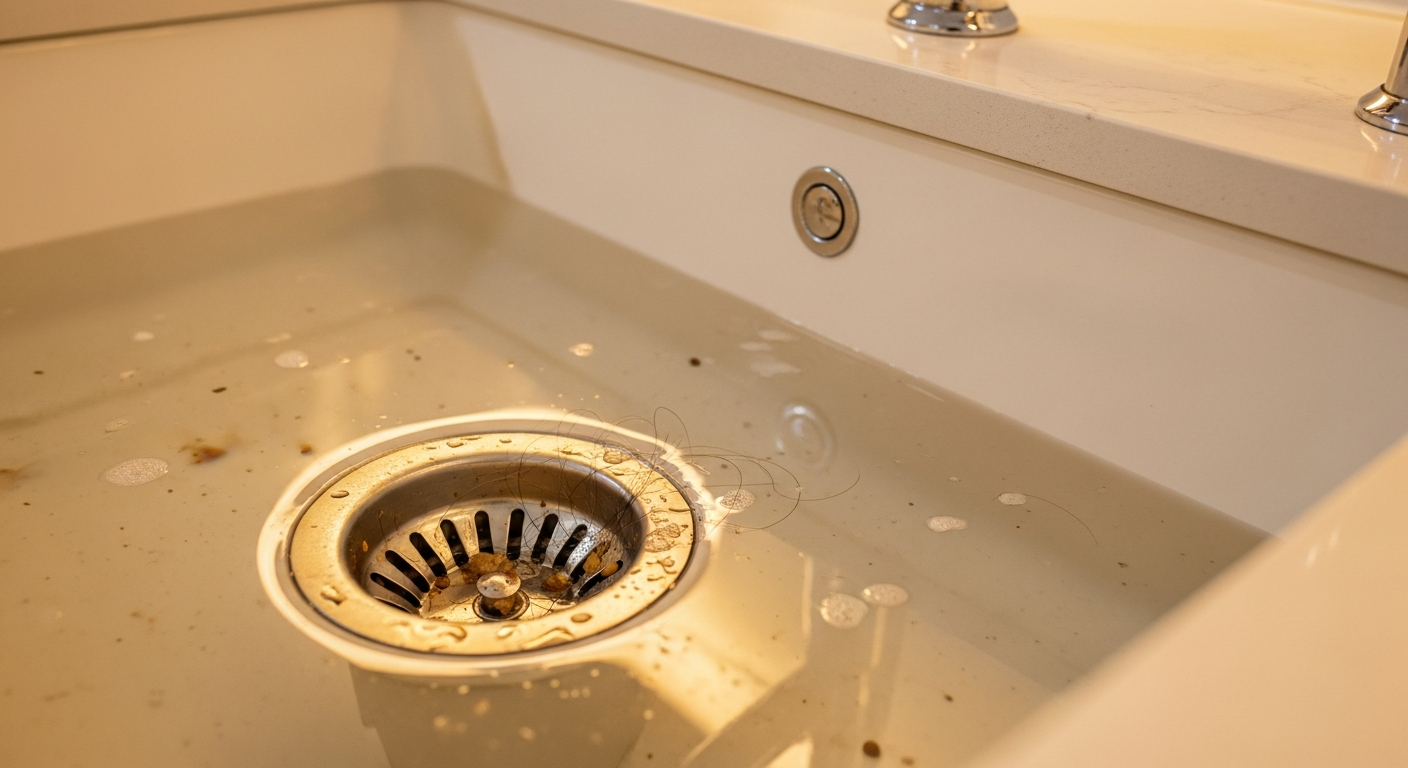

If water is standing in the washbasin, the shower only drains hesitantly or there is a smell from the kitchen sink, in most cases the plug is in the trap. There the water flows through a bend, slows down and leaves behind hair, soap residue, toothpaste and fat. The good news: cleaning a trap is usually done quickly and needs no special tools. This guide shows how to do it at the washbasin, in the kitchen and in the shower, which mistakes to avoid and how to tell that the blockage is deeper in the pipe.
How to recognise a dirty trap
A trap almost always gives warning before it blocks completely. Typical signs are a swirl of water that takes longer than it used to, a slight smell of rotten eggs coming straight from the drain, a dirty ring in the basin after it drains, or gurgling as the last of the water disappears. If only a single drain is affected, the trap is the most likely place. If several drains are slow at the same time, the problem is more likely in a shared pipe – more on this below.
Tools and materials
- A bucket or shallow bowl that fits under the trap
- Old towels or newspaper for the floor of the vanity unit
- Household gloves
- An old toothbrush or bottle brush for the cup and pipes
- Possibly a pair of water pump pliers with a cloth over the jaws, in case a nut is stuck
- For the shower: hair removal strips or a small pair of grabbing pliers
- For pipes beyond the trap: a small hand snake
- If needed, suitable replacement seals (flat, cone or O-ring seal)
A force cup, commonly known as a plunger, often helps with fresh, soft blockages even without unscrewing anything. With fat, solid balls of hair and old deposits, however, there is no way round opening the trap.
Cleaning the washbasin trap: step by step
Under most washbasins there is a bottle trap with a cup that can be unscrewed. This is how to proceed:
Step 1: Make space
Empty the vanity unit, lay out towels and place the bucket directly under the trap. Close or remove the plug in the basin so that no one runs water by mistake.
Step 2: Loosen the cup by hand
Unscrew the cup at the bottom of the trap anticlockwise. The water in the seal immediately runs into the bucket along with the dirt. Only loosen plastic parts by hand; use pliers only with a cloth and with little force.
Step 3: Remove the dip tube and bend
If the cup is clean but the blockage is still there, loosen the union nuts on the waste valve and the wall connection and remove the whole trap. Remember where the seals go or take a photo with your phone.
Step 4: Clean
Remove hair and sludge by hand, then rinse all the parts with warm water and a brush – in the bath or the bucket, not in the washbasin whose trap has just been removed.
Step 5: Check the wall connection
Use a torch to look into the pipe in the wall. If there is a plug there, you can clear it with a small hand snake while the trap is off.
Step 6: Reassemble
Check the seals, fit them correctly and tighten all the nuts hand-tight. The dip tube must reach far enough into the cup, otherwise no water seal forms.
Step 7: Test for leaks
Fill the basin with water, let it drain all at once and check under all the connections with a dry paper towel for drips. Check again after an hour.
Cleaning the kitchen trap
The kitchen trap works in the same way but is larger and often has side connections for the dishwasher and washing machine. Switch off both appliances before opening it so that they do not pump out while you are working. Choose a generously sized bucket: a kitchen trap holds more water, and the fat in it smells strongly. Greasy deposits are best removed with hot water and a little washing-up liquid; a brush helps with the connection spigots. When reassembling, make sure the appliance hose sits firmly on its spigot again and the hose clip is tightened. An unused appliance connection must stay closed with its blanking plug, otherwise sewer air escapes there.
In kitchens, the blockage is more often already beyond the trap than in the bathroom, because fat solidifies in the cold connecting pipe. More on this in the guide Blocked kitchen drain.
Cleaning the trap in the shower and bath
Showers and floor drains usually have a bell trap that is accessible from above. You can clean the shower trap without tools and without getting under the tray:
Step 1: Remove the cover
Lift off the cover grate or channel cover; some are screwed or clipped in place.
Step 2: Pull out the insert
Pull the cup or bell out upwards. Underneath is the water seal with the typical tuft of hair.
Step 3: Remove the hair
Pull out hair and soap sludge with gloves or a hair removal strip, and rinse the insert.
Step 4: Refit and fill
Refit the insert until it sits right at the bottom, put the cover back on and pour in a jug of water so that the seal is restored immediately.
With a bath, the trap is often only accessible via an access opening in the panel. It is often enough to clean the stopper and use a plunger; hold the overflow shut with a wet cloth while doing so, otherwise the pressure escapes. The guide Blocked shower, bath or washbasin covers this in detail.
Toilet trap: what is different
With a toilet, the trap is part of the ceramic and cannot be unscrewed. Here a toilet plunger helps first, and for solid objects a toilet auger with a protective sleeve so that the glaze is not scratched. What to do in detail is set out in the guide Blocked toilet: what to do?.
Cleaning a trap with home remedies: baking powder, vinegar, hot water
For light deposits and smells, a mixture of baking powder or baking soda and vinegar is often enough: a few spoonfuls of powder into the drain, pour vinegar after it, leave it to work and flush with hot water. This dissolves greasy deposits, but not a solid plug of hair. Hot water helps with fresh fat; boiling water, on the other hand, is not suitable for plastic traps and seals. We advise against chemical drain cleaners: they attack seals, are dangerous on contact with skin and rarely dissolve deposits further down. The guide Blocked drain: home remedies gives an overview of home remedies.
Cleaning a trap with a drain snake
A drain snake does not belong in the trap itself but in the pipe beyond it. In the tight bend of a bottle trap it jams and can damage plastic parts. So first remove the trap and insert the snake directly into the wall connection, turning it slowly and pushing it forward until the resistance eases. How far a hand snake reaches and where its limits are is described in the guide to the drain snake.
Seals: the most common cause of a dripping trap
Depending on the model, a trap has three types of seal: flat seals under the union nuts, a cone or conical seal on the dip tube or wall connection, and an O-ring on the cup. The narrow side of the cone seal points into the opening into which the pipe is inserted. Brittle, deformed or cracked seals should be replaced; they cost little from a plumbing supplier. A drip after reassembly almost always means a twisted or forgotten seal, not a faulty trap.
Common mistakes when cleaning a trap
| Mistake | Consequence | Better |
|---|---|---|
| No bucket underneath | Dirty water in the vanity unit | Bucket and towels before the first turn |
| Running water into the open basin | Water runs straight into the cupboard | Close the plug, rinse the parts elsewhere |
| Nuts tightened with full force | Plastic thread breaks, trap starts leaking | Only tighten hand-tight |
| Seal forgotten or twisted | Drips at the connection | Photograph the position beforehand |
| Dip tube not inserted far enough | No water seal, sewer smell | Take the dip tube below the water level |
| Chemical drain cleaner in the trap | Damaged seals, risk of chemical burns when opening | Clean mechanically |
| Appliance connection without blanking plug | Sewer air escapes into the kitchen | Close off the unused connection |
When the blockage lies beyond the trap
If the trap is clean and the water still does not drain, the narrow point is in the connecting, collecting or stack pipe. Typical signs are: several drains are slow at the same time, water rises in the shower when the washing machine pumps out, another drain gurgles when you flush, or there is a sewer smell even though all the traps are full. In the last case, the drain vent pipe of the soil stack may also be blocked, so that the traps are sucked empty.
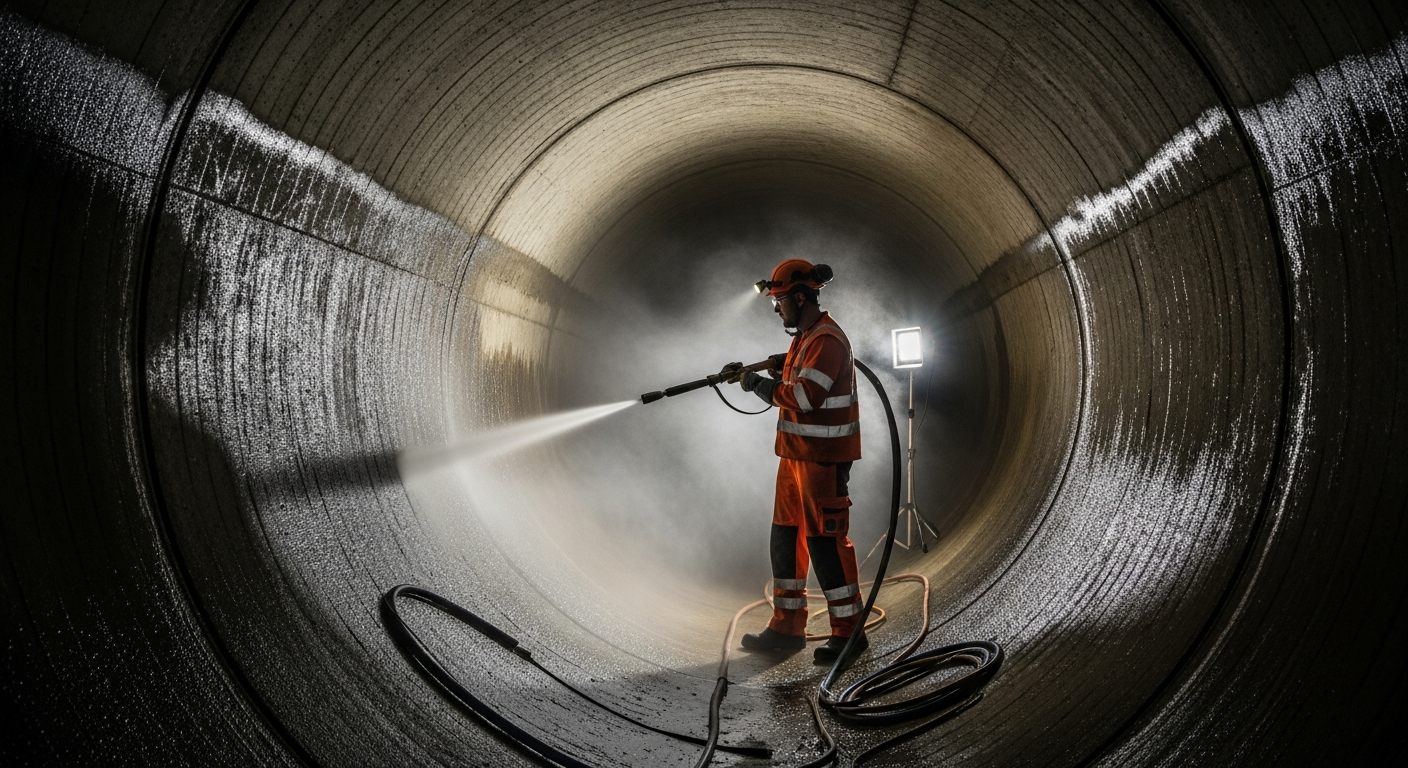
Then further work on the trap achieves nothing. A specialist clears the blockage with an electric drain snake or high-pressure water jetting and, if problems recur, can inspect the pipe with a camera. Karo Kanaltechnik jets without chemicals, using water pressure of up to 200 bar.
What does it cost if a professional comes?
At Karo Kanaltechnik, the guide prices are CHF 160 per working hour and CHF 60 call-out, both excl. VAT. A blocked washbasin or shower drain is usually clear in a short time and therefore costs approx. CHF 40 plus call-out; a kitchen or toilet drain usually takes around half an hour and costs approx. CHF 80 plus call-out. A typical job in a single-family home costs around CHF 150 to 400. If the pipe is to be inspected with a camera afterwards, a supplement from CHF 50 applies. More on the procedure on the page pipe cleaning and in the overview Costs of pipe cleaning and drain cleaning.
Prevention: how to keep the trap clear
- A drain strainer in the shower and washbasin holds back most of the hair.
- Fat and meat juices belong in the household waste, not in the sink.
- After shaving or washing your hair, briefly flush with hot water.
- Fill rarely used drains with water every few weeks so that the trap does not dry out.
- If problems recur, have the pipe checked instead of cleaning it again and again.
If you want to know how a trap works and what types of trap there are, you will find the basics in the glossary under trap / water seal.