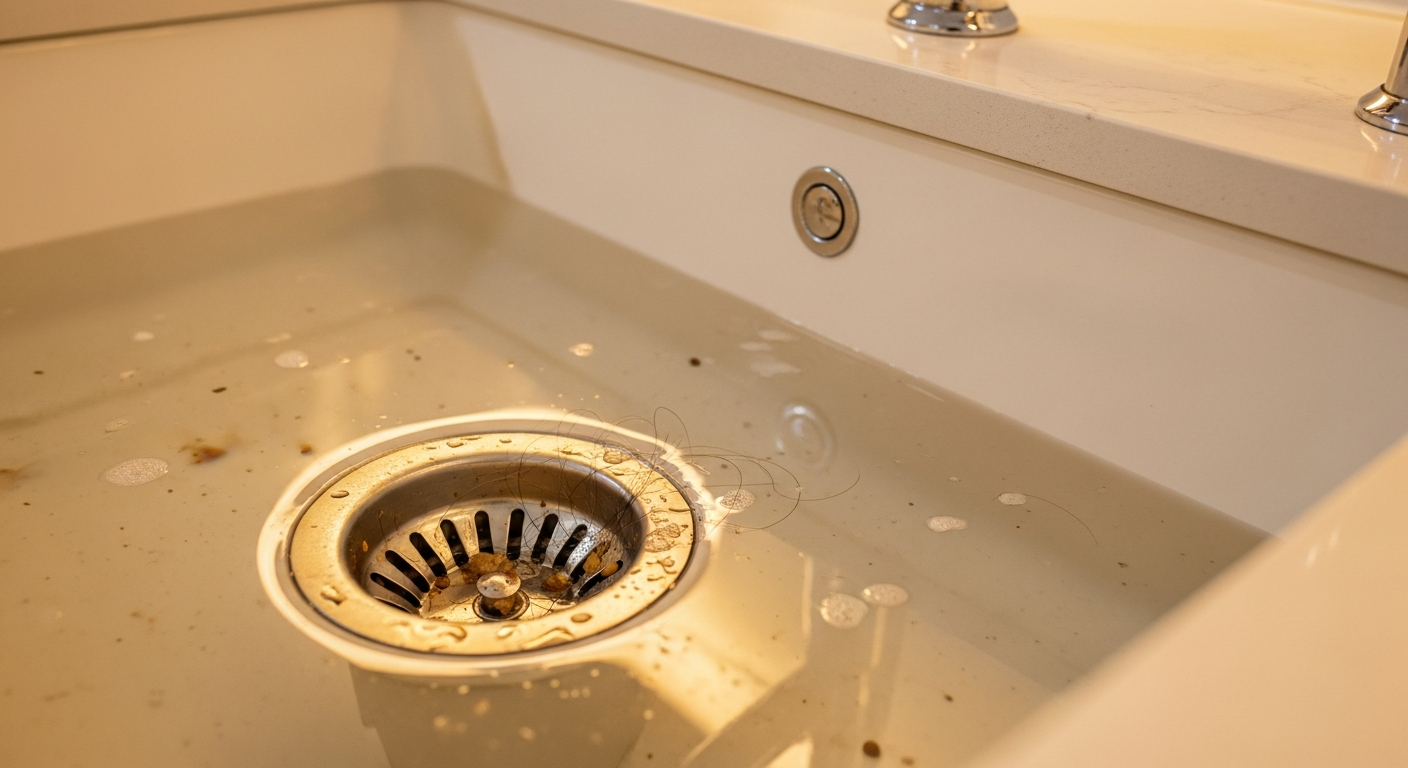

If the kitchen drain is blocked, fat is almost always behind it: frying fat, oil and food scraps that cool in the pipe, solidify and combine with soap residue to form a tough coating. First, stop running any more water into it, clean the trap under the sink and try a plunger. If the plug is further down in the wall or in the building's kitchen stack, only mechanical cleaning by a specialist contractor will help. This guide explains why fat blocks kitchen pipes so reliably, what you can do yourself, what tends to do harm and how to dispose of cooking oil properly in Switzerland.
Why does the kitchen drain in particular block so often?
In the bathroom it is hair and soap; in the kitchen it is fat. When cooking, washing up and running the dishwasher, small amounts of fat constantly get into the drain: the leftovers from the frying pan, butter on the plate, oil from the salad bowl, sauce on the rim of the pot. In warm washing-up water this fat is still liquid and seems to drain away without any problem. On its way through the pipe, however, the water cools, and the fat sticks to the colder pipe wall. Animal fats such as butter, lard or meat juices are solid at room temperature anyway, but vegetable oils, together with washing-up liquid, limescale and fine food scraps, also form a sticky film that gets thicker every week.
Grains of rice, coffee grounds, leftover pasta and vegetable peelings then stick to this film. The cross-section narrows, the water flows more slowly, and at some point a single larger lump closes the remaining opening. Typically, therefore, the kitchen drain does not block from one day to the next but gives warning over weeks: the water stays in the sink longer, there is a musty smell from the drain, and you can hear gurgling as it drains away.
The places where the water slows down are particularly vulnerable: the trap directly under the sink, horizontal connecting pipes in the wall with little gradient, bends and the transition from the vertical soil stack to the horizontal pipe in the basement. If the dishwasher is connected to the same drain, warm, greasy water also arrives in larger surges and settles further down in the cold pipe.
How can you tell where the blockage is?
Before you reach for the tools, it is worth taking a quick look at the symptoms. They usually reveal fairly precisely how deep the plug is and whether you can reach it yourself.
- Only the kitchen sink drains slowly, all other drains work: the blockage is very probably in the trap or in the first metre of the connecting pipe.
- The sink does not drain at all and the dishwasher reports an error when pumping out: both are on the same connection, and the plug is beyond it, often in the wall.
- There is gurgling as the water drains, but it still flows: typical of a partial blockage where air has to get past the coating.
- Water rises in the sink when a neighbouring flat does the washing-up: the blockage is in the shared kitchen stack below your flat.
- Several drains in the building are affected or water is coming out in the basement: the problem is in the underground drain or at the house connection. Trying to fix it yourself no longer makes sense here.
Blocked kitchen drain: immediate steps one by one
If only the kitchen sink is affected, you can try the following steps yourself in this order. Have a bucket, old cloths and household gloves ready.
Step 1: Stop running more water into it
Turn off the tap and do not start the dishwasher. Every additional litre increases the pressure on the plug and fills the sink without loosening anything.
Step 2: Empty the sink and check the strainer
Scoop out standing water and check the strainer or plug in the drain. Sometimes the blockage is right under the strainer and can be removed by hand.
Step 3: Use the plunger correctly
If the sink has two bowls or an overflow, seal this opening with a wet cloth. Place the plunger centrally on the drain, leave some water in the sink and pump vigorously ten to fifteen times. Without a sealed overflow, the pressure escapes there.
Step 4: Clean the trap under the sink
Place the bucket under the trap, loosen the union nuts by hand and remove the bend. Lumps of fat and food scraps can be washed out with an old brush and warm water with washing-up liquid. When reassembling, make sure the seals sit correctly.
Step 5: Warm water with washing-up liquid
With a fresh, soft coating of fat, hot but not boiling water with a squirt of washing-up liquid can help. Boiling water puts unnecessary strain on seals and older plastic pipes.
Step 6: Drain snake into the wall pipe
If the trap is clean and the drain is still blocked, the plug is in the connecting pipe. A hand-operated drain snake can reach the first metre. Insert the snake while turning it, never force it.
Step 7: Call a specialist contractor
If you have no success, water rises in other drains or the kitchen stack serving several flats is affected, the pipe belongs in professional hands.
You can find more detailed information on the plunger in the glossary under plunger, and on how the bend under the sink works under trap. For mechanical cleaning further down the pipe, the drain snake is the standard tool, which we also use in machine form.
What does not help with fat in the drain, or even does harm
There are lots of tips going around for a blocked kitchen drain. Some are harmless but ineffective; others make things worse.
- Chemical drain cleaners: they only attack solidified fat superficially, can damage seals and older pipes and make any further work on the trap dangerous, because the caustic solution stays standing in the pipe. Never mix different products.
- Boiling water by the litre: the fat is only liquefied and flushed a few metres further into the cold pipe, where it settles again, often in a place that is harder to reach. Boiling water also puts unnecessary strain on seals and older plastic pipes.
- Coffee grounds to «scour it clean»: coffee grounds do not dissolve fat but bind to it and form a particularly dense plug.
- Baking soda and vinegar on a solid plug of fat: the foaming looks impressive, but at best it dissolves a thin, fresh coating. Against a plug of fat that has built up over time, it has no effect.
- Wire or a coat hanger: this tends to compact plugs, and it easily causes scratches and leaks in the trap or on seals.
Why we at Karo Kanaltechnik always work without chemicals and what types of products exist is explained in the glossary entry drain cleaner. You can find a general overview of home remedies for blocked drains in the guide Blocked drain: what to do?.
The kitchen drain gurgles: what does it mean?
Gurgling while washing up is an early warning sign. Usually the pipe is already partly blocked, and the draining water has to push out air that can no longer flow back in freely. If the water still drains normally, cleaning the trap is often enough. If, on the other hand, it also gurgles when you are not running any water yourself, for example when someone higher up in the building is washing up or flushing a toilet, the cause is usually in the shared stack or in the building's ventilation. The pipe system is ventilated via the drain vent pipe; if it is blocked or missing, the draining water sucks the trap empty, and there is a sewer smell. In this case trying to fix it yourself achieves nothing; the pipe should be checked.
Apartment buildings: when the kitchen stack blocks
In apartment buildings, the kitchens are usually stacked one above the other and drain into a shared vertical kitchen stack. Whatever fat goes down the drain in the upper flats settles further down, especially where the stack turns into the horizontal pipe in the basement. The result: the blockage shows up first in the lowest flat, even though its occupants are least to blame. If water rises in your sink as soon as someone upstairs does the washing-up, you should not work with the drain snake yourself but notify the property management company or caretaker.
A kitchen stack can be cleaned from the basement or via a rodding eye with a drain snake or high-pressure water jetting. We work without chemicals at up to 200 bar and flush the fat coating off the pipe wall instead of just pushing a hole through the plug. If the problem recurs, a CCTV drain survey shows whether fat deposits, too shallow a gradient or damage is the cause. Who bears the costs in a rented property depends on the cause; more on this in the guide Blocked drain: who pays, tenant or landlord?.
Disposing of cooking oil properly in Switzerland
The most effective measure against a blocked kitchen drain is not to put fat down it in the first place. Cooking oil and frying fat belong neither in the sink nor in the toilet. In the toilet, the fat ends up in the same pipe network, settles in the stack and in the sewer system and has to be laboriously removed again at the wastewater treatment plant.
- Small amounts: wipe out pans and plates with kitchen paper before washing up and dispose of the paper with the household waste.
- Solidified fat: let frying fat cool in the pan, scrape it out with a spatula and put it in the rubbish bag.
- Larger amounts of oil, for example from the deep fryer: let it cool, pour it into a bottle or canister that can be sealed tightly and hand it in at your municipality's collection point or recycling centre.
- Which collection point accepts cooking oil, and when, is listed in the waste calendar or on your municipality's website. In Switzerland the rules are set by each municipality and vary from place to place.
- Do not mix cooking oil with engine or mineral oil unless the collection point expressly provides for this, and do not put it in the green waste collection unless your municipality allows it.
One example: the City of Zurich runs collection points for cooking oil and waste oil through its waste and recycling service (Entsorgung + Recycling Zürich, ERZ) and publishes the quantities collected in the city's open data catalogue (dataset «Drainage: waste and cooking oil from the collection points in the city», opendata.swiss). Other municipalities accept cooking oil at their works depot or recycling centre. If in doubt, ask your municipal administration.
In everyday life, a fine-mesh drain strainer in the sink also helps by holding back rice, coffee grounds and food scraps before they stick to the film of fat. Food scraps belong in the household waste or, depending on the municipality, in the green waste, not down the drain.
Restaurants and businesses: the grease separator requirement
What is an annoying blockage in a household quickly becomes a stoppage in a restaurant. Businesses with greasy wastewater, such as restaurants, canteens or butchers, therefore usually discharge it through a grease separator, in which the fat floats to the top and is held back before the water enters the sewer. The separator must be emptied and cleaned regularly; as a guide, at least once a month, more often where a lot of grease is produced. The exact requirements and documentation duties are set by the canton and municipality, often in the drainage regulations.
Even with a grease separator, the pipes between the washing-up station and the separator clog up over time. For businesses, we therefore recommend planning the cleaning of the separator and the flushing of the kitchen pipes in the same visit. Our article Commercial drain cleaning and grease separators describes the duties, intervals and process; what we take on for restaurants and commercial businesses is on the page Commercial and catering.
What does it cost to have a blocked kitchen drain cleaned?
Karo Kanaltechnik charges by time spent: CHF 160 per working hour plus a call-out fee of CHF 60, excl. VAT. A single blocked kitchen drain usually takes around half an hour. The following figures are guide prices; the actual time depends on where the plug is and how accessible the pipe is.
| Service | Guide price (excl. VAT) |
|---|---|
| Blocked kitchen drain (approx. 0.5 hrs) | approx. CHF 80 + call-out |
| Call-out fee | CHF 60 |
| Hourly rate for longer jobs, e.g. on the kitchen stack | CHF 160 per hour |
| Camera check of the pipe as a supplement | from CHF 50 |
| Typical cleaning job in a single-family home | around CHF 150 to 400 |
For a simple kitchen drain, that comes to approx. CHF 80 plus CHF 60 call-out, i.e. around CHF 140 excl. VAT or around CHF 151 incl. 8.1% VAT. A full hour including call-out costs CHF 220 excl. VAT or CHF 237.82 incl. VAT. You can find further guide prices on the page pipe cleaning and in the example of pipe cleaning in Zurich.
When to call a specialist contractor
Fixing it yourself makes sense as long as only your own sink is affected and the plug is in the trap or in the first metre of the pipe. Call a specialist contractor if the drain is still standing after plunging and cleaning the trap, if water rises in other drains or in the neighbouring flat, if there is already chemical cleaner in the pipe or if the blockage recurs every few weeks. With pipe cleaning, we open the pipe mechanically and flush out the fat coating instead of just punching through the plug. If the blockage keeps occurring in the same place, a CCTV drain survey documented to SN EN 13508-2 shows whether damage, a displacement or too little gradient is behind it. If nothing drains at all in the evening or at the weekend, you can reach our emergency service around the clock.