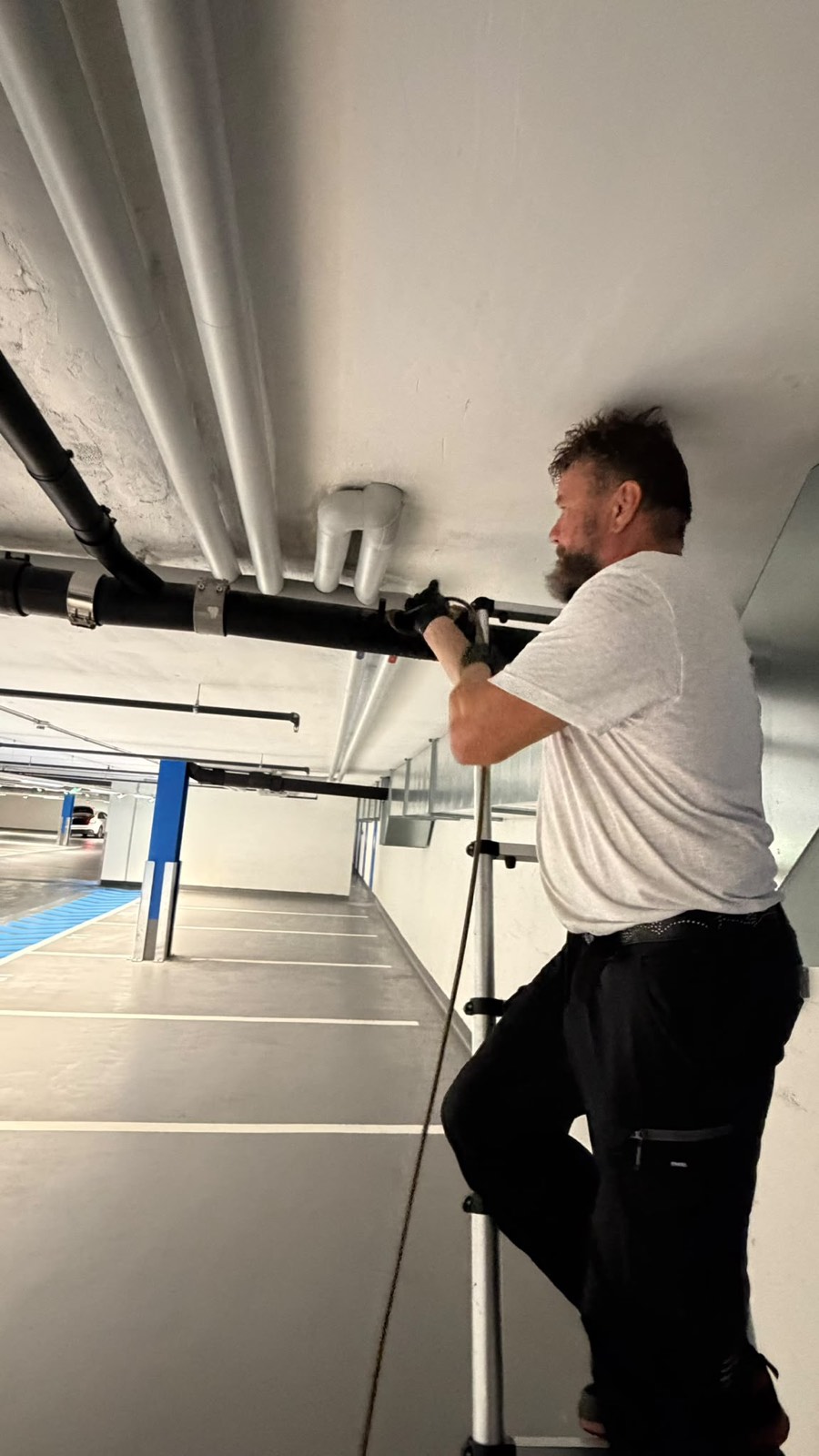
You should have drainage cleaned when damp appears in the basement, waterlogging forms in the garden or the drainage pipe is visibly no longer carrying water away. Over the years, drainage pipes become blocked with sludge, sand, iron ochre and roots, so that they no longer carry seepage water away from the building. Cleaning is carried out with gentle high-pressure water jetting, which clears the perforated pipes again. This restores the protective function of the drainage before expensive damp damage to the masonry occurs. As functioning drainage permanently protects the foundations from water pressure, looking after it is one of the most important and at the same time most frequently neglected maintenance tasks on a building.
What is drainage for in the first place?
Drainage is a system of perforated pipes laid around a building or under an area to take up excess water from the ground and carry it away in a controlled way. It keeps water pressure away from basement walls and foundations and prevents waterlogging in the soil. For it to work, the water must enter the pipes through small slots and flow unhindered to the outlet or soakaway shaft. It is precisely these slots that become blocked over time.
Why does drainage become blocked?
Several causes lead to blockages. Fine sand and sludge are washed in with the seepage water and are deposited in the pipe. Iron ochre is particularly insidious: a sludgy, rust-brown deposit that forms when iron-rich groundwater comes into contact with oxygen. It literally glues the slots shut. On top of that come roots that grow into the damp pipes, as well as limescale and biological deposits. Once the pipe is blocked, the water backs up and presses against the building.
What makes this particularly problematic is that these processes happen gradually. The blockage builds up over months and years without anything being visible on the surface. Only when the drainage reaches a critical point does damp damage suddenly appear. That is why preventive checks are so valuable: they detect the onset of soiling before it reaches the building and allow timely, inexpensive cleaning instead of costly damage repair.
When is cleaning necessary?
Clear warning signs are damp or wet basement walls, salt efflorescence on the masonry, a musty smell and standing water in inspection chambers. Permanently waterlogged lawns or puddles along the facade after rain also indicate faulty drainage. If any of these symptoms appear, the drainage should be checked and cleaned. In addition, a preventive check at intervals is recommended, because functioning drainage protects the building fabric in the long term.
How does drainage cleaning work?
First, the technician gains access to the drainage system via the inspection and flushing shafts. A CCTV drain survey is often carried out first to assess the route, degree of blockage and any damage. This is followed by flushing with adapted high pressure and special nozzles that are matched to the sensitive, perforated drainage pipes.
The water jet loosens sludge, sand and iron ochre from the pipes and flushes them to the shaft, from where they are finally vacuumed up and collected. With heavy iron ochre build-up, several passes are sometimes needed, as the sticky layer only comes loose gradually. A reduced pressure matched to the perforated pipes is important, because drainage pipes are thinner-walled and more sensitive than ordinary wastewater pipes. A final camera check documents the result and shows whether the pipes are clear again. The extracted sludge is disposed of properly.
How often should drainage be maintained?
How often drainage needs cleaning depends heavily on local conditions. The decisive factors are the type of soil, the iron content of the groundwater and the amount of seepage water. In soils with a high iron content, iron ochre forms more quickly, so a check every one to two years makes sense. In more favourable conditions, longer intervals may be sufficient.
A sensible rule of thumb is to check the drainage regularly via the flushing shafts, combined with cleaning when there is a recognisable need. If you open the shafts occasionally and watch the water level and the amount of sludge, you will recognise early on when flushing is needed. A maintenance contract with fixed dates relieves owners of this check and ensures that the protective function of the drainage is maintained in the long term.
Can drainage damage be detected in the process?
Yes, the CCTV drain survey carried out as part of the cleaning reveals not only soiling but also structural defects such as crushed pipes, displacements or incorrect gradients. Such damage cannot be fixed by flushing alone and requires a targeted repair or rehabilitation. The documentation from the cleaning is therefore also the basis for deciding whether further measures are needed.
What if cleaning is not enough?
In some cases, flushing alone does not bring lasting improvement, for example if the drainage pipes are crushed, displaced or laid with an incorrect gradient. Then the water cannot drain away properly despite clean pipes. The accompanying CCTV drain survey reveals such structural defects and shows whether a repair or reconstruction of the affected section is needed. Even with very stubborn iron ochre, more frequent maintenance can make more sense than trying to solve the problem once and for all with a single cleaning.
If the drainage is basically intact but repeatedly put under strain, a well-thought-out maintenance plan helps. This includes regular cleaning of gutters, roof water pipes and gully pots, so that as little dirt as possible gets into the drainage in the first place, as well as checking the flushing shafts. This keeps the building dry in the long term, and costly rehabilitation can be avoided or at least postponed.
What does drainage cleaning cost?
The costs depend on the pipe length, the type of blockage and access. As a guide, there is an hourly rate of around CHF 160 per hour plus a flat call-out fee of about CHF 60, and an accompanying CCTV drain survey can be added from around CHF 50. These figures can vary by plus/minus 15 per cent. Heavy iron ochre build-up increases the effort, as several flushing passes may be needed. A quote in advance after the camera check provides clarity about the amount to be expected.
Damp basement or waterlogging around the house? Karo Kanaltechnik checks your drainage by camera and flushes it clear gently, so that your building is dry again. In the event of acute water pressure, our 24/7 emergency service can be reached around the clock on +41 43 588 12 08.