What is a roof water pipe?
A roof water pipe is the vertical and horizontal section of pipe that carries rainwater away from the roof. On a pitched roof, the gutter collects the water and carries it to the downpipe on the façade. On a flat roof, roof outlets take in the water and usually carry it down through the building.
At its lower end, the roof water pipe connects to the underground drain for stormwater. Depending on the property, the water then flows into the sewer system, an infiltration system or a retention structure. It is planned as part of the property drainage to SN 592 000.
In everyday use, several terms are used side by side. ‘Downpipe’ and ‘rainwater downpipe’ mean the visible, vertical pipe on the façade. ‘Roof outlet’ is the inlet in the flat roof into which the water flows first. ‘Roof drainage’ is the umbrella term for the whole system of gutters, outlets, downpipes and emergency overflows. The roof water pipe is the section in between that connects all these parts to the drainage system in the ground.
Design: from the gutter to the underground drain
On a classic pitched roof, roof drainage starts at the eaves. The gutter collects the water along the whole length of the roof and carries it with a slight fall to the gutter outlet. This is where the downpipe begins; it is taken to the façade via bends and fixed with pipe clips. There is often a leaf guard in the gutter outlet that holds back coarse material.
Just above the ground, the downpipe changes into a sturdier shoe pipe that can withstand knocks from lawnmowers or bicycles. On many properties, there is a cleaning access point on the shoe pipe or directly below it, through which specialists can jet the pipe downwards. Some properties instead have a silt trap at the foot of the downpipe, in which sand and leaves settle before the water flows into the underground drain.
From ground level, the roof water continues in the horizontal underground drain – in a separate system in its own stormwater pipe, in a combined system together with the foul water. These sections of pipe in the ground cannot be seen from outside and are therefore often only noticed when they cause problems.
Downpipe materials
Downpipes on the façade are usually made of copper, titanium zinc, coated steel or plastic. In the ground and inside the building, plastic pipes made of PE, PP or PVC are used, and in older buildings also cast iron, vitrified clay or fibre cement. It is precisely the old spigot-and-socket joints in the ground where roots later get in or pipes become displaced against each other.
External and internal roof drainage
External rainwater downpipes made of copper, zinc, steel or plastic are easy to reach and easy to check. Their weak point is the transition into the ground: this is often where there is a shoe pipe with a cleaning access point or a silt trap in which leaves and sand collect.
Internal roof water pipes are common on the flat roofs of residential and commercial buildings. They run in ducts or walls and cannot be seen from outside. A blockage therefore goes unnoticed for a long time, until water builds up on the roof or escapes from a leaking joint. Flat roofs also need emergency overflows that carry the water away in a controlled manner if the main outlet is blocked.
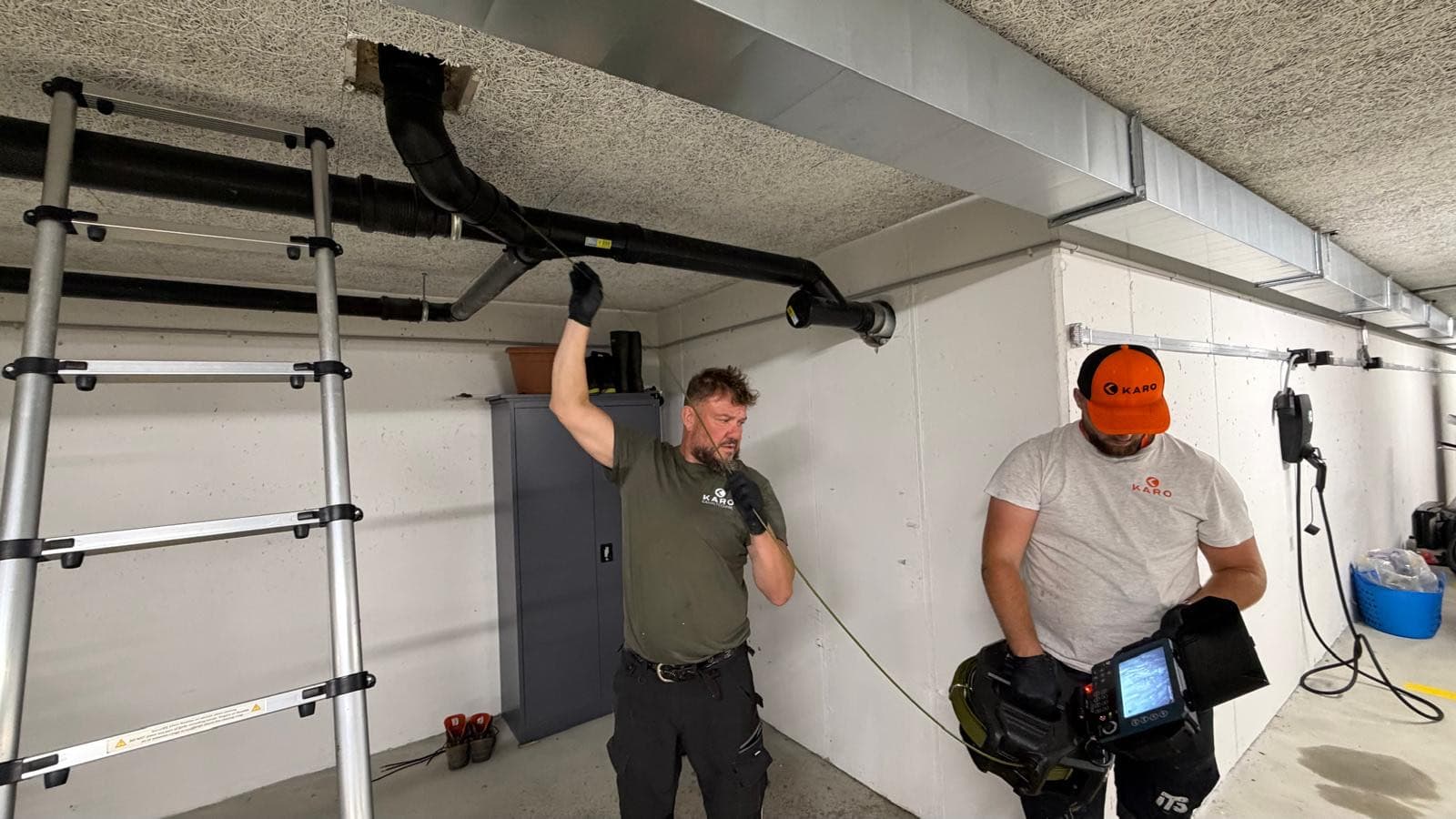
Internal pipes have another disadvantage: if water escapes, it happens in the middle of the building. Damp patches on ceilings, in service ducts or in the underground car park are therefore always a reason to have the roof water pipe checked too, not just the water supply pipes.
Roof water pipe or soil stack? The difference
The two terms are often confused, because both run vertically down through or along the building. The soil stack, however, is the wastewater pipe for foul water: the washbasin, shower, toilet and kitchen on every floor discharge into it. It is vented through the roof and carries wastewater that belongs in the treatment plant.
The roof water pipe, on the other hand, only carries rainwater from the roof. In modern buildings, the two run separately, even if they lie side by side in the same service duct. This separation is important: clean roof water should soak away or go into the stormwater pipe wherever possible, but foul water never should. An incorrect connection, where a washing machine is connected to the roof water pipe, for example, sends polluted water into the infiltration system or the watercourse.
The problems differ too. In the soil stack, blockages are caused mainly by grease, soap, hair and wet wipes; in the roof water pipe, by leaves, moss, sand and, in winter, ice. Cleaning and prevention differ accordingly.
Flat roof drainage and the emergency overflow
On a flat roof, water does not flow into a gutter by itself. A slight fall in the waterproofing carries it to the roof outlets, which usually sit in gravel guards or under gratings. From there, internal roof water pipes carry the water vertically down through the building. On green roofs and retention roofs, the roof layer also holds back some of the water and releases it with a delay.
Because a flat roof can fill up with water like a tub if the outlet is blocked, every flat roof drainage system includes emergency drainage. The emergency overflow sits somewhat higher than the main outlet and only comes into action when the main outlet can no longer cope. It is often designed as a spout or an opening in the roof parapet that visibly discharges the water outside.
This visibility is intentional: if water runs out of the emergency overflow even though it is only raining moderately, it is a clear sign that the main outlet or the roof water pipe below it is blocked. The pipe should then be cleaned quickly, before a heavier thunderstorm overloads the roof.
Looking after flat roof outlets properly
Roof outlets and emergency overflows on flat roofs should be checked at least once a year, ideally after the leaves fall and before the winter. Leaves, moss and wind-blown dirt are removed from gravel guards and gratings. If water stands on the roof for a long time after rain, it is worth checking the pipe below with the camera.
Blocked downpipe: leaves, moss, ice
The main cause is organic material. Leaves, needles, blossom and moss are washed off the roof and collect in bends, branches and at the transition to the underground drain. On top of this come sand and granules from roof tiles or bitumen sheeting, which compact into solid deposits.
In the ground, roots play a major role. Older roof water pipes made of vitrified clay or cement often have leaking joints through which fine roots get in. Birds and wasps also occasionally build nests in outlets. In winter, ice can narrow the cross-section further.
Ice is mainly an issue with external downpipes on the shady side. During the day, snow on the roof melts; at night, the meltwater freezes in the downpipe. If the pipe is already narrowed by leaves, it freezes solid more quickly. The water then backs up in the gutter, overflows and forms icicles on the façade. Using force with a hammer or bar damages the pipe; it is better to wait or to loosen the ice carefully with warm water.
How to tell that a downpipe is blocked
Typical signs are a gutter that overflows in normal rain, water escaping from the cleaning access point or a joint on the shoe pipe, gurgling noises in the pipe and wet patches on the façade below the gutter. If you tap the downpipe, a blocked section often sounds dull rather than hollow. If everything drains away at the top but water backs up at the foot, the blockage is usually in the ground.
Consequences of a blocked roof water pipe
If the gutter overflows, the water runs down the façade, soaks the render and timber and reaches the cellar wall. With internal pipes, water can spread in walls and ceilings. On flat roofs, a blocked outlet leads to water accumulating, which puts additional load on the roof.
Less visible but just as important: if the stormwater pipe in the ground is blocked or has collapsed, the water can soak into the ground around the foundations. Damp cellar walls and water getting in during heavy rain are then typical signs.
Cleaning a downpipe: from above or via the cleaning access point
Gutters and leaf guards should be checked and emptied at least once a year, ideally after the leaves fall. If the downpipe itself is blocked, it is cleaned from above or via the cleaning access point using a drain snake or high-pressure water. It is best to jet the connected underground drain at the same time.
If problems keep recurring, a camera inspection provides clarity: it shows whether roots, breaks or displacements are obstructing the flow. Minor damage can be repaired without digging using a patch liner, longer sections with a CIPP liner. This keeps the roof drainage working in the long term, without the garden or driveway having to be dug up.
Cleaning from above
If the blockage is in the upper part, for example in the gutter outlet or the first bend, cleaning from the gutter is often enough. Leaves are removed by hand, and the pipe is then flushed through with water. For work on the roof or on tall ladders, safety comes first. On buildings with several storeys, steep roofs or flat roofs without fall protection, the work belongs in the hands of specialists.
Cleaning via the cleaning access point
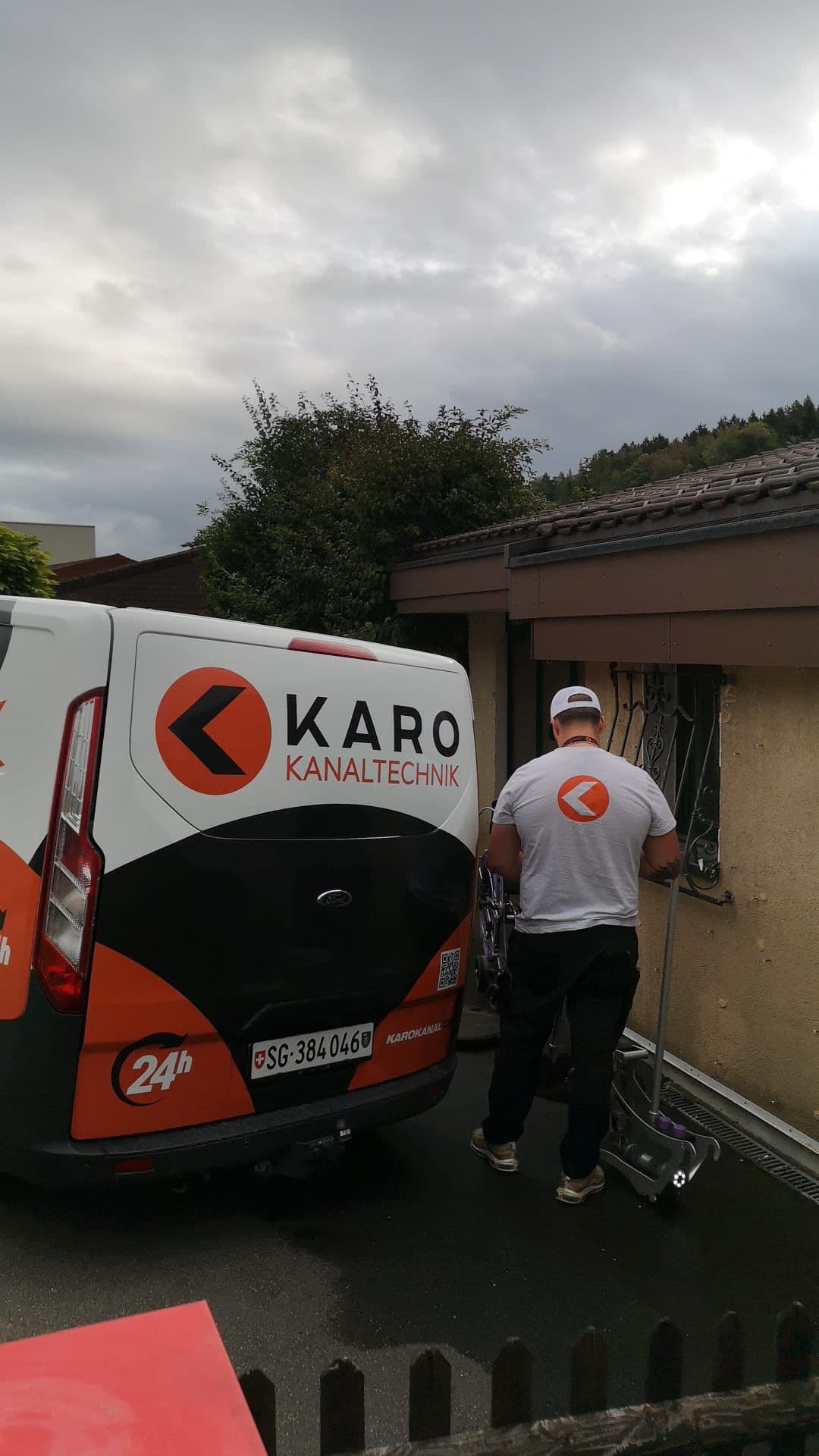
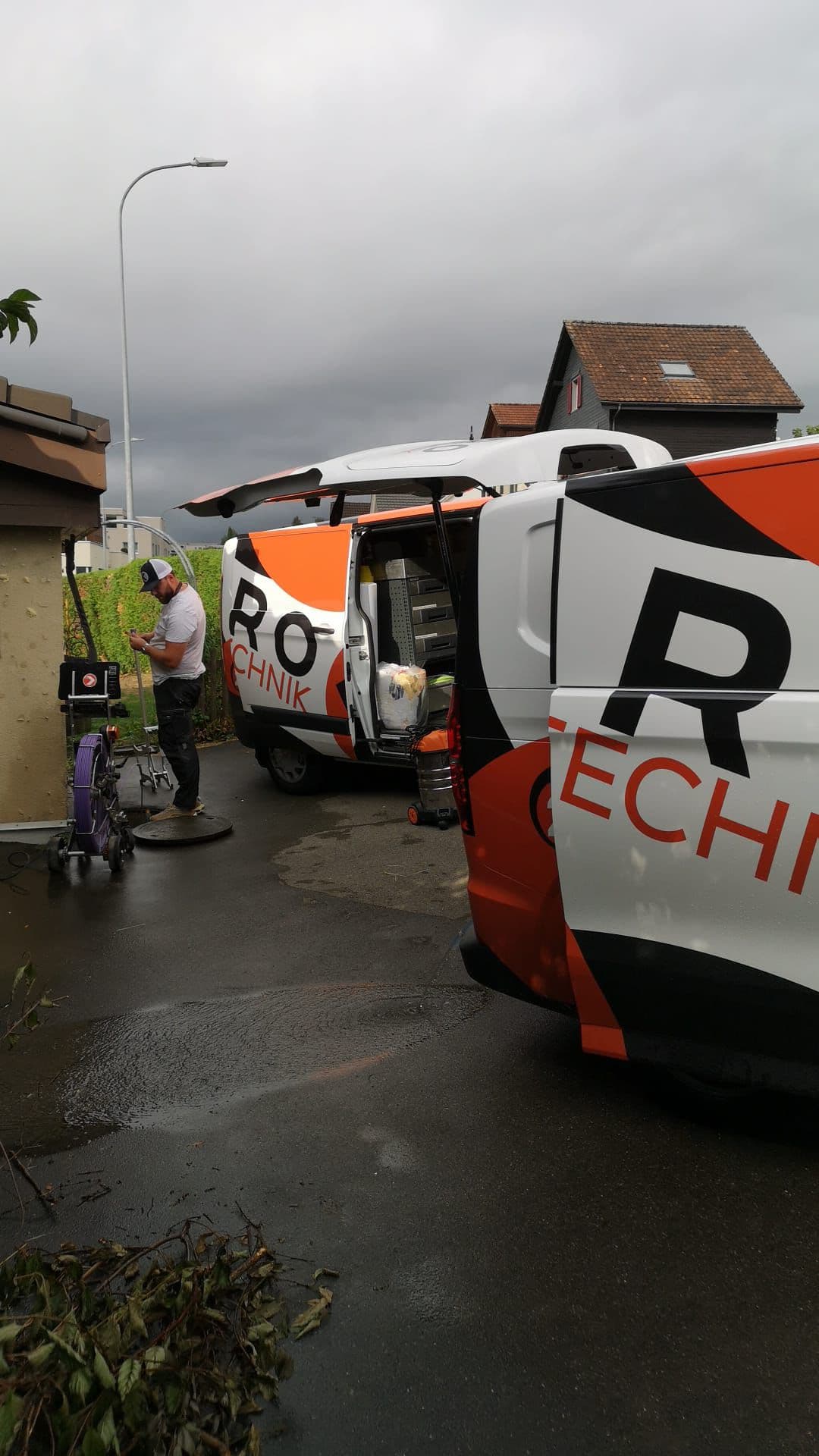
If the blockage is in the shoe pipe or below it, the cleaning access point at the foot of the downpipe is opened. From there, the pipe can be jetted downwards into the underground drain or worked on with a drain snake. Karo uses chemical-free high-pressure water jetting for this, with the pressure adjusted to the pipe material and condition, and uses a cutter head for roots.
If there is no cleaning access point, the work is done via the next inspection chamber or silt trap. Afterwards, the camera shows whether the pipe is really clear. The footage is documented to SN EN 13508-2, so that the owners and property management can later see what condition the pipe was in.
Where may roof water be discharged?
Roof water is generally regarded as unpolluted wastewater. Under the Waters Protection Act, it should be allowed to soak away wherever possible, instead of placing a burden on the sewer system and the treatment plant. If infiltration is not possible, it is discharged into a stormwater pipe or a watercourse; in areas with a combined system, it flows into the sewer system together with the foul water.
Which solution applies to a plot is determined by the canton and municipality, for example through the general drainage plan (GEP, Genereller Entwässerungsplan) and the drainage regulations. During conversions, when adding a new roof area or during roof renovation, it is worth checking the drainage at the same time. This often reveals that old pipes are too small, have roots growing into them or are incorrectly connected.
How much does it cost to clean a roof water pipe?
Karo charges for cleaning by time spent: CHF 160 per working hour plus a CHF 60 call-out fee, excl. VAT. One hour including the call-out therefore comes to CHF 220 excl. VAT or CHF 237.82 incl. 8.1% VAT. If the pipe is then checked with the camera, there is a surcharge from CHF 50.
A typical job at a single-family home usually costs around CHF 150 to CHF 400. These are guide values excl. VAT and materials; what counts is accessibility, the length of the pipe, the type of blockage and whether roots have to be cut out. You can get a guide price for your property via the enquiry form.
At an apartment building in Thalwil, a gutter overflowed every time it rained heavily, even though it had been cleaned. Karo jetted the downpipe and the connected stormwater pipe at high pressure and then inspected them with the camera. In the ground, there was a dense braid of roots from a neighbouring hedge that almost completely closed off the cross-section. The roots were cut out and the leaking joint was sealed with a patch liner. Since the work, the roof water has been draining away freely again.