
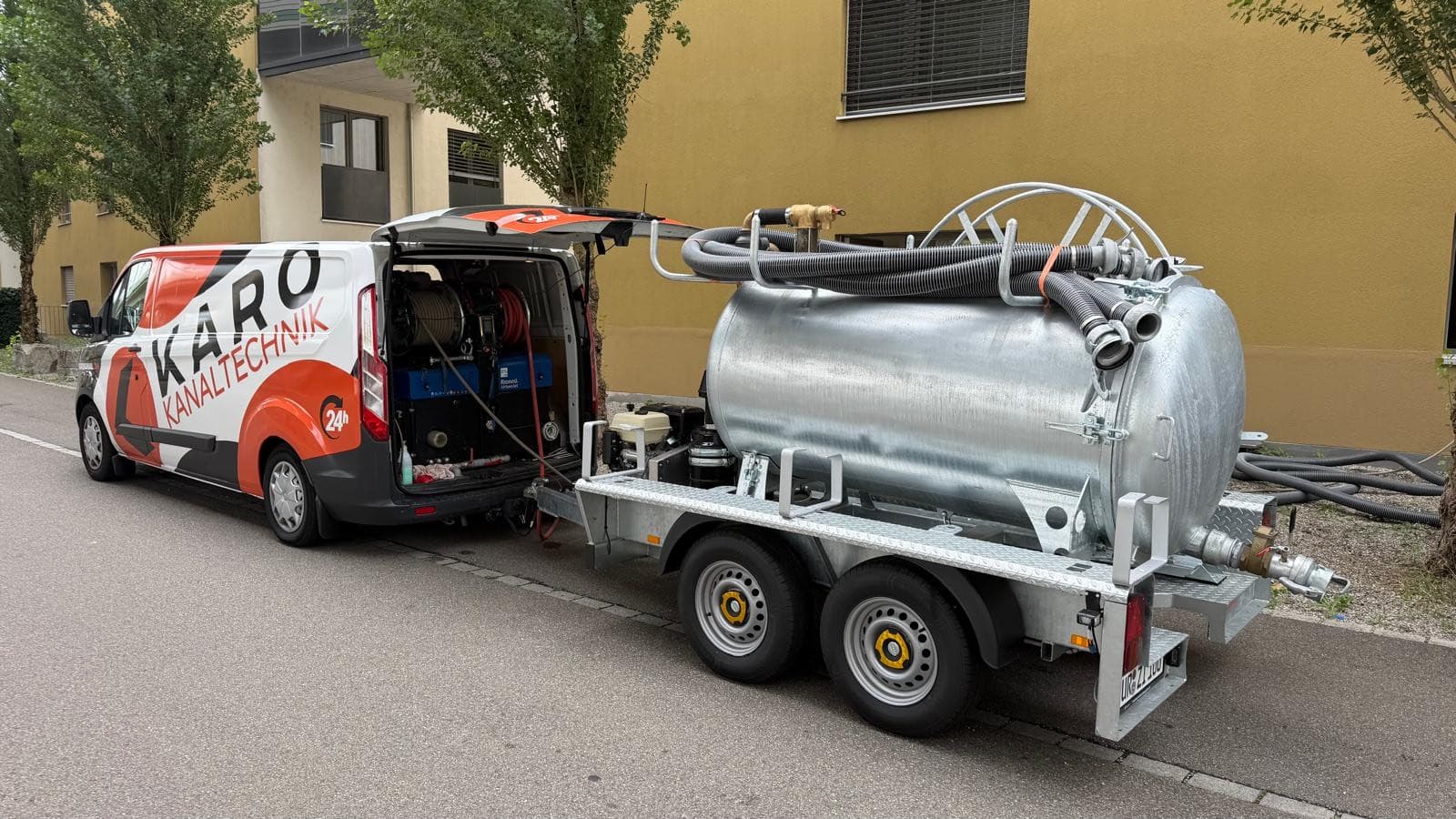
What is a land drain?
A land drain is a pipe with holes or slots that lies in the ground and collects excess water there. The water enters the pipe through the openings and flows with a gradient to a chamber, an infiltration system or an outlet pipe. In Switzerland, land drain (Sickerleitung) is the common term for the pipe that is laid along the foundations of residential buildings and protects the basement walls from water pressure.
For this to work, the pipe does not simply lie in clay, but in a filter pack of coarse gravel. The gravel lets the water seep quickly through to the pipe. A filter fleece (geotextile) around the pack or around the pipe holds back fine soil particles so that they do not clog the pipe. Today, land drain pipes are usually made of plastic; in older properties you still find clay or porous concrete filter pipes.
As a rule, flushing or inspection chambers are located at the corners of the building and at changes of direction. They allow the pipe to be jetted later, surveyed with the camera and observed to see whether water and sludge are arriving. A land drain without accessible chambers can hardly be maintained – if they are missing, they are usually added during a rehabilitation.
Land drain, drainage, soakaway pit: the difference
The terms are often mixed up in everyday use. «Drainage» refers to the whole system for draining the ground around a building or under an area: land drains, gravel pack, fleece, flushing chambers and the outlet pipe. The land drain is the central component of this system, i.e. the perforated pipe itself. In practice, «jetting the land drain» and «jetting the drainage» therefore usually mean the same job.
A soakaway pit, on the other hand, is not a pipe but a permeable chamber that collects water and releases it into the subsoil through its base and walls. Many land drains discharge into such a soakaway pit or another infiltration system. Land drain and soakaway pit therefore often work together, but they are different components.
It is also important to distinguish it from the foul water pipe. A land drain carries clean ground and hillside water, not wastewater from the kitchen, bathroom or toilet. If seepage water gets into the foul sewer system, it counts as infiltration water that puts an unnecessary load on the wastewater treatment plant. Where a land drain may discharge is determined by the municipality and the drainage plan.
Why land drains silt up
The most common cause is fine material: sand, silt and clay are washed in with the seepage water and settle on the pipe invert. If the filter fleece is missing or damaged, or if the filter pack was backfilled with unsuitable material, this happens much faster. With each layer the free cross-section becomes smaller, until the water stands in the pipe instead of draining away.
Iron ochre is particularly stubborn. It forms when groundwater containing iron comes into contact with oxygen – which is exactly what happens in a land drain. A rust-brown, slimy coating forms that clogs the slots. On top of this come limescale deposits, especially with water that seeps past fresh concrete or lime-rich backfill, and roots from hedges and trees that deliberately grow into the damp pipes.
Another often overlooked cause is misconnections. If roof water is fed directly into the land drain, leaves, moss, tile grit and dirt get in, and the pipe is overloaded during heavy rain. Crushed pipes after building work or reverse falls due to settlement also slow drainage. The consequences appear gradually: damp basement walls, salt efflorescence, a musty smell, water in light wells or permanently wet patches in the garden.
Jetting a land drain: the process
It starts with a survey of the existing situation. The team looks for the flushing chambers, opens them and checks whether water is standing or sludge is lying in them. If the route of the pipe is unclear, it is determined with a camera and locating sonde. A short camera run before cleaning is often worthwhile to see whether the pipe is merely dirty or structurally damaged.
Jetting is done from chamber to chamber. The jetting nozzle works with rear-facing jets: it pulls itself into the pipe and washes the loosened material back to the chamber. Our chemical-free high-pressure water jetting delivers up to 200 bar, but for land drains the pressure is deliberately reduced considerably and the nozzle and flow rate are matched to the pipe material. Thin-walled plastic pipes and old clay pipes would be damaged at full sewer pressure, and the fleece could be washed out.
The jetted material of sand, sludge and ochre is collected in the chamber with the suction hose and disposed of properly. Heavy ochre infestation requires several passes, because the layer only comes away gradually. Ingrown roots can be removed with special nozzles or mechanically, provided the pipe allows it.
Finally, the camera surveys the cleaned sections. The footage shows whether the pipe is clear again and makes damage such as fractures, deformations, displacements or a missing gradient visible. Karo documents the findings in accordance with SN EN 13508-2, so that you have a traceable basis for further maintenance or any rehabilitation.
How often should a land drain be jetted?
There is no fixed interval that suits every property. The decisive factors are the soil type, the iron content of the groundwater, the amount of water arising, nearby trees and the condition of the filter fleece. In iron-rich soils a check every one to two years makes sense; in unproblematic conditions longer intervals are sufficient. The municipality of Stallikon states one to three years for land drains in its information sheet «Private drainage installations», the municipality of Bassersdorf every two years on average, more often with hard water.
A look into the flushing chambers makes more sense than a rigid calendar. If you open them once or twice a year, you can see whether sludge is collecting, whether the water is rust-brown or whether it stands for an unusually long time after rain. After the first jetting with a camera check, the right interval for your property can be determined much more precisely.
You should act immediately if you have damp basement walls, new salt efflorescence, water in the light well or if a flushing chamber is full after rain. A camera check of the land drain is also worthwhile after building work on the house, after felling large trees or before buying an older property.
How much does it cost to jet a land drain?
Karo charges by time and effort: CHF 160 per working hour plus a CHF 60 call-out fee; the CCTV check costs a surcharge from CHF 50. All prices are excl. VAT. One hour of work including call-out therefore comes to CHF 220 excl. VAT or CHF 237.82 incl. 8.1% VAT.
Worked example: if jetting the land drain of a single-family home takes two hours, it costs CHF 380 excl. VAT (2 × CHF 160 plus CHF 60 call-out fee). With a camera check from CHF 50, it comes to from CHF 430 excl. VAT or around CHF 465 incl. VAT. At Karo, a typical cleaning job at a single-family home usually costs between CHF 150 and 400 – with land drains, however, the amount depends heavily on their condition.
The main cost drivers are the length of the pipe, the number and accessibility of the flushing chambers, heavy ochre or root infestation and the amount of sludge to be sucked out. Covered-over or missing chambers that first have to be found also take time. If you send us photos of the chambers and the drainage plan in advance, we can better estimate the work involved and give you a quote before work begins.
Relaying or rehabilitating a land drain
If the camera shows crushed or broken pipes, a continuous reverse fall, missing fleece or disintegrated clay pipes, even the best jetting will not bring lasting improvement. In that case the affected section or the entire land drain must be relaid. This is done using open-cut construction: the pipe is exposed, the new land drain pipe is laid with a gradient in a fresh gravel pack with filter fleece, and flushing chambers are installed at corners and changes of direction so that the pipe can be cleaned in future.
This is often a good moment to remedy other defects: roof water wrongly running into the land drain is drained away separately, the waterproofing of the basement wall is checked, and the discharge is adapted as required by the municipality's drainage regulations. Whether relaying a land drain requires a permit should be clarified with the municipality in advance.
Trenchless rehabilitation with a CIPP liner is not an option for the perforated part of the land drain, because the liner would close the openings and the pipe would no longer take up any water. For the closed outlet pipe after it – for example the pipe from the last flushing chamber to the infiltration system or the rainwater connection – a CIPP liner can be an option, provided the condition, diameter and accessibility allow it. Karo provides a warranty of up to 10 years on rehabilitation work.
A typical case from the Greater Zurich area: at a single-family home on a slope, damp patches and white salt efflorescence appear on the basement wall after a wet spring. In two flushing chambers at the corners of the house, the water stands almost up to the rim, with a layer of rust-brown sludge at the bottom. The Karo team first locates the route of the land drain, then jets it from chamber to chamber at reduced pressure and sucks out the sludge and iron ochre. The subsequent camera run shows a clear pipe – and a downpipe connection through which roof water, including leaves, ran directly into the land drain. This is diverted, and an annual check of the chambers is agreed for the property.