
What is a drainage channel?
A drainage channel is an open-topped channel built into the ground and covered with a mesh, bar or slot grating. Unlike a floor drain or a gully, which take in water at a single point, the channel collects water along its entire length. Specialists therefore speak of linear drainage as opposed to point drainage.
This is necessary wherever a surface cannot be sloped so that all the water flows to one point – or where water must on no account cross a boundary. Classic examples are the sloping garage driveway in front of the door, the transition from a terrace to the house facade or the level-access shower without a shower tray. Here the channel forms a kind of barrier line at which the water is intercepted.
In everyday language, several terms are used for the same component: drainage channel, channel drain, trench drain or simply channel. If the grating is very narrow and inconspicuous, it is called a slot drain, and in the shower a shower channel. What is not meant is the roof gutter: it collects rainwater on the roof and carries it away via the roof water pipe.
Types and locations: driveway, yard, terrace, shower
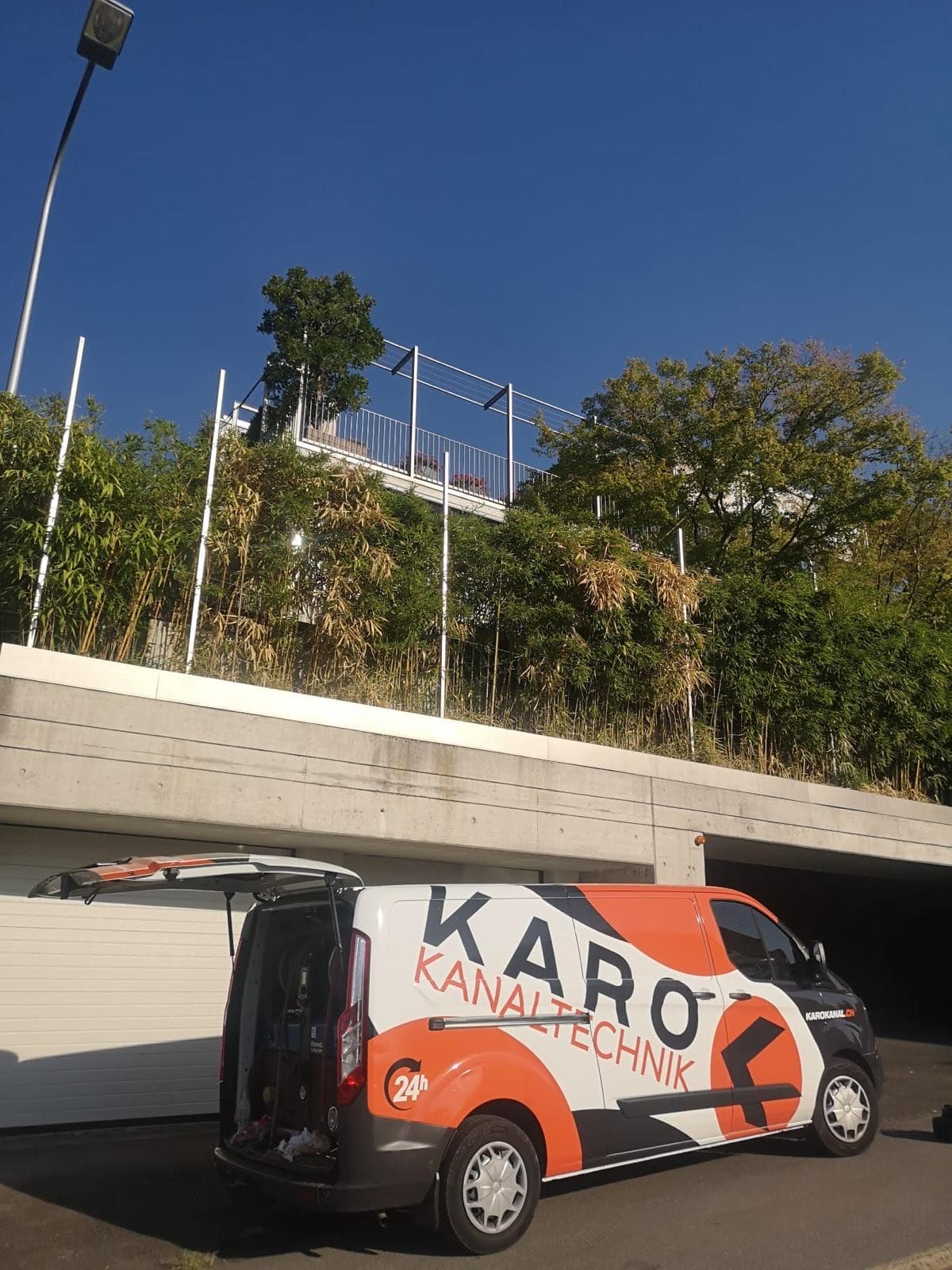
Garage driveway and underground car park ramp: here the channel runs across the direction of travel, usually directly in front of the door or at the foot of the ramp. It prevents rainwater from the road or the driveway from running into the garage. Because cars drive over it, it must be trafficable. If the channel at the foot of an underground car park ramp lies lower than the sewer, the water cannot drain away by gravity – the channel then leads into a pump chamber with a lifting station.
Yard, car park and access road: larger paved areas are often drained with several channel runs that lead into silt traps or gully boxes. In commercial premises, delivery zones and washing areas, heavier designs are used, sometimes with a downstream separator if the water may be contaminated with oil or fuel.
Terrace, balcony and front entrance: in front of level-access doors and French windows, a channel catches splash water and standing water before it reaches the threshold. These channels are usually narrow, made of plastic or metal and only walked on. They are often laid flush with the gravel or paving and are therefore easy to overlook – until water backs up in front of the door.
Shower and wet room: shower channels are not part of external drainage, but work on the same principle. They lie flush with the floor in the fall and carry the shower water via a built-in water seal trap into the foul water pipe. They are covered not by the channel standard EN 1433, but by the standard for drains in buildings, EN 1253.
Load classes to EN 1433: which channel is trafficable?
Drainage channels for traffic areas in Europe are manufactured and tested to the standard EN 1433; in Switzerland it applies as SN EN 1433. The standard divides channels, including their grating, into load classes. The letter denotes the class, and the number the test load in kilonewtons that the channel and cover must withstand in the test.
A 15 is intended for areas used only by pedestrians and cyclists, such as garden paths and terraces. B 125 applies to footpaths, pedestrian zones and private parking areas as well as garage driveways used by cars. C 250 is intended for kerb areas and road verges. D 400 covers carriageways of roads and parking areas used by all vehicles. E 600 and F 900 are reserved for areas with very high wheel loads, for example industrial and port facilities or airfield operating areas.
If you are looking for a «trafficable drainage channel», the private driveway of a single-family home usually needs at least B 125. If vans, refuse lorries or HGVs drive over the channel, a higher class is needed. What matters is the whole system: the channel body, grating, grating fixing and the concrete foundation in which the channel is bedded. A heavy grating on a channel that has been installed too weakly will not hold.
A channel that has been chosen too weak or poorly bedded shows itself over time through rattling or loose gratings, broken channel edges and sunken sections. Water stands in such channels, sand settles, and drainage gets worse from year to year.
Construction and connection to the silt trap and rainwater pipe
A channel system consists of the channel units, the covers, an end cap at the start and an outlet at the end or in the middle. The channel body is made of polymer concrete, concrete, plastic, stainless steel or galvanised steel. Some channels have a built-in invert fall, others are laid without their own gradient; there the water only flows to the outlet through the head of water building up in the channel and is more likely to leave sand behind.
Ideally, the outlet has a gully box with a silt bucket, or the channel leads into a silt trap. There, sand, gravel and leaves settle before the water flows into the pipe. If this settling space is missing, all the dirt from the surface goes directly into the underground drain, and deposits form there that later have to be jetted out.
From here, the water flows into the rainwater pipe, in a combined system into the shared wastewater pipe, or into an infiltration system. Where the water from a surface belongs is set by the municipality or the canton and by the property's drainage plan. Channels on surfaces where polluted water is to be expected, such as washing areas, need separate treatment and must not simply be connected to the infiltration system.
Typical problems: leaves, sand, backflow
The most common problem is a creeping blockage. Leaves, pollen, bark mulch, grit and chippings from winter gritting are washed into the channel with every rainfall. This dirt is left behind in the channel body and above all in the silt bucket or silt trap. Once the settling space is full, it moves on into the pipe, or the channel cross-section fills up so much that, in heavy rain, the water runs over the channel into the garage or against the house facade.
A second problem is backflow. If the pipe behind the channel cannot take the water quickly enough – because it is blocked, because roots have grown into it or because the public sewer system is full during a thunderstorm – the water in the channel rises. With channels in front of underground car parks that lie below the backflow level, this is particularly delicate: without a lifting station or backflow protection, water from the sewer can be pushed back into the garage.
Other findings are missing or loose gratings, broken channel units, sunken sections with standing water, odours from shower channels with a dried-out or dirty water seal trap, and ice formation in winter when water stands in the channel.
Cleaning a drainage channel: by hand, with high pressure, with suction
Short, easily accessible channels can be cleaned by hand: lift the gratings, remove coarse dirt with a shovel or trowel, empty the silt bucket at the outlet and rinse with the garden hose. That is enough as long as only the channel itself is dirty and the water drains away quickly after rinsing.
If the water drains poorly despite a clean channel, the blockage is in the outlet, the silt trap or the connecting pipe. Then the garden hose is no longer any help. Karo jets the pipe without chemicals at high pressure of up to 200 bar: the jetting nozzle is inserted from the outlet or the nearest manhole, loosens deposits and pulls them back, where they are taken up with the suction hose. At the same time, the team sucks the silt trap empty.
If the problem recurs or it remains unclear why the water is standing, a camera inspection shows what is going on in the pipe: roots, a displacement, a break or a section with the wrong gradient. The condition is documented in accordance with SN EN 13508-2, so that owners or property managers have a reliable basis for the next steps.
With shower channels, the cause is usually hair and soap residue in the water seal trap. Taking out the insert, removing the hair, cleaning it and putting it back solves the problem in many cases. If the blockage persists afterwards, it sits further back in the pipe and is a job for pipe cleaning.
Maintenance: how often to check and clean?
There is no fixed interval for all channels; the interval depends on how much dirt falls on the surface. It has proved worthwhile to check channels and silt buckets in autumn after the leaves have fallen and in spring after winter gritting. Channels under trees, next to building sites or on gravel areas need more frequent checks than channels on a paved area without planting.
For apartment buildings, underground car parks and commercial properties, it pays to include channels, silt traps and rainwater pipes together in regular drain maintenance. That way, silt traps are emptied before dirt gets into the pipe, and damage is noticed early. A grating that rattles, a section with standing water or a silt bucket that is full at every check are indications that a closer inspection is advisable.
If you call in Karo for the cleaning, you pay by time: CHF 160 per hour plus CHF 60 call-out fee, excl. VAT. One hour including call-out therefore costs CHF 220 excl. VAT or CHF 237.82 incl. 8.1% VAT. A CCTV drain survey is charged with a surcharge from CHF 50.
At a single-family home in Kloten, after every thunderstorm water stood in front of the level-access terrace door and ran up to the threshold. The narrow channel in front of the door was full of gravel, leaves and soil from the planters. The owners emptied it by hand, but the water still stood. Karo found the real cause in the outlet: the short connecting pipe to the silt trap was choked with sand. The team jetted the pipe clear at high pressure, sucked the silt trap empty and then inspected the pipe with the camera. It was intact. Since then, the owners have checked the channel and silt trap every autumn after the leaves have fallen.