
What is a wastewater pipe?
A wastewater pipe is any pipe through which used water or precipitation is carried away from a building. This includes the short pipe under the washbasin as well as the vertical pipe in the service shaft, the horizontal pipe under the basement ceiling and the buried pipe that finally joins the municipal sewer. Together, these pipes form the property drainage.
Almost all wastewater pipes in the house work as gravity pipes: the water flows without a pump, by gravity alone, and does not completely fill the pipe. This gives rise to the three basic rules of every wastewater installation: horizontal pipes need a continuous gradient, vertical pipes need air so that no negative pressure develops, and every pipe must remain accessible for cleaning and inspection. Only where rooms lie lower than the public sewer does a lifting station raise the wastewater via a pressure pipe.
This article explains the types of pipe and their function. The pipe materials involved – cast iron, vitrified clay, fibre cement or plastic – are described under the glossary term sewer pipe.
The types of pipe in the house according to SN 592 000
In Switzerland, the standard SN 592 000 «Installations for property drainage» from VSA and suissetec governs how wastewater pipes are planned and installed. For pipes inside buildings, the European SN EN 12056 series of standards supplements the requirements. Both distinguish pipes by their location and task. If you follow a drop of water from the washbasin to the road, it typically passes through five sections.
The branch pipe, often also called the single connecting pipe, connects a sanitary fitting such as a washbasin, shower, WC, sink or washing machine to the next larger pipe. The water seal trap sits directly on the fitting. Branch pipes are short, have the smallest diameter in the system and therefore block most often – usually due to hair, soap or kitchen grease. If several fittings in a bathroom are combined into one pipe, this is referred to as a common branch pipe.
The stack pipe, known in everyday language as the soil stack, carries the wastewater vertically down through the floors. The branch pipes join it on each floor. At the top, the stack is extended above the roof as a ventilation pipe.
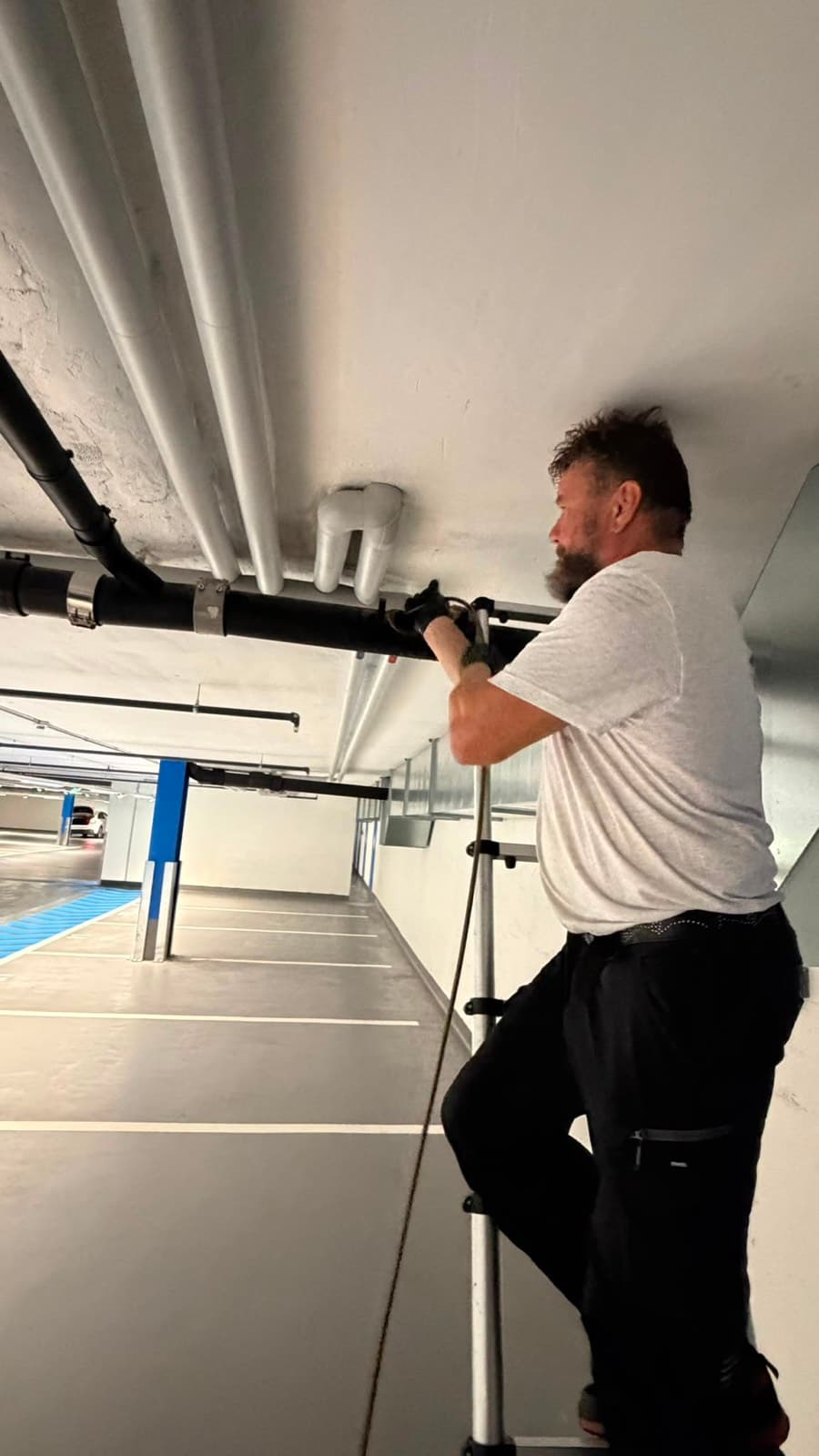
The collector pipe is a horizontal pipe inside the building that takes several stacks. It typically hangs from the basement ceiling or under the ceiling of an underground car park and is therefore visible and easily accessible. The underground drain, by contrast, lies in the ground or under the floor slab and can only be reached via manholes and cleaning access points. The final section is the house connection, i.e. the pipe from the last inspection chamber on the plot to the public sewer.
A word of caution about the terms: in practice, the German word for connecting pipe is used for two different things – for the short pipe on the fitting and for the pipe from the plot to the municipal sewer. When reporting damage, it is therefore best to describe where the pipe is located.
Foul water and rainwater pipes
Besides their location, wastewater pipes are distinguished by what they carry. Foul water pipes carry the wastewater from the kitchen, bathroom, WC and laundry room. It has to reach the wastewater treatment plant and must neither soak away nor flow into a watercourse. Rainwater pipes carry away rainwater from the roof, balconies, open areas and driveways.
Whether the two types of water flow separately depends on the municipality's drainage system. In the combined system, foul water and rainwater flow in the same public sewer to the treatment plant. In the separate system there are two sewers, and the pipes on the plot must also be routed separately. Under the Waters Protection Act, unpolluted rainwater should be allowed to soak away where possible. Which solution applies to a property is set out in the general drainage plan (GEP) and the municipality's wastewater regulations.
A common fault in older buildings and conversions is incorrect connections: a roof water pipe is connected to the foul water pipe, or a washing machine drain to the rainwater pipe. In the first case, the treatment plant is burdened with clean water; in the second, foul water ends up in a stream. Such faults can be proven with a camera, smoke or dye.
Gradient: why every horizontal pipe has to slope
Because wastewater flows by gravity alone, every horizontal pipe – branch pipe, collector pipe and underground drain – must fall slightly and continuously from the fitting to the sewer. Only then is the water fast enough to carry solids such as paper, food scraps and sand with it. The minimum values for each type and diameter of pipe are set out in SN 592 000; planners and plumbers follow them.
The kitchen is a typical example of too little gradient: the branch pipe from the sink is often long and runs horizontally under the base units. Grease cools in it, sticks to the pipe wall and binds food scraps. If a blockage occurs again and again at the same point, a missing gradient or a dip is often behind it. In underground drains, such dips develop later when the ground beneath the pipe settles. A camera inspection with inclination measurement shows where the water stands.
Ventilation: no clean drainage without air
When water falls through a stack, it pushes air ahead of it and pulls negative pressure behind it. So that this pressure difference does not suck the sealing water out of the traps in the flats, the stack is continued above the roof as a ventilation pipe. Air flows in through it, and at the same time sewer gases escape above the roof instead of into the flat.
If the ventilation is missing, undersized or blocked by a bird's nest or leaves, typical signs appear: drains gurgle when water is draining elsewhere in the house, the water level in the WC fluctuates, and there is a sewer smell in the bathroom or kitchen. Air admittance valves can supplement the ventilation in certain cases. Whether and where they are permitted is set out in the standard; as a rule, they do not replace main ventilation above the roof.
Typical problems in wastewater pipes
Which fault occurs depends greatly on the type of pipe. In branch pipes, it is almost always blockages caused by hair, soap residue, grease, limescale or foreign objects. In stacks, deposits collect in the lower bend, where the water is diverted into the collector pipe or underground drain and slowed down. If water backs up on the ground floor while it is still draining upstairs, the plug is usually there.
In underground drains there is also structural damage: roots get in through leaking joints, pipe joints shift, cracks and fragmentation develop through settlement or traffic loads, and in older pipes encrustation narrows the cross-section. Leaking underground drains let wastewater escape into the ground or let groundwater in as infiltration water.
Warning signs of a problem in a wastewater pipe are slow drainage at several points at the same time, gurgling, sewer smells, water pushing up out of the floor drain in the basement, and damp patches on walls or ceilings. If the problem affects only a single fitting, the cause is usually in its branch pipe; if several floors or the whole house are affected, it is more likely in the stack, collector pipe or underground drain.
Cleaning and camera inspection of wastewater pipes
There is no one cleaning method for all pipes. Short branch pipes with a small diameter are cleaned mechanically with the drain snake, which loosens the plug or pulls it out. Stacks, collector pipes and underground drains are jetted at high pressure: a jetting nozzle pulls itself through the pipe with backward-facing water jets and loosens grease, sludge and sand from the pipe wall. Karo works without chemicals at up to 200 bar. Roots and hard encrustation are removed with a cutting head.
Access is via cleaning access points, inspection chambers or the roof vent. After cleaning, a CCTV drain survey shows whether the pipe is really clear and whether there is damage such as cracks, displacements or dips. The findings are coded in accordance with SN EN 13508-2 and recorded in a survey report with images. This documentation is the basis for deciding whether a pipe only needs cleaning or must be rehabilitated trenchlessly.
What does it cost to have a wastewater pipe jetted? At Karo, the hourly rate is CHF 160 plus a CHF 60 call-out fee, excl. VAT. A job at a single-family home usually costs CHF 150–400. For a CCTV inspection, there is a surcharge from CHF 50. The decisive factors are accessibility, pipe length and the type of blockage.
Maintenance: how to keep wastewater pipes working
The best protection starts at the drain: grease, food scraps, wet wipes, sanitary products and cat litter do not belong in the pipe. A strainer in the shower drain holds back hair. Traps on rarely used drains, for example in the guest bathroom or the basement, should be topped up with water regularly so that no sewer smell escapes.
For the pipes themselves, preventive jetting is worthwhile at intervals that depend on usage: in apartment buildings and commercial properties with kitchens it is needed much more often than in a single-family home. A camera inspection makes sense when ownership changes, before landscaping work or in the case of recurring blockages. It is also important that inspection chambers and cleaning access points remain accessible and do not disappear under paving, lawn or cladding – otherwise every job takes longer and costs more.
A typical case from the Zurich area: in an apartment building, water drains only slowly in the ground-floor flats, but normally on the upper floors. This does not point to a blocked washbasin, but to an obstruction deeper in the system. The team works from the cleaning access of the collector pipe on the ceiling of the underground car park and jets the pipe at high pressure. Grease deposits from the kitchen pipes, which had lodged at the transition from the stack into the horizontal collector pipe, are cleared. The subsequent camera inspection up to the inspection chamber shows that the pipe is clear again and undamaged. The property management company receives the survey report with images and a recommendation for preventive jetting.