
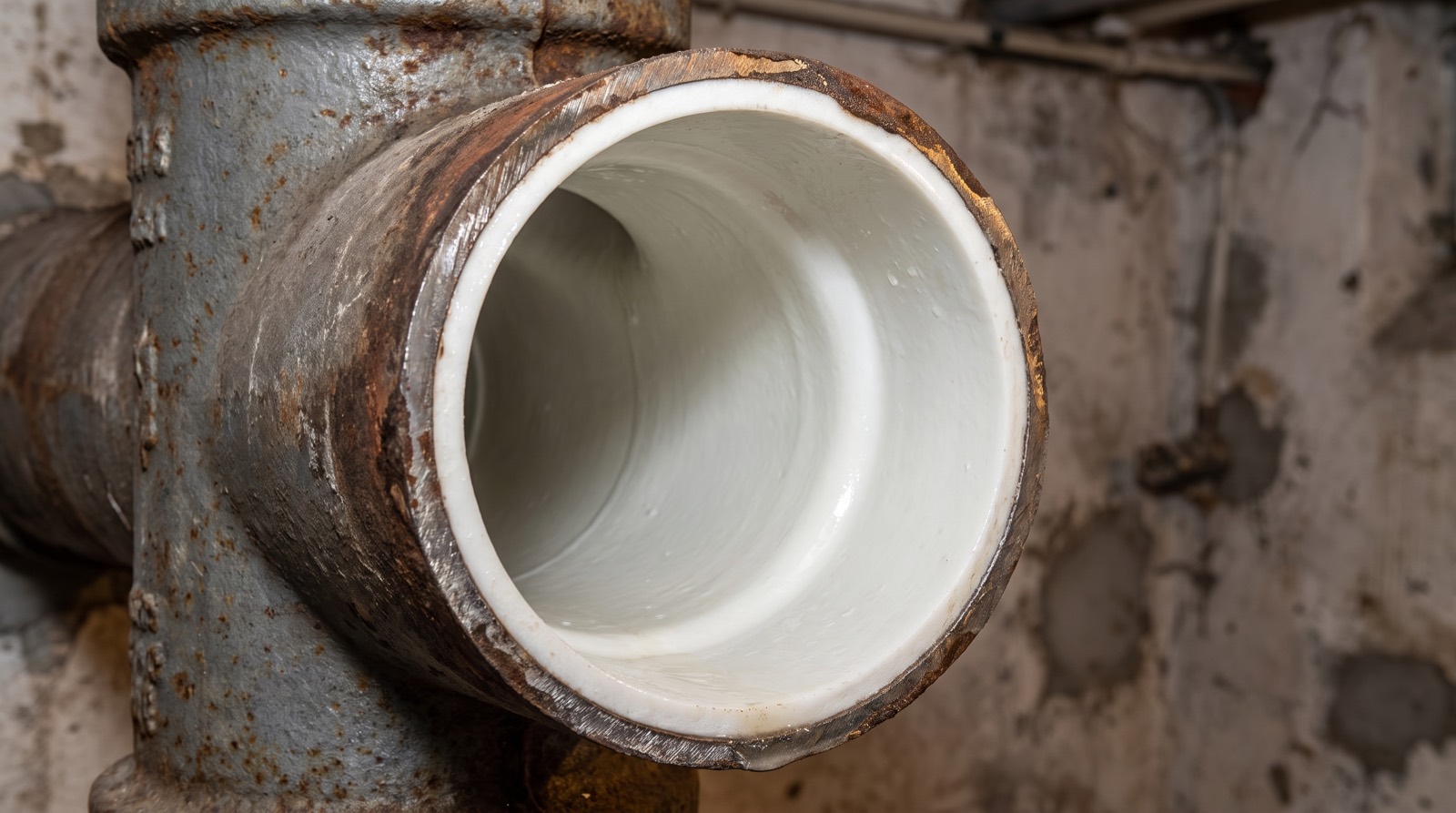
What drain rehabilitation with a CIPP liner costs depends on pipe length, nominal diameter (DN), damage pattern, accessibility and the number of connections that have to be reopened after installation. A reliable price per metre is therefore only possible after a CCTV drain survey. The big advantage of the method: usually nothing is dug up, so earthworks, disposal of excavated material and reinstatement of floors, terraces or roads are largely eliminated.
In this cost guide, we show which items make up the price of CIPP lining, which of them have fixed prices at Karo Kanaltechnik, why a flat price per metre from the internet says little, what the process looks like and who pays for the rehabilitation. This will help you to assess quotes, compare items and make an informed decision on whether a CIPP liner, a patch liner or excavation after all is the right solution for your pipe.
What is a CIPP liner and how does it work?
In the CIPP lining method (cured-in-place pipe), a flexible fabric tube is impregnated with synthetic resin and inserted into the damaged pipe. There it is pressed against the pipe wall and cured, usually with hot water, steam or UV light. Once cured, the tube forms a new, watertight and structurally load-bearing pipe within the old one. You can read more about the principle in the glossary under CIPP drain liner.
The result is a smooth, jointless inner surface that permanently bridges cracks, leaking joints, displaced joints and corrosion. Because the existing pipe serves as the mould, the existing route is retained and there is no need to dig along the entire length. For shorter damaged sections there are also partial methods such as the patch liner or Pointliner, and for small, angled household pipes spray lining.
Cost per metre: why a flat price says little
Anyone searching for «CIPP liner cost per metre» will find many price ranges on the internet, often from Germany and in euros. They say little about your pipe, because the price per metre is not a fixed value, but the result of several factors. Two pipes of the same length can differ considerably in price, for example because one is straight and easily accessible via a manhole, while the other has several bends, branches and root ingress.
In addition, some of the costs are not incurred per metre at all. Call-out, site set-up, the preliminary camera inspection, opening each individual connection and acceptance are items charged per job or per unit. For a short house connection they make up a large part of the invoice, for a long collector pipe a smaller part. A price per metre without details of diameter, condition and number of connections is therefore only a rough guide, never a binding price.
Karo Kanaltechnik therefore deliberately does not state a flat price per metre for CIPP lining, but quotes after the camera inspection with all items broken down individually. The services that come at the start of every rehabilitation have fixed prices: cleaning and inspection.
What has a fixed price at Karo
Our published guide prices apply to the preparatory work. They are the first items in every CIPP lining quote and can be estimated in advance:
| Service | Karo guide price | Note |
|---|---|---|
| Working hour cleaning (e.g. high-pressure jetting) | CHF 160 per hour | excl. VAT and any material costs |
| Call-out | CHF 60 per job | excl. VAT |
| Surcharge for CCTV check | from CHF 50 | Documentation to SN EN 13508-2 |
| Example: 1 hour plus call-out | CHF 220 excl. VAT | CHF 237.82 incl. 8.1% VAT |
Our guide price configurator provides an initial estimate for cleaning and inspection. We provide a binding quote for the items for liner material, installation, curing and opening the connections as soon as the condition report is available. Only then are the length, nominal diameter, damage pattern and number of inlets known.
These factors determine the costs
The price of CIPP lining is made up of several components. The most important are the length and diameter of the pipe to be rehabilitated, as these determine the material required and the effort. The damage pattern also plays a role: individual cracks are easier to fix than several damaged sections, fragmentation or severe deformation. The following overview shows which factors work in which direction:
| Cost factor | Cheaper if … | More expensive if … |
|---|---|---|
| Nominal diameter (DN) | small house connection | large collector or main pipe with more material and equipment |
| Length | short, continuous stretch in one job | long stretch or several separate sections requiring relocation |
| Damage pattern | individual cracks, leaking joints | deformation, fragmentation, root ingress along the whole length |
| Pipe route | straight, few bends | many bends, branches and changes in diameter |
| Accessibility | existing manhole or access opening | access must first be created, cramped basements |
| Preparatory work | pipe only lightly soiled | roots, encrustations or protruding connections must be cut out |
| Connections | few inlets | many inlets that are opened and sealed with a top-hat profile |
| Pipe material | plastic or intact vitrified clay | badly damaged vitrified clay, concrete or cast iron requiring extensive preparation |
Further factors are the necessary preparatory work, such as thorough high-pressure water jetting and cutting out ingrowing roots, and the number of inlets that are reopened after rehabilitation with the robotic cutter and, if necessary, sealed tight with a top-hat profile. The material of the old pipe also plays a part: a vitrified clay pipe with displaced joints places different demands on preparation than a plastic pipe. Every case is individual, which is why a reliable quote always requires a prior camera inspection.
The cost components of a CIPP lining quote
A transparent quote lists the individual steps separately. This lets you see exactly what you are paying for and compare offers fairly. These items belong in it:
- Camera inspection before rehabilitation with a condition report to SN EN 13508-2: the basis for planning, sizing and the quote.
- Cleaning the pipe, usually with chemical-free high-pressure jetting at up to 200 bar: a prerequisite for the liner to fit cleanly and cure watertight.
- Cutting work for roots, encrustations or protruding connections.
- Liner material (carrier fabric and resin) to suit nominal diameter, length and structural requirements.
- Installation and curing with hot water, steam or UV light.
- Opening the covered connections with the robotic cutter, with a top-hat profile depending on the findings.
- Acceptance survey with the camera, supplemented by a leak-tightness test on request.
- Documentation with recordings before and after rehabilitation as proof for the municipality, property management or insurer.
The largest single item is usually the liner itself, together with installation and curing. This is where the nominal diameter has its full effect: larger pipes need more material and more complex equipment. Preparation, by contrast, is the item where cutting costs pays off least. Without a clean pipe wall, the resin does not adhere reliably, and the rehabilitation would not be permanently watertight.
Why quotes differ so widely from one another
Because every provider includes different services. A cheap quote that does not include cleaning, cutting work or opening the connections quickly becomes more expensive through supplements than an initially higher but complete offer. So do not just compare the total, but the individual items. Flat prices «per metre» without details of condition and connections do not reflect the actual effort.
Also check whether the quote is based on a recent camera inspection, which nominal diameter and length are assumed, how many connections will be opened and whether the acceptance survey is included. If these details are missing, there is no basis for a fair comparison.
The process of CIPP lining
CIPP lining always follows the same sequence. Each step builds on the previous one, and each is a separate item in the quote:
Step 1: Camera inspection and condition report
The camera documents the condition, location and type of defects. The report to SN EN 13508-2 is the basis for choosing the method and for the binding quote.
Step 2: Cleaning and cutting work
The pipe is cleaned at high pressure and freed from deposits, encrustations and ingrown roots so that the liner fits snugly against the pipe wall.
Step 3: Impregnate and insert the liner
The fabric tube is impregnated with resin and pulled in via a manhole or access opening, or inverted with pressure, i.e. turned inside out as it goes in.
Step 4: Press on and cure
Under pressure, the tube presses against the old pipe wall and cures with hot water, steam or UV light. This creates a new pipe inside the old one.
Step 5: Open the connections
A remote-controlled robotic cutter reopens the covered inlets. Leaking junctions are sealed with a top-hat profile if necessary.
Step 6: Acceptance and documentation
A final camera inspection and, on request, a leak-tightness test confirm the result. You receive the recordings from before and after the rehabilitation.
Many rehabilitations of household pipes are completed in one day; several pipe branches or hard-to-reach pipes take longer. The planned duration is stated in the quote. You will find details of the methods on our pages on drain rehabilitation and pipe relining.
CIPP liner or excavation: the cost comparison
At first glance, the pure material price of a CIPP liner does not always seem cheaper. However, once all the incidental costs of open-cut construction are included, the picture often reverses. Excavation adds earthworks, breaking open and reinstating floors, paths or roads, disposal of the excavated material and long construction times. With open-cut rehabilitation, you mainly pay for the excavator, excavation, disposal and surface, not for the pipe itself.
| Criterion | CIPP liner (trenchless) | Excavation (open-cut construction) |
|---|---|---|
| Earthworks and excavation | largely eliminated | main cost block |
| Surface (garden, terrace, paving, floor) | remains intact | must be opened and reinstated |
| Time on site | often one day for household pipes | usually several days, longer depending on scope |
| Disruption to daily life | low, access via manhole | building site, noise, closed driveways |
| Suitable for | cracks, leaking joints, corrosion, light to moderate deformation | collapsed or badly displaced pipes, change of gradient or position |
| Result | new pipe inside the old one, smooth inner surface | completely new pipe, position freely selectable |
The CIPP liner really comes into its own under sealed surfaces, under the house, under a terrace, under trees or in occupied properties. Only when a pipe has completely collapsed, is no longer passable along a stretch or its gradient has to be fundamentally changed is there no way around open excavation. Often a partial excavation at that one spot is then sufficient, while the rest is rehabilitated without trenching.
Patch liner or continuous CIPP liner?
If only a single spot is damaged, such as a crack or a leaking joint, a Pointliner that rehabilitates only this section is often sufficient. We use it in sizes from DN 100 to DN 600. This is cheaper than a continuous liner over the entire pipe. If, on the other hand, several defects are spread along the length or the pipe is generally weakened by age, the continuous CIPP liner is usually more economical and sustainable.
As a rule of thumb: up to two or three isolated defects, a local repair is worthwhile; beyond that, the continuous solution. The camera inspection shows which option suits you. You will find a detailed comparison of the methods in the article CIPP lining, patch liners and spray lining compared.
Service life and guarantee
The materials of properly installed liners are designed for a service life of at least 50 years. Calculated over the service life, the cost per year is therefore low, especially as the smooth inner surface improves flow and prevents new blockages and root ingress. We give a warranty of up to 10 years on our rehabilitation work, depending on the method and scope. The camera recordings from before and after the rehabilitation, which you receive together with the report, serve as proof.
A wastewater pipe rehabilitated with documentation is therefore more than a repair: it preserves the value of the property. When selling, towards the property management or during a condition check by the municipality, you can prove the condition at any time.
Who pays for CIPP lining?
In Switzerland, property owners are responsible for their private wastewater pipes. The Waters Protection Act obliges them to operate and maintain the installations properly, usually including the underground drain and house connection up to the public sewer. Exactly where the private pipe ends is regulated by your municipality's wastewater regulations. More on this in the glossary under maintenance obligation.
- Owners of a property: bear the costs for the underground drain, house connection and manholes on their section.
- Rented flats: rehabilitation and maintenance of the wastewater installations are basically a matter for the landlord.
- Condominium ownership: soil stacks, underground drains and the house connection are generally part of the common property and are financed through the community or the renewal fund.
- Several properties on a shared pipe: the cost allocation is governed by the regulations or an agreement between the owners.
And the insurance? That depends on the claim and the policy. In the case of a sudden loss event such as a pipe collapse with escaping water, part of it may be covered; rehabilitation due to age and wear generally remains the owner's responsibility. Clarify this with your insurer before placing the order; the condition report from the camera inspection serves as the basis. Whether the costs are tax-deductible as property maintenance is assessed by the cantonal tax office.
How to save on CIPP lining
- Rehabilitate without trenching rather than open-cut wherever technically possible: the earthworks and paving work saved are the biggest lever.
- Rehabilitate several defects in the same job: call-out and set-up time are charged only once.
- Carry out cleaning and the camera inspection in the same appointment instead of planning two jobs.
- Rehabilitate early: otherwise a small crack turns into extensive damage with washed-out soil.
- Compare quotes item by item, not just the total.
Anyone who only reacts when the basement is under water ends up paying considerably more than for planned, timely repairs. Regular drain cleaning with a camera check reveals defects while they can still be fixed locally and cheaply.
Conclusion: sustainable rehabilitation without building-site chaos
Drain rehabilitation with a CIPP liner is a proven, long-lasting method that repairs damaged pipes without major excavation. The costs arise individually from length, nominal diameter, damage pattern, accessibility and number of connections; only the preliminary CCTV drain survey provides a reliable figure. At Karo, the preparatory work has fixed prices: CHF 160 per hour, CHF 60 call-out and a CCTV surcharge from CHF 50, each excl. VAT. Overall, the trenchless method is often the more economical and gentler choice.
Do you suspect damage to your drains or would you like to plan a rehabilitation? Call us on +41 43 588 12 08 or enquire online. We check the condition of your pipes with the camera and then prepare a transparent quote with all items, throughout German-speaking Switzerland, for example for drain rehabilitation in Zurich. In an emergency, you can reach our emergency service round the clock.


