
What is biogenic sulphuric acid corrosion?
Biogenic sulphuric acid corrosion refers to the attack of sulphuric acid on cement-bound building materials in wastewater installations, where the acid does not arrive with the wastewater but is formed on site by microorganisms. The word «biogenic» points to exactly this: without bacteria, this form of corrosion would not exist. Concrete manholes, concrete pipes, pump sumps and masonry structures with cement mortar are particularly affected.
The insidious thing about it: the damage does not occur where the wastewater flows, but in the so-called gas space above it – on the manhole walls above the waterline, in the cone under the cover and at the crown of pipes. These surfaces are often only glimpsed briefly when looking into an open manhole. There, the concrete loses strength layer by layer until aggregate particles become loose, reinforcement is exposed and, in the worst case, parts of the wall are missing.
For property owners, the term is mainly important in two situations: when a camera survey or manhole inspection shows severely attacked concrete surfaces, and when it has to be decided during manhole rehabilitation what protection the inner surfaces need. Anyone who knows the cause can prevent a freshly rehabilitated manhole from looking the same again after just a few years.
How does biogenic sulphuric acid corrosion occur?
It starts with oxygen-poor wastewater. Domestic and commercial wastewater contains sulphate and many organic substances. If it stands for a long time in a pipe, a pump sump or under deposits, the dissolved oxygen is used up. In this environment, sulphate-reducing bacteria – mainly in the biofilm on the pipe wall and in sludge deposits – break down the sulphate into sulphide. The warmer the wastewater, the longer the retention time and the higher the organic load, the more sulphide is produced.
In the second step, the sulphide passes into the air as hydrogen sulphide. This happens especially where wastewater is agitated: at the outlet of a pressure pipe, at drops, changes in gradient and in pump chambers. Hydrogen sulphide is the gas with the typical smell of rotten eggs, also known as sewer smell.
In the third step, the hydrogen sulphide dissolves in the moist condensate film that covers the manhole walls above the water level. Fresh concrete is highly alkaline and initially not very inviting for bacteria. However, carbon dioxide and the acidic gas attack gradually lower the pH value of the surface. Sulphur-oxidising bacteria (thiobacilli) then settle and oxidise the hydrogen sulphide to sulphuric acid. This can create very acidic conditions on the surface; the technical literature describes pH values down to the range of 1 to 2.
The sulphuric acid reacts with the lime-containing components of the hardened cement paste. Gypsum forms, and further reactions can produce ettringite, which takes up more volume than the starting materials. The surface swells, becomes soft and mushy and falls off. Underneath, fresh concrete is exposed again – and the cycle starts all over. That is why biogenic sulphuric acid corrosion continues to progress as long as conditions in the manhole remain the same.
Where does it occur particularly often?
Structures in which wastewater that has been standing for a long time comes back into contact with air are most at risk. The classic example is the transfer or relief manhole at the end of a pressure pipe: in the completely filled pressure pipe, the wastewater turns septic without contact with air; when it exits into the manhole, it is agitated and suddenly releases the hydrogen sulphide. The situation is similar in pump chambers and immediately after wastewater lifting stations that collect wastewater from the basement and pump it into the underground drain in batches.
A second focal point is restaurants, catering and food businesses. Their wastewater is warm and rich in grease, protein and organic residues. Grease deposits in pipes and poorly maintained grease separators create exactly the oxygen-poor zones in which sulphide is formed. The manholes downstream of such businesses therefore show concrete damage more often than manholes of purely residential properties.
Corrosion is also encouraged by shallow-gradient pipes with low flow velocity, in which sludge settles, by wastewater from certain commercial and industrial businesses with an increased sulphate content and by poorly ventilated manholes in which the gas builds up. Where several of these factors come together, the damage is greatest.
Damage pattern: how to recognise the corrosion
A rough, sandy or mushy concrete surface in the upper part of the manhole is typical, while the area in the channel appears comparatively intact. There is often a whitish to yellowish soft coating on the wall – converted cement paste. If you scratch it, it can be removed with little force. Underneath, the aggregate becomes visible that is embedded in the cement paste in sound concrete.
In advanced stages, the aggregate particles protrude or are already missing, the wall thickness decreases and any reinforcement comes to light and rusts. Step irons, cover frames and support rings are also attacked. A loose cover or a sunken frame can be a late consequence of this. In addition, there is almost always a distinct smell of rotten eggs when the manhole is opened.
It is important to distinguish this from other types of damage: leaking ring joints, root ingress or mechanical spalling have other causes and call for other measures. Biogenic sulphuric acid corrosion appears as surface-wide material loss in the gas space, not as an individual crack. A specialist makes this distinction on the basis of the inspection images.
Detection by CCTV and manhole inspection
Because the damage lies above the water level and often deep in the manhole, a systematic inspection is the safest route to a diagnosis. Beforehand, the manhole is cleaned so that coatings and sludge do not conceal any damage. Karo cleans without chemicals at high pressure of up to 200 bar and then surveys the connected pipes with the camera.
In the CCTV drain survey, surface damage is coded in accordance with SN EN 13508-2 – that is, according to a uniform code that describes whether the surface has merely become rougher, whether aggregates are visible or missing, or whether reinforcement is exposed. In this way, the extent can be recorded in a traceable manner and later compared with a follow-up inspection. The condition grade, and thus the urgency of rehabilitation, is derived from this documentation.
An important safety note: hydrogen sulphide is toxic, and at high concentrations it can no longer be smelled because the sense of smell is numbed. Manholes where sewer gas is suspected may only be entered with gas measurement, safety precautions and by trained specialist personnel. Owners should never climb into a manhole themselves to take a look.
Countermeasures: tackling the cause
The most effective measure targets the formation of the hydrogen sulphide. The shorter the time the wastewater stands and the fewer deposits there are in the pipes, the less sulphide the bacteria produce. Regular drain cleaning, well-maintained grease separators and lifting stations in whose collecting tanks the wastewater does not stand for long already reduce gas formation significantly.
The second lever is ventilation. A well-ventilated manhole and a functioning ventilation pipe above the roof dilute the gas and allow the wall surfaces to dry out more quickly. Where turbulence releases the gas, for example at the outlet of a pressure pipe, an adapted inlet with a calmed transition into the channel can help.
For larger pressure pipes and pumping stations, operators additionally resort to process engineering measures, such as introducing air or oxygen or adding substances that inhibit sulphide formation or bind sulphide. This is a task for the planners and the operator of the installation and is determined on a case-by-case basis.
Countermeasures: protecting and rehabilitating the concrete
Where gas formation cannot be sufficiently avoided, the concrete itself is protected. First, the destroyed, soft layer is completely removed, typically with high-pressure water jets, until a load-bearing substrate is exposed. Defects are reprofiled with suitable mortar. This is followed by a pipe coating that is resistant to acid – depending on the load, an acid-resistant mineral mortar system or a synthetic resin-based coating, for example based on epoxy or polyurethane.
In the case of very severe attack or a badly weakened wall, a lining with plastic elements or an inserted inner manhole may be considered. This creates a new, acid-resistant inner surface without having to excavate the manhole. Which method is suitable depends on the damage pattern, the remaining wall thickness and the future load.
The combination is decisive: a coating without measures against gas formation does protect the wall, but the cover, step irons and connecting pipes remain vulnerable. Good manhole rehabilitation therefore always also considers the inflow, ventilation and maintenance. Karo provides a warranty of up to 10 years on rehabilitation work.
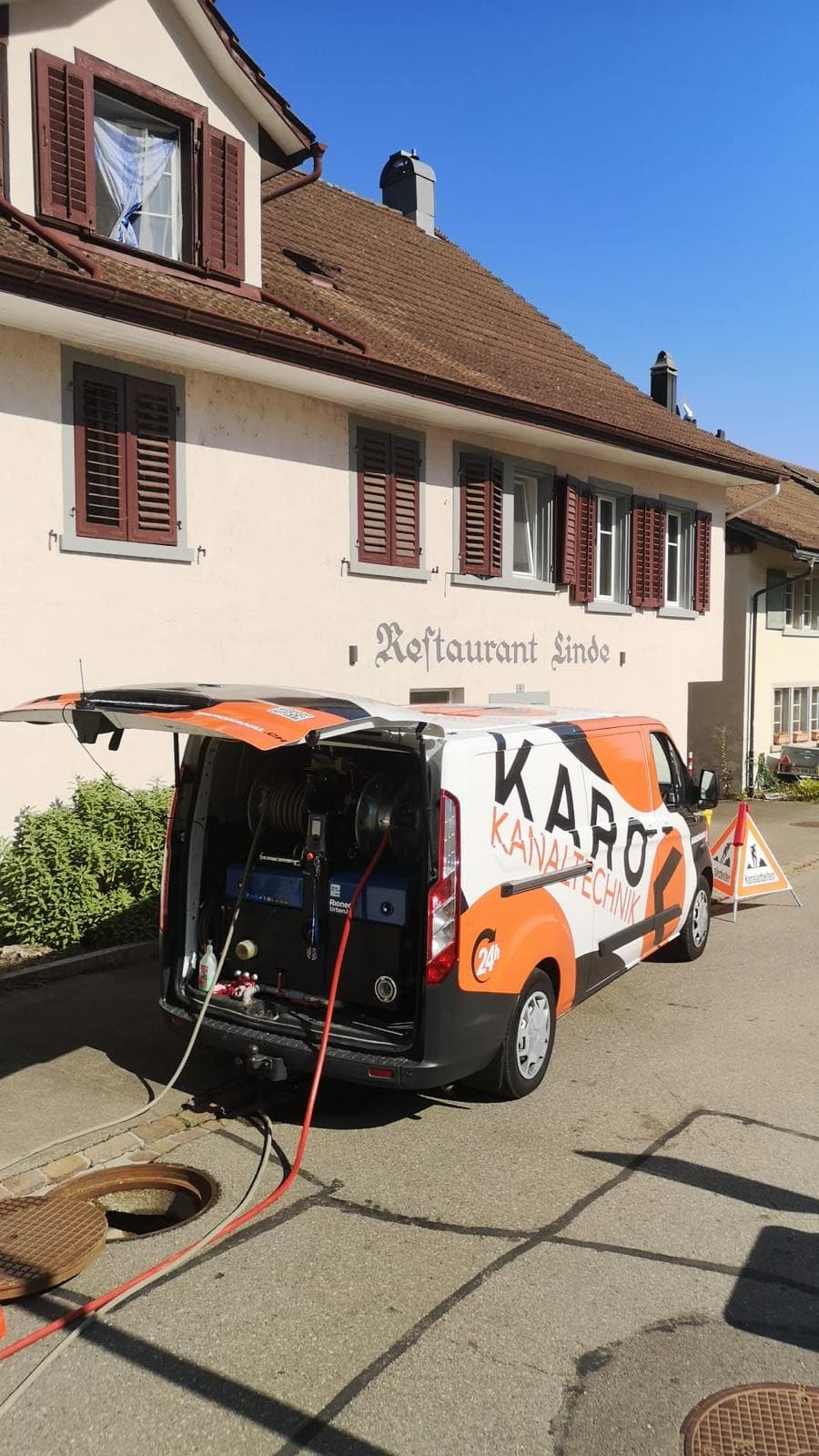
A typical scenario from our service area: beneath a country inn in the canton of Thurgau, there is a strong smell of rotten eggs when the inspection chamber is opened. The kitchen wastewater flows through a grease separator, and the wastewater from the basement is pumped into the same manhole by a lifting station. After high-pressure cleaning, the inspection shows a soft, sandy concrete surface with visible aggregate particles in the upper part of the manhole, but hardly any damage in the channel – the classic picture of biogenic sulphuric acid corrosion. The findings are documented in accordance with SN EN 13508-2. The recommendations are removing the destroyed layer, an acid-resistant coating, a shorter maintenance interval for the grease separator and a check of the ventilation, so that the damage does not recur.