How often drain cleaning is needed depends on the type of pipe and its use: private single-family homes should have their main drain cleaned roughly every three to five years, every two to three years under heavy use; commercial businesses with heavy use at least once a year, and larger properties with many households usually annually to every two years. Land drains, silt traps, lifting stations and grease separators, on the other hand, have their own cycles, some of them considerably shorter. These guide values ensure that deposits never lead to blockages or backflow in the first place.
As a drain cleaning specialist based in Frauenfeld with five further locations in Eastern Switzerland and the greater Zurich area, we see every day how much preventive cleaning pays off. Knowing the right cycle saves costly emergency call-outs and protects the fabric of your property in the long term. In this guide you will therefore find not only guide values by building type, but a table by pipe type, with our recommendation and the guide values given by Swiss municipalities, cantons and standards.
Cleaning intervals by pipe type: the overview
The following table summarises how often the individual parts of a property drainage system should be cleaned, emptied or serviced. The column «Karo recommendation» contains the values we work with when planning; where we do not give a blanket value, we set the interval after the first findings. Alongside, for comparison, are the guide values of municipalities, cantons and standards, each with its source.
| Pipe type / installation | Karo recommendation | Guide value authority / standard |
|---|---|---|
| Underground drain, single-family home (foul and combined water) | every 3 to 5 years, every 2 to 3 years under heavy use | 2 to 5 years (municipality of Stallikon); every 2 years or as needed (municipality of Bassersdorf) |
| Underground drain, apartment building | annually to every 2 years | 2 to 5 years, strongly dependent on the gradient (Stallikon) |
| Land drain / drainage | inspection every 1 to 2 years in iron-rich soil, otherwise according to findings | 1 to 3 years (Stallikon); on average every 2 years, more often with hard water (Bassersdorf) |
| Silt trap | annual inspection after leaf fall, emptying as needed | as a rule at least once a year (Thurgau Office for the Environment, garage, construction and transport trades) |
| Inspection chamber | every 2 to 3 years, annually for catering, industry or lots of leaves and sand | 2 to 5 years (Stallikon) |
| Lifting station / pump chamber | clean the pump sump during servicing | servicing at the latest every 3 months (commercial), 6 months (apartment building), 12 months (single-family home) according to SN EN 12056-4 |
| Soil stack | every 3 to 5 years in apartment buildings | every 5 years or as needed, inspect annually with a high grease content (Bassersdorf) |
| Grease separator | empty completely and clean at least monthly, more often with high grease loads | requirement of the municipality or permit, based on SN EN 1825 |
| Floor drain, laundry room drain | together with the underground drain, immediately in case of odour or sluggish drainage | – |
| Roof and terrace drain | according to findings, check annually under trees | every 2 years or as needed (Bassersdorf) |
| New construction and conversion | cleaning before occupancy | clean all wastewater and land drains before occupancy, repeat after one year (Bassersdorf) |
Sources of the guide values: information sheet «Private drainage installations» of the municipality of Stallikon ZH (30 May 2018), information sheet 09 «Rehabilitation of wastewater pipes» of the municipality of Bassersdorf ZH (2024), information sheet «Maintenance and inspection work on wastewater pre-treatment installations in the garage, construction and transport trades» of the Thurgau Office for the Environment (July 2019) and the standard SN EN 12056-4. The Karo recommendation is based on our experience from cleaning jobs and camera surveys in Eastern Switzerland and the greater Zurich area; for your property we set the interval after the first findings.
The soil stack leaves the most room for judgement. The municipality of Bassersdorf states every five years or as needed, with an annual inspection where the grease content is high. The reason: a soil stack in a single-family home with two occupants has little in common with the stack of an apartment building with twelve kitchens. For apartment buildings we therefore stick to three to five years, because in our experience kitchen grease and limescale build up there over the years until the lower flats suffer backflow.
Why deposits form in the first place
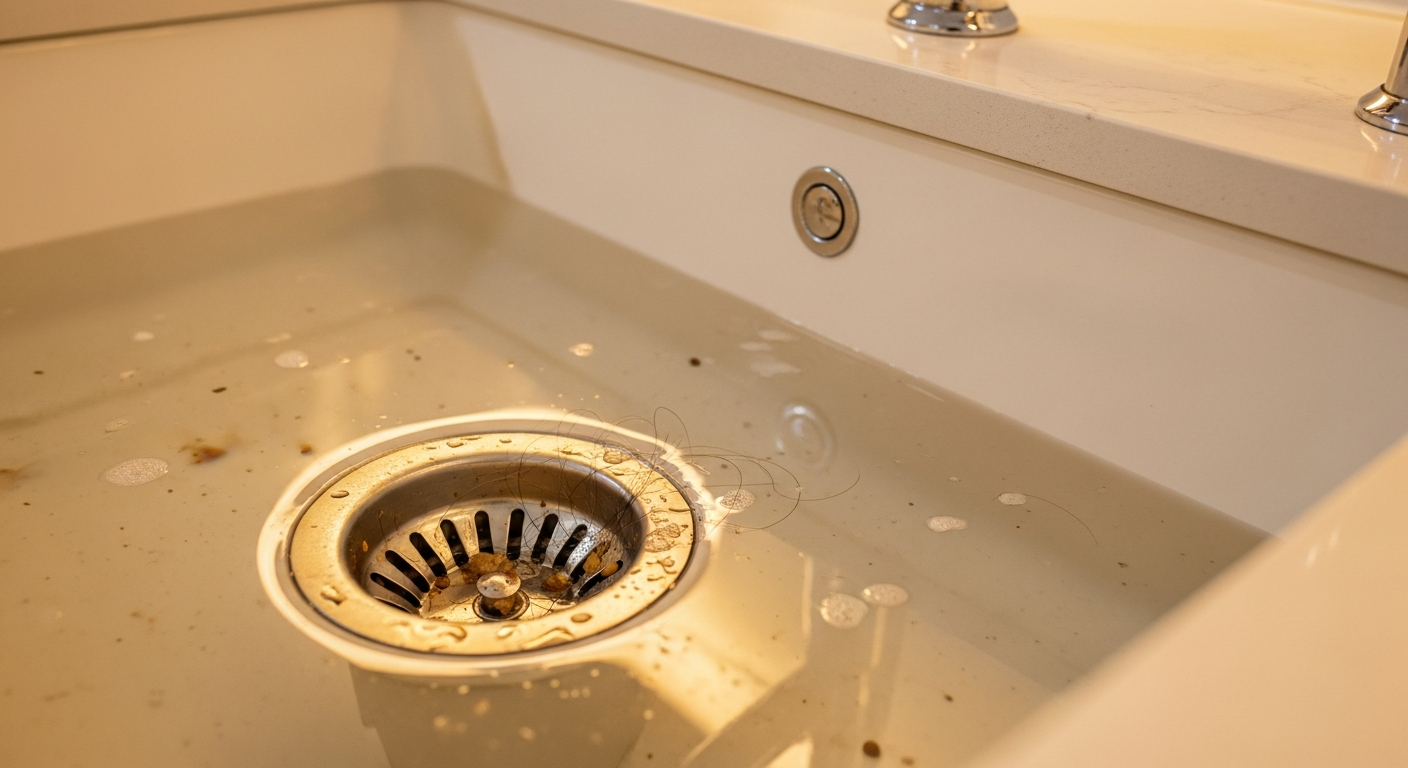
In every wastewater pipe, grease, soap residue, hair, limescale, sand and organic matter accumulate on the pipe walls over time. These layers narrow the cross-section slowly but steadily. At first you notice nothing, but at some point the water drains more sluggishly, the drain gurgles or unpleasant odours arise. By then, a considerable amount of build-up has already formed. Hard, firmly adhering deposits of limescale or urine scale are called encrustation; they can hardly be removed by normal flushing.
Kitchen drains into which grease regularly finds its way are particularly critical. Grease solidifies in the pipe and binds further particles to itself. In apartment buildings there is the added factor that the soil stacks combine the wastewater of many households and are therefore under considerably more strain.
The individual pipe types in detail
The underground drain carries all of a building's wastewater below the floor slab to the house connection. It is the pipe to which most interval figures refer. According to the Stallikon information sheet, how quickly it becomes dirty depends above all on the gradient: in pipes laid too flat, the flow velocity is not enough to carry away sand and solids; they remain behind and form deposits.
The land drain carries slope water and groundwater away from the building. Here it is not grease and faeces, but limescale, fine sand, iron ochre and roots that block the slots and the cross-section. The Bassersdorf information sheet describes the mechanism well: deposits create turbulence, and turbulence promotes limescale precipitation, so that the narrowing progresses ever faster. Hence the rule: better to flush regularly and gently than to wait until the pipe is completely blocked. More on this in the guide Cleaning drainage.
The silt trap catches sand, leaves and grit from yard and roof drainage before they enter the pipe. Once the silt chamber is full, the material enters the pipe unchecked, often the land drain. Under trees, at driveways with gritting chippings or on gravel areas it fills up considerably faster than with a pure roof drain. We therefore recommend an annual inspection, ideally after the leaves have fallen in autumn.
The lifting station pumps wastewater from rooms below the backflow level into the sewer. For its servicing, the standard SN EN 12056-4 specifies maximum intervals of three months in commercial premises, six months in apartment buildings and twelve months in single-family homes. Servicing the pump itself is a matter for the manufacturer or the plumber; we clean the pump sump and the inlet and outlet pipes so that wet wipes, grease and sludge do not block the float switch.
The grease separator is generally mandatory in restaurants, canteens, butcher's shops and bakeries. As a rule of thumb, it is completely emptied, cleaned and refilled with fresh water at least once a month, more often in businesses with a lot of grease. The binding interval is set by the municipality. Explained in detail in the guide Commercial drain cleaning and grease separator obligations.
Floor drains in the laundry room, garage or basement and the inspection chamber belong in the same cycle as the underground drain. Floor drains dry out when rarely used, and then drain smells rise; the inspection chamber collects sediment that narrows the outflow during heavy rain.
Guide values for private households
For an average single-family home without any particular strain, we recommend preventive drain cleaning every three to five years. Anyone who cooks a lot, keeps pets or lives in a region with hard, calcium-rich water should shorten the interval to two to three years. Property drainage systems with many bends, gully pots or long pipe routes also tend to develop deposits more quickly.
The age of the property is also a good indicator: older pipes made of concrete or vitrified clay often have rougher inner surfaces to which dirt adheres more easily. Here, an accompanying CCTV drain survey can provide clarity about the actual condition.
Usage habits in the household also have a strong influence on the interval. If food scraps, coffee grounds or deep-frying oil are disposed of down the sink, or wet wipes or sanitary products flushed down the toilet, this considerably accelerates the formation of deposits and blockages. Taking care here can noticeably extend the cleaning cycle and at the same time spares the public sewer system.
Commercial and catering: higher frequency
Restaurants, butcher's shops, bakeries, canteens and food businesses produce large quantities of grease and food waste. Here, annual drain cleaning is the absolute minimum; in many cases six-monthly intervals make sense. In addition, many municipalities prescribe regular emptying and cleaning of grease separators, often several times a year.
Industrial and commercial businesses with process-related dirt input, such as car washes, workshops or production plants, should also maintain their drainage at close intervals. For garage, construction and transport businesses, the Thurgau Office for the Environment, for example, requires silt traps and mineral oil separators to be emptied as a rule at least once a year; the contents are hazardous waste and are disposed of with a consignment note. A blocked pipe here can lead to business interruptions that are far more expensive than preventive cleaning.
Properties and apartment buildings
For property managers and owners' associations, a maintenance contract with a fixed interval is advisable, usually annually or every two years. Because many households share the same soil stacks and underground drains, the risk of blockage is considerably higher. In the worst case, backflow can lead to water damage in basements and flats, for which the owners are liable.
A predictable cleaning cycle also gives property managers the advantage of cost control: instead of expensive, unplanned emergency call-outs, there are calculable maintenance costs. We document every job comprehensibly, which also keeps things transparent at owners' meetings and in the service charge statement.
These factors shorten the interval
The values in the table are starting points. Whether a pipe is at the lower or upper end is decided above all by these factors:
- Trees and shrubs near the pipe: roots penetrate leaking joints and form root masses in which paper and grease get caught. Where root ingress is known, the pipe belongs at the lower end of the intervals.
- Catering and kitchens with a lot of grease: grease solidifies in the cold pipe and grows layer by layer. Here, six-monthly to annual intervals apply to the pipe and monthly intervals to the grease separator.
- Shallow gradient or sags: where the water flows too slowly, sand and solids remain behind. According to the information sheet of the municipality of Stallikon, the intervals for underground drains depend above all on the gradient.
- Hard, calcium-rich water and calcareous soils: limescale narrows land drains in particular. Bassersdorf recommends more frequent flushing there than every two years.
- Iron-rich soil: iron ochre blocks drainage pipes. An inspection every one to two years is then advisable.
- Leaves, grit and gravel: they fill silt traps, roof and terrace drains more quickly.
- Age and material: the rougher inner walls of older concrete and vitrified clay pipes hold on to dirt; displaced joints form edges where deposits collect.
- New construction: cement and building rubble in new pipes. The Bassersdorf information sheet requires cleaning before occupancy and recommends repeating it after one year because of heavy cement precipitation.
Combinations are typical: a single-family home with a large tree above the underground drain, hard water and a silt trap under the driveway needs a different interval from a new building with plastic pipes and a good gradient. Where root ingress occurs, flushing solves the problem only temporarily; it is then worth asking whether rehabilitating the defect is cheaper in the long run than repeated cutting.
Is drain cleaning mandatory?
There is no legally fixed interval for private pipes in Switzerland. Responsibility, however, is clearly regulated: under Art. 15 of the Waters Protection Act, the owners of wastewater installations must ensure that these are properly operated, serviced and maintained. The pipes from the building to the public collector sewer generally belong to the property owners and must be maintained by them, as stated, for example, in the information sheet of the municipality of Stallikon. The municipality has supervisory authority and can require inspections and rehabilitation under its wastewater regulations. More on the maintenance obligation and drain maintenance in the glossary.
For grease separators, mineral oil separators and silt traps in commercial premises, the canton and municipality often set specific emptying intervals and require proof. A documented maintenance plan here is not only convenient, but the simplest way of demonstrating compliance with this obligation.
Signs that cleaning is overdue
Regardless of the interval, there are warning signs that point to an immediate need for action: slowly draining water in the shower, washbasin or toilet, gurgling noises, recurring odours from the drain or water rising in unusual places. If several of these symptoms occur at the same time, cleaning should not wait until the next scheduled appointment.
In such cases, a CCTV drain survey can help to locate the exact cause and position before major measures become necessary. It can also establish whether simple cleaning is sufficient or whether no-dig pipe relining makes sense. In the event of acute backflow, our emergency service can be reached round the clock.
The advantage of a maintenance plan
Instead of rigidly following the calendar, we recommend an individually tailored maintenance plan for many properties. It takes into account the specific use, the pipe material, the number of occupants and the experience from previous jobs. This creates a cycle that cleans neither too often nor too rarely, but intervenes exactly when it makes sense.
Such a plan can be combined with a periodic camera inspection. The images show how quickly deposits actually form and make it possible to adjust the interval over the years on the basis of data. For owners and property managers, this means maximum security at optimum cost, because only the service that is really needed is provided.
In regions with hard water, such as parts of eastern and north-eastern Switzerland, limescale build-up also plays a role. Limescale deposits gradually narrow the cross-section and aggravate existing layers of grease and dirt. This too is an argument for checking the condition regularly instead of reacting only when backflow occurs.
Step 1: Inventory
We record which pipes and installations are present: underground drain, soil stacks, land drain, silt trap, inspection chambers, lifting station, grease separator. We include existing plans and previous reports.
Step 2: Initial cleaning and camera findings
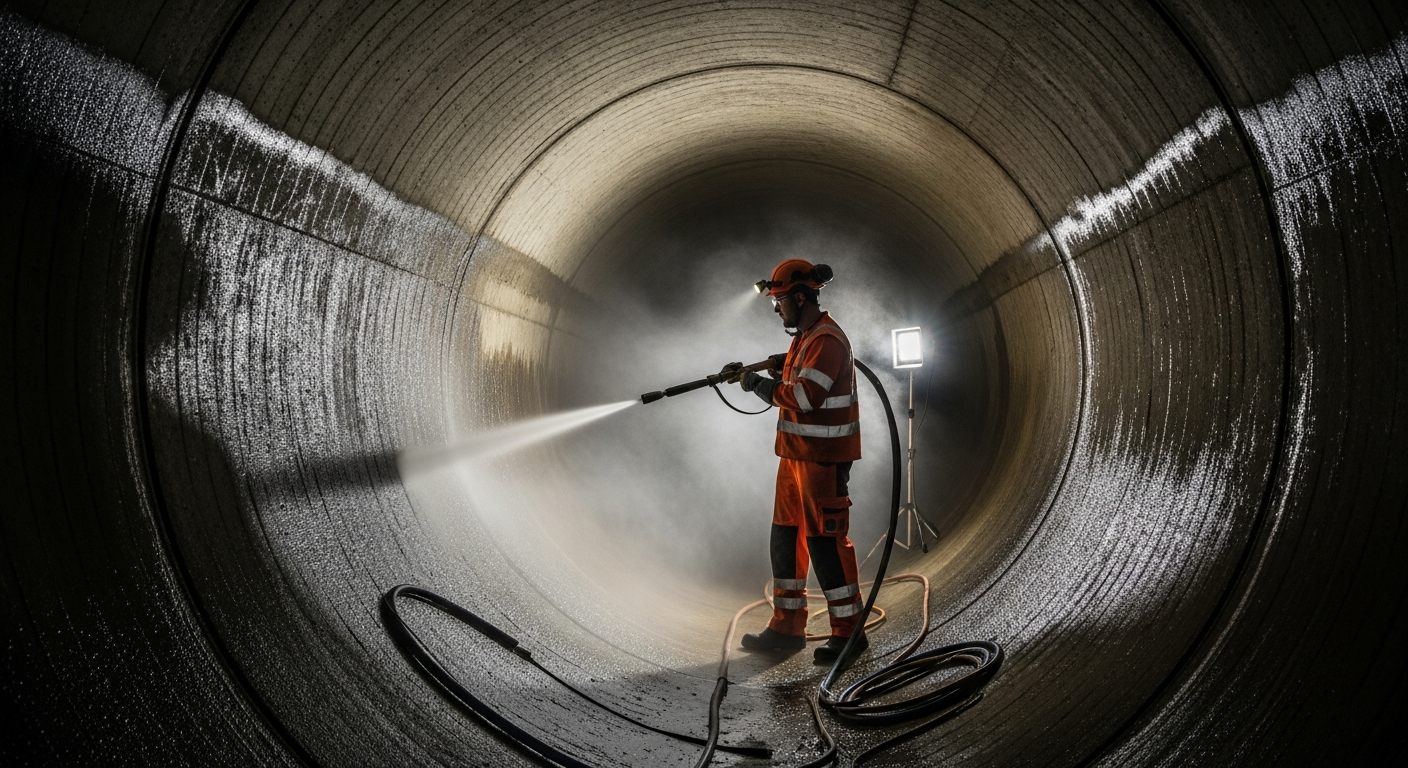
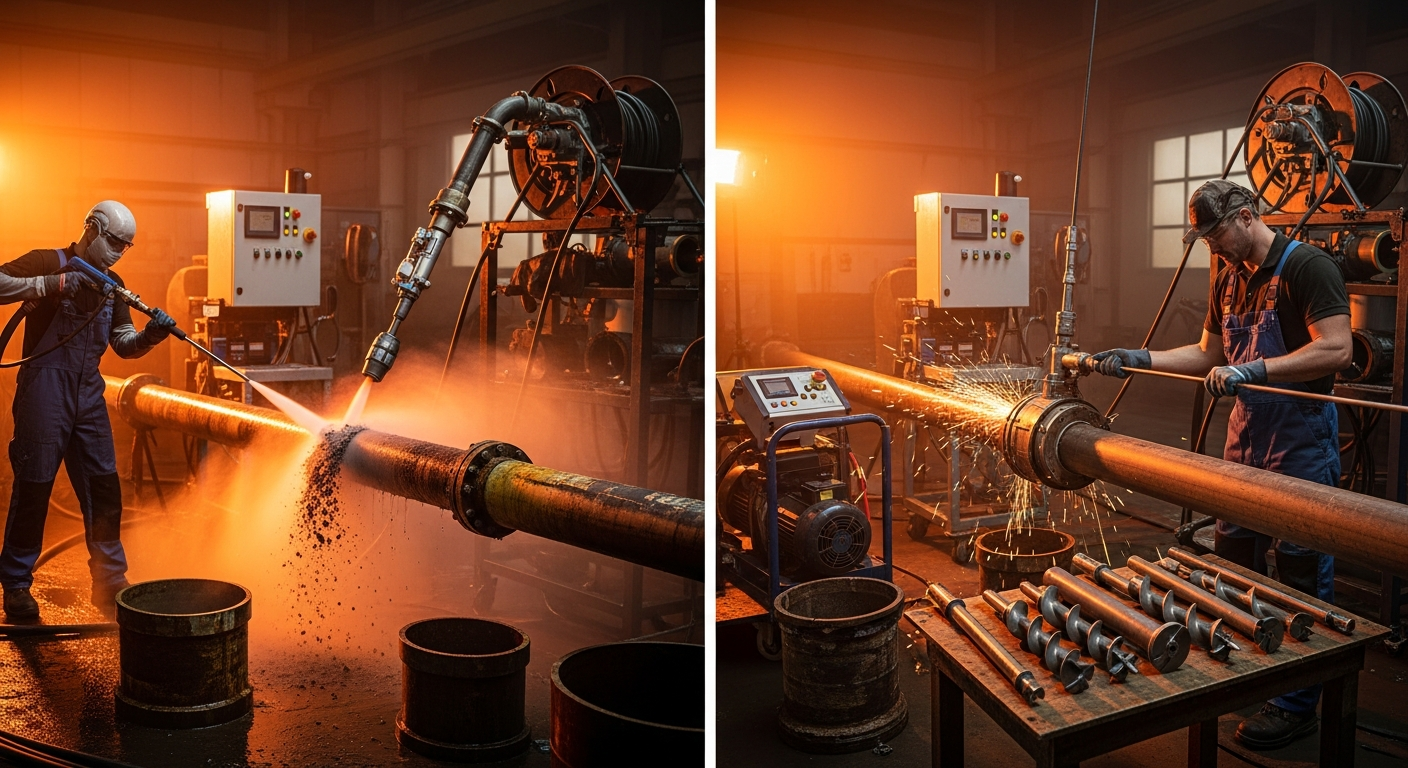
During the first cleaning, we flush the pipes without chemicals at high pressure of up to 200 bar. On request, this is followed by a camera inspection with documentation to SN EN 13508-2, which shows where deposits, roots or defects are located.
Step 3: Set the interval for each installation
Based on the findings, use and the guide values in the table, we set a separate interval for each pipe type, for example annually for the silt trap and every three years for the underground drain.
Step 4: Recurring jobs and adjustment
The jobs are scheduled at a fixed cycle and documented. If after two or three rounds it turns out that a pipe stays clean, we extend the interval; if it silts up faster, we shorten it.
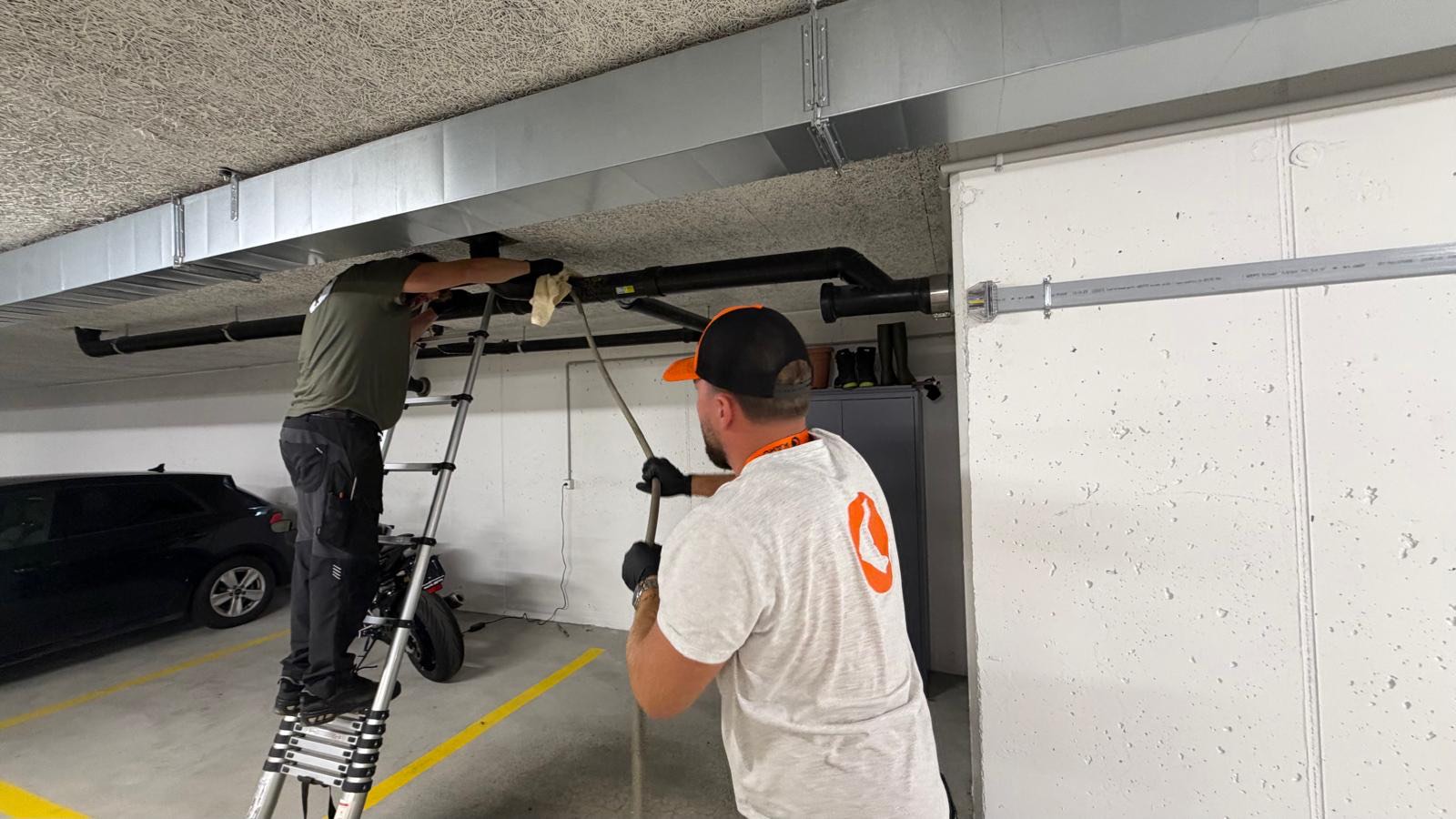
For property managers and municipalities, we also carry out drain cleaning and manhole cleaning at a fixed cycle. For a single-family home, a combined appointment every few years is often enough, at which the underground drain, inspection chamber and silt trap are cleaned in a single job; this saves multiple call-outs.
What does regular drain cleaning cost?
We charge on a time-and-effort basis: CHF 160 per hour for drain cleaning plus a CHF 60 call-out, both amounts excl. VAT. A one-hour job therefore costs CHF 220 excl. VAT or CHF 237.82 incl. 8.1% VAT. A preventive job at a single-family home usually comes to between CHF 150 and CHF 400. A camera check is added from a CHF 50 surcharge. You can find all guide prices at a glance on the page Drain cleaning costs and in the guide Costs of pipe and drain cleaning in Switzerland.
With short intervals in particular, it pays to bundle work. Having the silt trap, inspection chamber and underground drain cleaned at the same appointment means paying the call-out only once. And regular flushing usually means shorter jobs, because no hard crusts have been able to form that would have to be removed with a cutter or special nozzle.
Conclusion: prevention is cheaper than repair
The right drain cleaning at the right interval is one of the most effective measures for avoiding water damage, backflow and costly emergencies. For private households, intervals of several years are often enough, while commercial premises and larger properties need shorter cycles. Land drains, silt traps, lifting stations and grease separators have their own, often shorter cycles. As a guide value, we calculate with around CHF 160 per hour for drain cleaning plus a CHF 60 call-out; the actual costs depend on scope and accessibility (±15%).
Unsure which interval suits your property? We will be happy to advise you and, on request, draw up an individual maintenance plan. Call us on +41 43 588 12 08. For acute blockages, our 24/7 emergency service is available round the clock, at all six locations from Frauenfeld via St. Gallen and Winterthur to Zurich.