
What is the sewer system?
The sewer system means the entirety of all pipes, manholes and structures used to collect and drain away a settlement's wastewater. This includes foul water from the kitchen, bathroom, toilet and laundry room as well as rainwater (stormwater), i.e. rain and meltwater from roofs, forecourts and roads. Specialists also speak of urban drainage or the sewer network.
The sewer system works almost exclusively by gravity. The pipes are laid with a slight gradient so that the water flows downhill without pumps – from the house into the street, from the residential street into the larger collector sewer and from there to the wastewater treatment plant. Only where the terrain does not allow it, for example in deep basements or on flat valley floors, do lifting stations and pumping stations help out.
For owners, the distinction between the private and public parts is important. In everyday speech, people often simply say «the sewer» and mean the sewer under the road. In fact, however, the network already begins in your own house, and a large part of the pipes lies on private land.
How the sewer system is structured
The sewer system can be described as a tree with many branches. The finest branches are the drains in the flat: washbasin, shower, toilet and sink. Their water flows via connection pipes into the vertical soil stack and in the basement into the underground drain, which usually lies under the floor slab or in the ground around the building. The pipes come together in inspection chambers on the plot and are accessible there for cleaning and inspection.
From the last manhole on the plot, the house connection leads to the public sewer under the road. These municipal sewers collect the wastewater from many properties and flow into larger collector sewers that take the water from an entire neighbourhood or several municipalities. At the end of the network is the WWTP, where the wastewater is treated mechanically, biologically and chemically before it flows back into a stream, a river or a lake.
The network includes numerous special structures: silt traps and inlet chambers for rainwater, grease and oil separators at commercial businesses, stormwater overflows and stormwater tanks, pumping stations and infiltration systems through which clean rainwater goes directly into the ground. Depending on the year of construction, the pipes themselves are made of vitrified clay, concrete, plastic or, in older properties, also asbestos cement.
Combined system and separate system
In Switzerland, there are two basic principles by which a sewer system is built. In a combined system, foul water and rainwater flow together in one sewer to the WWTP. This is simple and space-saving, but leads to large volumes of water during heavy rain. To prevent the sewer and treatment plant from being overloaded, there are stormwater overflows and stormwater tanks that temporarily store part of the diluted combined wastewater or discharge it into a watercourse.
In a separate system, foul water and rainwater are drained away in two separate pipes. The foul water goes to the WWTP, the rainwater into a watercourse or an infiltration system. This relieves the treatment plant, and the foul sewer fills up less during heavy rain. In return, a property generally needs two separate connection pipes, unless the rainwater soaks away on the plot, and misconnections – such as a toilet connected to the rainwater sewer – must be avoided at all costs.
Older village centres and urban districts are often served by a combined system, newer neighbourhoods often by a separate system. Which system applies to a particular plot is set out in the municipality's general drainage plan (GEP, Genereller Entwässerungsplan). For new builds and conversions, many municipalities require foul water and rainwater to be kept separate on the plot, even if there is still a combined sewer in the street.
Private pipes and public sewer: who is responsible?
The public sewer system – the sewers under roads, the collector sewers and the WWTP – is built and maintained by the municipality or a wastewater association. It is financed through connection and wastewater charges. Within the building zone, the Water Protection Act requires polluted wastewater to be discharged into the public sewer system; a property must therefore as a rule be connected.
Everything that belongs to the property is the owner's responsibility: drains, soil stacks, underground drains, inspection chambers, separators, pumps and, in many municipalities, also the house connection up to where it joins the public sewer – even where it runs under the pavement or the road. The owners must keep these installations watertight, functional and accessible. This is referred to as the maintenance obligation.
Exactly where the boundary lies is set out in the municipality's wastewater or drainage regulations. Some municipalities draw it at the plot boundary, others at the connection point on the municipal sewer. In the event of damage, it is therefore worth checking the regulations or asking the building authority before awarding any work. The owner is liable to the municipality – even for rented properties; in condominium ownership, the owners' association is responsible for the shared pipes.
What does not belong in the sewer system
The sewer system is built for faeces, toilet paper and used water – not for rubbish. Wet wipes, sanitary products, cotton buds and dental floss do not dissolve, get caught on pipe joints and, together with fat, form solid ropes. Cooking fat and frying oil solidify in cold pipes and gradually clog the cross-section. Food scraps also attract rats.
Medicines, paints, solvents, engine oil, chemicals and cement slurry do not belong down the drain either. They damage pipes and seals, disrupt the biological treatment at the WWTP or – via a rainwater sewer in a separate system – even reach a watercourse untreated. Road and yard drains are particularly sensitive: whatever is poured into a rainwater gully may not be treated at all, depending on the system.
For restaurants, canteens and butchers, municipalities generally require a grease separator, and for garages, wash bays and petrol stations an oil separator. These installations hold back grease and oil, but must be emptied and cleaned regularly in order to work.
Maintenance and CCTV drain survey
Even a properly used sewer system ages. Over the years, sand, fat and limescale are deposited, roots grow in through leaking joints, pipe joints shift due to settlement, and old pipes develop cracks or fragmentation. Much of this damage goes unnoticed for a long time, until the water drains more slowly, there is a smell in the basement or backflow occurs during a thunderstorm.
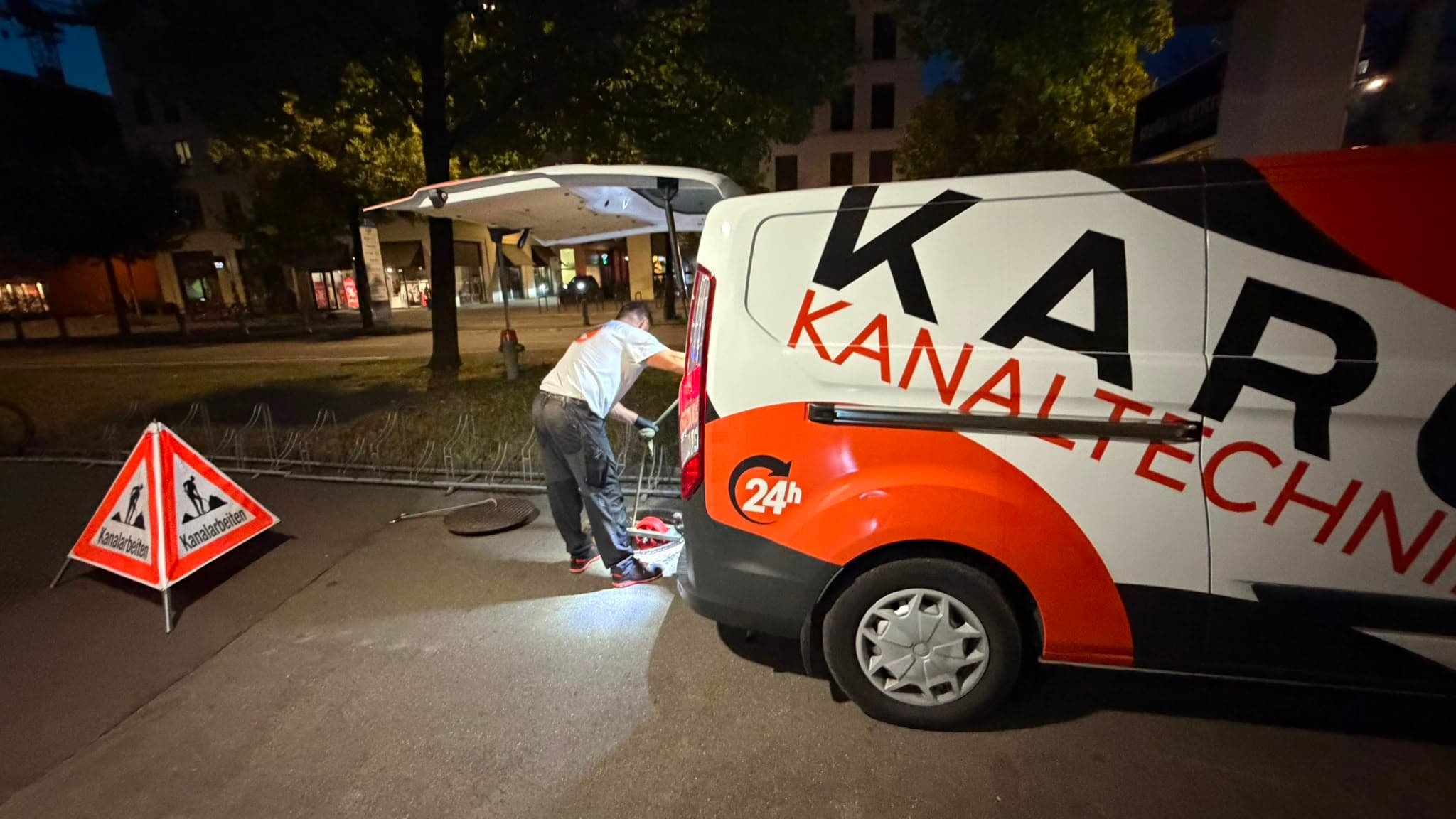
The most important element of maintenance is regular cleaning. Karo Kanaltechnik cleans private pipes with chemical-free high-pressure water jetting at up to 200 bar: the nozzle loosens deposits, and the dirt is flushed back to the manhole and sucked out. How often cleaning should take place depends on the use – a single-family home needs jetting much less often than a restaurant or a large residential development.
Only a CCTV drain survey shows whether the pipe is structurally sound. A camera travels through the pipe from the inspection chamber, records every metre and measures the position of every finding. The defects are coded according to SN EN 13508-2 and documented in the report. Some municipalities require such a survey for conversions, changes to connections or as part of their GEP; what applies is set out in the wastewater regulations. If it reveals damage, this can often be rehabilitated without digging using a CIPP liner or patch liner, without tearing up the garden or driveway.
A short history of the sewer system
Sewers already existed in antiquity; the Romans built masonry channels that carried rainwater and used water out of the cities. In medieval towns, on the other hand, wastewater often flowed openly through the streets or into narrow ditches between the houses (Ehgräben). The consequences were stench and recurring epidemics.
The modern water-carriage sewer system, in which faeces are flushed away with water through closed sewers, became established in the larger Swiss cities from the second half of the 19th century – above all as a response to outbreaks of cholera and typhoid. At first the wastewater was hardly treated at all; it flowed directly into rivers and lakes. Only with the expansion of wastewater treatment plants, especially from the 1960s and 1970s onwards, did the waters become noticeably cleaner. Pipes from this period are now several decades old; many of them need to be gradually renewed or rehabilitated.
Swiss terms relating to the sewer system
In German-speaking Switzerland, some words are common that hardly anyone in Germany knows. The gully (Dole) refers, depending on the context, to the sewer system itself, a road gully or a manhole – «the water runs into the gully». The gully cover (Dolendeckel) is the cover on top of it. Rainwater (Meteorwasser) is the technical term for rain and meltwater, foul water (Schmutzwasser) for domestic and commercial wastewater.
Other typical terms are property drainage (Liegenschaftsentwässerung) for all private pipes on a plot, the GEP for the municipality's drainage planning and infiltration water (Fremdwasser) for clean water such as groundwater or spring water that gets into the sewer system through leaking pipes and puts an unnecessary load on the WWTP. The technical basis for private pipes is the Swiss standard SN 592000 «Installations for property drainage».
A typical case in the canton of Zurich: in an older apartment building, the water in the basement drains slowly, and the floor drain in the laundry room gurgles during thunderstorms. The property management company does not know whether the problem lies in its own pipes or in the municipal sewer. Karo jets the underground drain from the inspection chamber at high pressure and then runs the camera up to where it joins the public sewer. The footage shows roots in a joint of the house connection under the pavement – a section that in many municipalities still belongs to the private part of the sewer system. With the report coded according to SN EN 13508-2, the property management company clarifies responsibility with the building authority and plans the trenchless rehabilitation of the damaged spot.