
What is a small sewage treatment plant?
A small sewage treatment plant is a decentralised wastewater treatment installation that treats the domestic wastewater of one or a few properties – that is, the water from the WC, kitchen, bathroom and washing machine. On a small scale, it does what a municipal ARA, the wastewater treatment plant (WWTP), does for an entire village or town: separating out solids, breaking down organic pollution and treating the cleaned water to the point where it does not harm the environment.
The size of a small sewage treatment plant is stated in population equivalents (PE). One population equivalent corresponds to the wastewater load that one person produces on average. For prefabricated and site-assembled plants of up to 50 population equivalents, the European standard series SN EN 12566 applies, which has also been adopted in Switzerland. How many population equivalents a plant needs depends on the number of occupants and the use of the property and is determined during planning.
In everyday use, the term is often used loosely. Some people say «septic tank» or «private treatment plant» and mean both a modern biological plant and an old multi-chamber tank that only allows the wastewater to settle. For the permit and maintenance, however, this difference is decisive, as the following sections show.
When is a small sewage treatment plant permitted?
The basic principle in Switzerland is the obligation to connect: under the Waters Protection Act (GSchG, Art. 11), polluted wastewater within the building zone must be discharged into the public sewer. Outside the building zone, the obligation also applies if the connection is appropriate and reasonable or if a sewer has been built specifically for this purpose. A small sewage treatment plant is therefore not a free choice, but the exception for properties where a connection would not make technical sense or would be disproportionately expensive.
For these cases, Art. 13 GSchG stipulates that the wastewater must be treated in accordance with the state of the art. What this means in individual cases – what treatment performance is required, whether the treated water may infiltrate the ground or be discharged into a stream and what checks are needed – is determined by the cantonal water protection authority. Responsible bodies include, for example, the Office for the Environment in the canton of Thurgau, the Office for Water and Energy in the canton of St. Gallen or the AWEL in the canton of Zurich. The municipality is usually the first point of contact; its drainage regulations and the general drainage plan (GEP) show whether a sewer is planned.
A special rule applies to farms with substantial numbers of cattle or pigs (Art. 12 para. 4 GSchG): here, under certain conditions, domestic wastewater can be used together with the liquid manure instead of being treated in a separate small sewage treatment plant. This also requires the approval of the canton. Anyone who wants to buy a small sewage treatment plant or replace an existing tank should therefore always first clarify with the municipality and canton which solution will actually be approved at their location.
Design and how it works
Almost every small sewage treatment plant works in three stages. In the primary treatment stage – usually a tank with two or three chambers – heavy substances settle on the bottom as sludge, while grease and light substances float to the top as a scum layer. Only the pre-treated water flows on. This stage is the part that has to be emptied regularly.
In the biological stage, microorganisms break down the dissolved organic substances. Common types are activated sludge plants and SBR plants, in which air is blown into the wastewater, as well as fixed-bed and moving-bed plants, in which the bacteria grow on a carrier material. Reed bed systems pass the water through a planted soil filter and do without a blower, but need considerably more space.
In the secondary clarification stage, the surplus sludge from the biological stage settles before the treated water leaves the plant. Depending on the permit, it is discharged into the ground via an infiltration system or into a surface watercourse. A properly functioning plant also includes watertight inlet and outlet pipes, an accessible inspection chamber for samples and, for electrically operated plants, a control unit with a fault alarm.
Small sewage treatment plant, slurry pit and soakaway pit – the differences
The three terms are often confused, but they refer to fundamentally different installations. A small sewage treatment plant treats wastewater and then releases it back into the environment. A slurry or liquid manure pit, on the other hand, is a watertight store: it collects slurry, liquid manure or wastewater without treating it, and must be emptied completely. Finally, a soakaway pit is built to be permeable and allows water to seep into the ground – it is intended for clean or slightly polluted rainwater, not for untreated foul water.
Old multi-chamber tanks that are referred to as «septic tanks» and let the wastewater seep away directly after settling are a problem. They only provide mechanical pre-treatment and therefore generally no longer meet the state of the art. Whether such a plant can continue to be operated, must be upgraded or must be replaced is decided by the canton. The existing tank can often be reused as the primary treatment stage and supplemented with a biological stage.
Important for maintenance: sludge and solids accumulate in all three installations, and all three must therefore be emptied by suction. The intervals, the disposal of the extracted material and the requirements for leak-tightness differ, however – anyone who knows which installation they actually have avoids false assumptions and unnecessary costs.
Emptying and desludging
The sludge in the primary treatment stage grows steadily. If it is not removed in good time, solids get into the biological stage, clog the carrier material or aeration there and cause treatment performance to collapse. In the worst case, barely treated wastewater flows into the ground or the stream. When it must be emptied depends on the size and type of plant, the number of occupants and the requirements in the permit and operating instructions. The decisive factor is the measured sludge level, not a fixed calendar.
During desludging, a vacuum tanker extracts the sludge and scum layer from the primary treatment stage. The inlet, chambers and overflows are then checked and flushed if necessary. Depending on the type of plant, a small amount of sludge is deliberately left behind, or the chamber is refilled with water so that the plant can continue working without interruption – the manufacturer's instructions apply here.
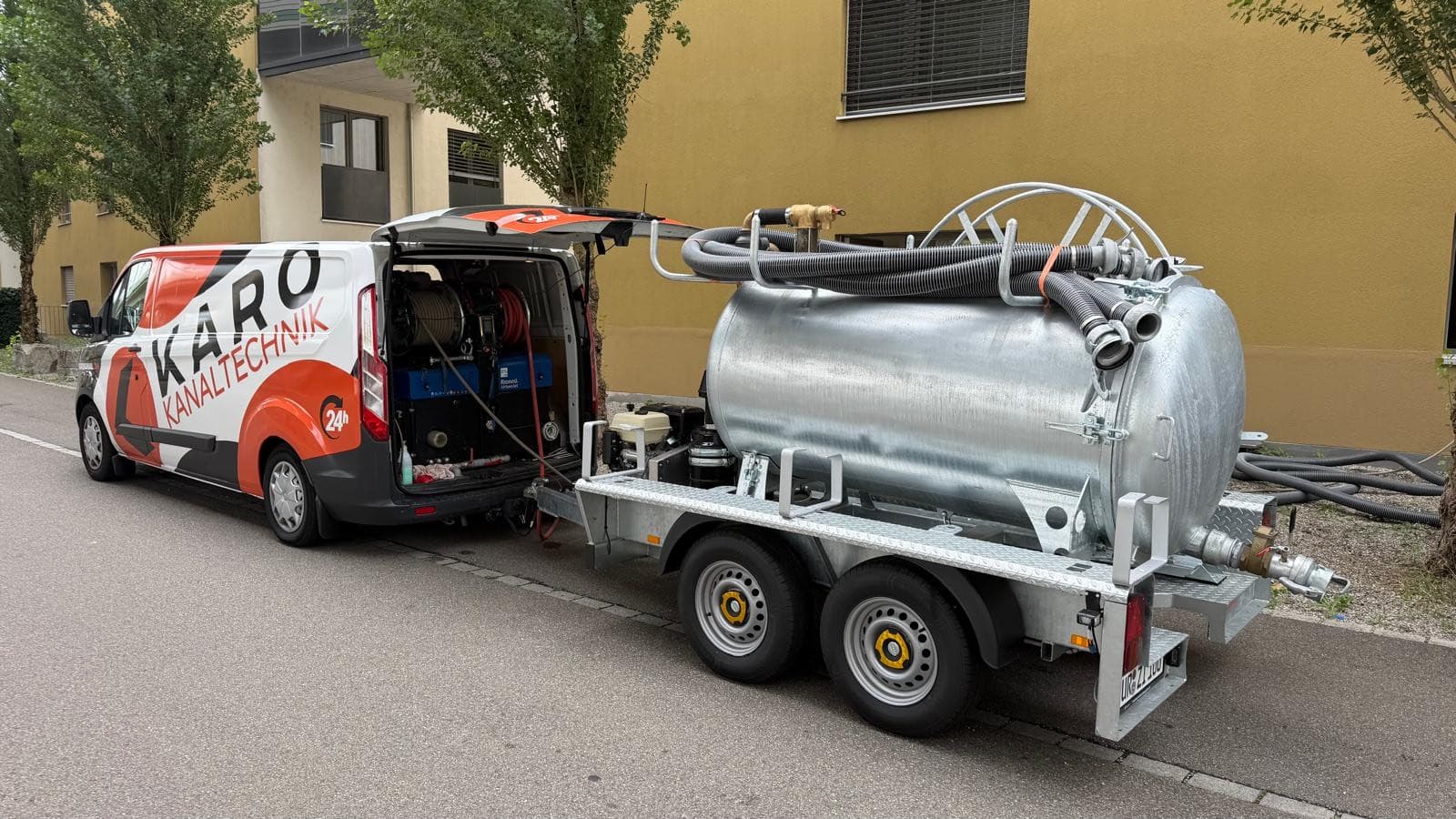
The material extracted from a small sewage treatment plant is faecal sludge and must be disposed of properly, generally via a municipal ARA. In Switzerland, sewage sludge and faecal sludge may not be spread on meadows and fields as fertiliser. Karo Kanaltechnik works with combination jet-vac tankers and disposes of the extracted material with a disposal certificate, which you can keep for your records and for any inspection by the authorities.
Maintenance obligation and inspection
Anyone who operates a small sewage treatment plant is responsible for keeping it in proper condition – this follows from the general duty of care in water protection and, as a rule, also directly from the permit. The permit often requires that a specialist company services the plant regularly, that an operating log is kept and that maintenance and disposal certificates can be produced. In addition, the authorities may have wastewater samples taken at the outlet.
Maintenance typically includes checking the blower, pumps and control unit, measuring the sludge level, visually inspecting the outlet and cleaning distributors, filters and manholes. The exact intervals are set out in the permit and in the manufacturer's maintenance instructions. Electrical plants often signal faults with a warning light or alarm – such alerts should never be ignored for weeks.
The pipes leading to the plant are just as important as the plant itself. A leaking inlet pipe allows wastewater to enter the ground untreated, a partially blocked pipe leads to backflow in the house, and groundwater or rainwater getting in overloads the biological stage. A camera survey shows the condition of the pipes, and a leak-tightness test proves that they are watertight. Karo documents the findings in accordance with SN EN 13508-2, so that they are also clear to authorities and planners.
Buying, building or replacing a small sewage treatment plant – what to look out for
Anyone searching for «buy small sewage treatment plant» or «small sewage treatment plant price» should observe the right order: first the permit question, then the plant. Only once the municipality and canton have confirmed that no sewer connection is required, and the requirements for treatment performance and discharge are established, can the right plant be chosen. A self-purchased model that is not approved at the location is an expensive lesson.
When choosing, in addition to the purchase price, the space required, power consumption, accessibility for the vacuum tanker, the maintenance effort and whether an existing tank can be reused as the primary treatment stage all count. Reputable offers state the design capacity in population equivalents and conformity with SN EN 12566. Planning and installation belong in the hands of a specialist planner who also supports the permit application.
For ongoing operation, it is worth factoring in the costs of desludging, maintenance and any pipe cleaning from the outset. For Karo jobs, the guide price is CHF 160 per hour plus CHF 60 call-out fee, both excl. VAT; how long a job takes depends on the size, accessibility and condition of the plant.
When the sewer arrives: connection and decommissioning
If the municipality extends a sewer to a hamlet or a remote farm, the adjacent properties generally become subject to an obligation to connect, provided the connection is appropriate and reasonable. The small sewage treatment plant then becomes superfluous and must be decommissioned. The length of the transition period and what is to happen to the old plant are determined by the municipality and canton.
Before decommissioning, the plant is completely emptied and cleaned so that no faecal residues remain in the ground. It is then backfilled, dismantled or – after cleaning and with the approval of the authorities – reused, for example as a rainwater storage tank, depending on the requirements. The new house connection must be watertight; before acceptance, it is therefore often surveyed with a camera and tested for leak-tightness.
A typical case from our service area: a farmhouse in a hamlet in Hinterthurgau lies far outside the building zone and therefore has a biological small sewage treatment plant with an upstream three-chamber primary treatment stage. The operating log shows that the sludge level has reached its limit, and the WC on the ground floor has been draining sluggishly for a few days. On site, the primary treatment stage is first emptied with the combination jet-vac tanker, and the extracted material is taken to the ARA with a disposal certificate. The inlet pipe is then jetted and surveyed with the camera: a root in the area of a joint was slowing the flow. The finding is documented in accordance with SN EN 13508-2, so that the owner can show the cantonal authority that the plant and pipe are back in order.