There is no general obligation in Switzerland to test all existing private wastewater pipes periodically for leak-tightness. A leak-tightness test is required above all at acceptance of new or modified pipes, periodically in groundwater protection zones and wherever the municipality orders it as part of its supervisory role. What applies in an individual case is set out in the building permit, the protection zone regulations and the drainage regulations of your municipality.
The test ensures that no wastewater escapes into the soil and groundwater and that no infiltration water enters the drain. This article shows on what occasions it is required, which standards apply in Switzerland, how the test to SN EN 1610 and SIA 190 is carried out and what it costs at Karo Kanaltechnik.
When is a leak-tightness test mandatory?
The basis is federal law: under Art. 15 para. 1 of the Waters Protection Act (GSchG), the owners of wastewater installations must ensure that these are properly constructed, operated, serviced and maintained. This also applies to homeowners: as a rule, they own the property drainage up to the connection to the public sewer; exactly where the boundary lies is regulated by the municipality. How this maintenance obligation is checked is regulated by the cantons and municipalities. According to a specialist article by the VSA (Aqua & Gas 3/2020), in most cantons the municipalities have a duty to supervise the drainage installations in their area, and this expressly includes private installations.
Depending on the occasion, this results in the following picture. The examples from Winterthur, Thurgau and Appenzell Ausserrhoden show how authorities implement the obligation in practice; deadlines and forms may differ in your municipality.
| Occasion | Leak-tightness test required? | Basis and example |
|---|---|---|
| New construction of property drainage | Yes, as part of acceptance before occupancy, underground drains before backfilling or encasing in concrete | Sewer connection permit and acceptance by the municipality. Since the beginning of 2025, Winterthur has required the leak-tightness reports to SIA 190, Annex A, before final acceptance. |
| Conversion or modification of pipes | As a rule yes, for the new and modified parts | Same permit and acceptance obligation as for new construction (Winterthur: «new construction or modifications to property drainage installations»). |
| Rehabilitation, pipe replacement, liner | Common as a quality check, mandatory in protection zones | Acceptance of the work. Appenzell Ausserrhoden: new or rehabilitated pipes in groundwater protection zones must be tested for leak-tightness at building acceptance. |
| Groundwater protection zone S2 or S3 | Yes, recurring periodically | Protection zone regulations of the water catchment. Thurgau: at least every 5 years. Appenzell Ausserrhoden: in S2 at least every 3 years, in S3 every 6 years for socket-jointed pipes. |
| Change of ownership (house sale) | No general obligation | Only if the municipality's regulations or the purchase contract require it. A condition survey before purchase is nevertheless advisable. |
| Existing pipe outside protection zones | Not required periodically | Maintenance obligation under the GSchG; the municipality can order inspections and rehabilitation. According to the VSA article, private installations should be inspected roughly every 20 years. |
| Suspected leak | When ordered or voluntarily | For example with infiltration water in the network, subsidence above the pipe, drain smell or conspicuous defects in the findings of a CCTV drain survey. |
Be careful with search results: a large proportion of the hits for «leak-tightness test mandatory» come from Germany, for example from North Rhine-Westphalia or Hamburg. The state rules and deadlines that apply there do not apply in Switzerland. What counts here are federal law, cantonal water protection law and the municipality's requirements.
Which standards apply in Switzerland?
The European standard EN 1610, adopted in Switzerland as SN EN 1610, governs the installation and testing of drains and sewers. It defines the test methods with air and water, the test pressures, the test duration and the acceptance criteria. For testing with air, it specifies several methods (LA to LD) with different test pressures.
In addition, two Swiss sets of rules apply. The standard SIA 190 «Sewer systems» contains its own requirements for leak-tightness testing in Annex A and states there that, by way of derogation from SN EN 1610, it sets higher requirements. For the installations on the property, SN 592 000 «Property drainage installations – planning and execution» also applies, the new edition of which was published on 1 July 2024. For the procedure and test equipment, SIA 190 refers to the VSA guideline «Leak-tightness testing of wastewater installations»; cantonal information sheets, for example from Thurgau and Appenzell Ausserrhoden, also cite it. For owners this means: before the test, clarify according to which standard the municipality requires the report, so that the test is recognised at acceptance.
Test methods: air, water or fill test?
Pipes can be tested either with water overpressure (method W) or with air overpressure (method L). SIA 190 describes the requirements of the two methods as comparable and equivalent. In the water test, the pipe is filled and the amount of water that has to be topped up during the test period is measured. In the air test, the sealed-off pipe run is pressurised and the pressure drop is measured. In practice, the air pressure test is often preferred because it is quicker and requires no water.
How strict the criteria are is shown by SIA 190, Annex A: when testing with air, the test pressure is generally 0.20 bar, the permissible pressure drop 0.015 bar, and the test duration is calculated from the air volume and wall area of the test section. When testing with water, outside groundwater protection zones a maximum of 0.10 litres per square metre of wetted pipe surface may be topped up in 30 minutes, inside groundwater protection zones and areas only 0.05 litres per square metre in 60 minutes. If branched or inaccessible underground drains cannot be sealed off at both ends, authorities order a fill test with water; inspection chambers are also tested with a fill test.
How a leak-tightness test works
Step 1: Clarify plans and requirements
Obtain the drainage plan of the property, define the test sections and clarify with the municipality which standard and which report are required.
Step 2: Clean and inspect the pipe
The pipe run is flushed and surveyed with the CCTV camera. This identifies deposits and visible defects before the pressure test.
Step 3: Seal off the test section
Pipe stoppers or test plates seal the pipe run at both ends, usually from manhole to manhole.
Step 4: Build up test pressure
The pipe is pressurised with air or water. After a stabilisation period, the actual measurement begins.
Step 5: Measure and evaluate
Over the prescribed test duration, the pressure drop or the amount of water added is measured and compared with the permissible value.
Step 6: Issue the test report
The result is documented and signed with the test object, date, test pressure, test duration, test criterion, result and tester.
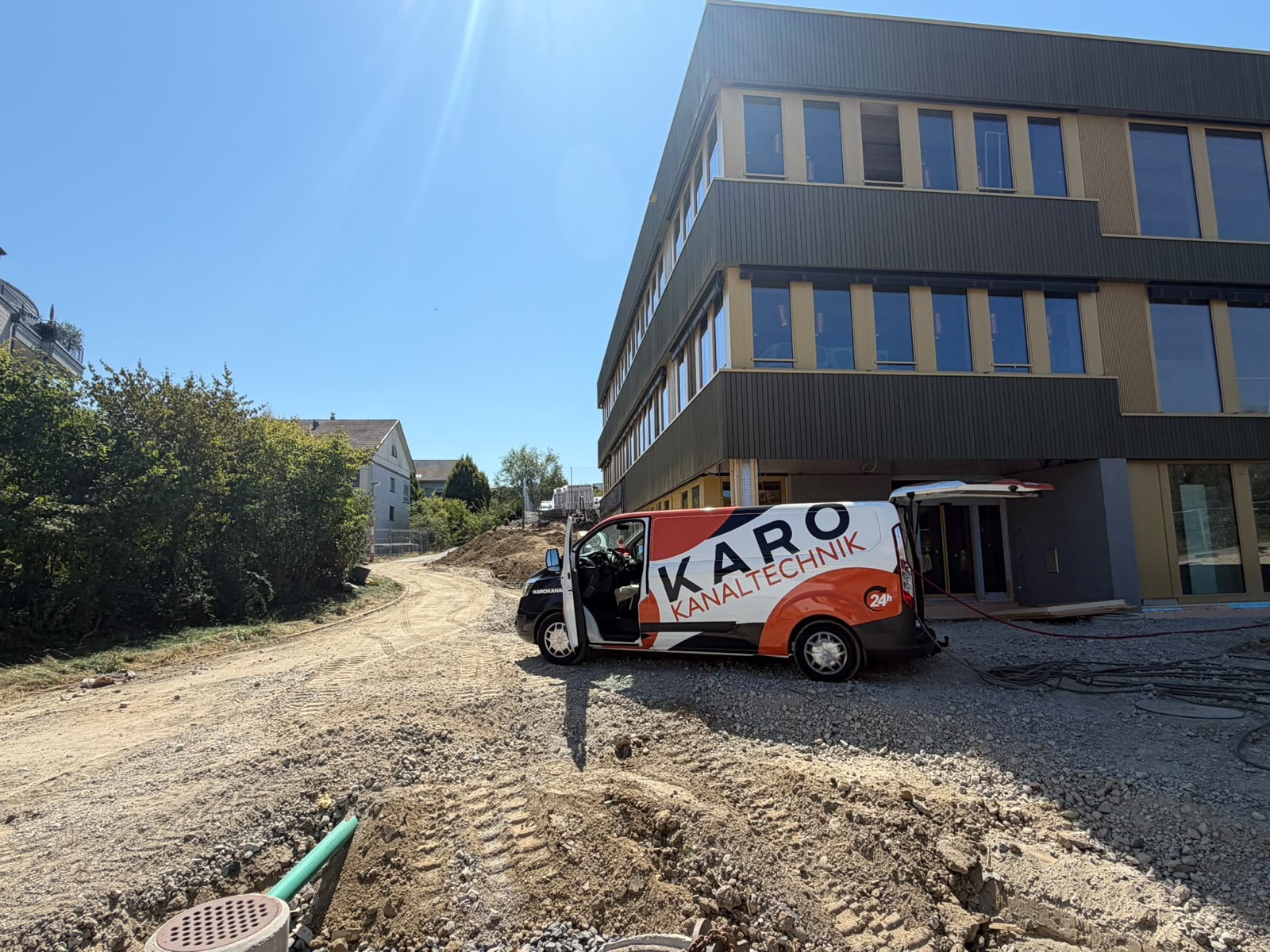
At Karo Kanaltechnik, testing one pipe run including preparation usually takes 30 to 60 minutes; you receive the test report directly after the test. We document the preceding CCTV drain survey to SN EN 13508-2, so that the test report and the condition findings match. You can read more about the service on the page Leak-tightness test.
Test report: what it must contain and who receives it
According to SIA 190, Annex A, the test report must contain at least the exact designation of the test object, the type of test with date, test pressure, test duration, the test criterion, the result (met or not met) and the tester. It is signed by the test technician and by a supervisor. The report goes to the responsible municipality; for installations in groundwater protection zones, Appenzell Ausserrhoden, for example, also requires a copy to be sent to the canton. Keep the report, as-built plan and CCTV recordings with the building records: in the event of a later sale or an inspection by the municipality, they are the simplest proof.
Why the test is more than paperwork
According to studies cited in the VSA article mentioned above, private pipes in Switzerland have more defects than the public sewer system: more than half of private drainage pipes are said to be defective or leaking. At around 80'000 km, the private network is also longer than the public one at around 50'000 km. A Bernese civil engineer quoted in the article estimates that around 80 per cent of all leaks in the sewer network arise during construction. A mere visual check or subsequent CCTV recordings are therefore not sufficient at acceptance; the established standard is a leak-tightness test with an acceptance report. A defect noticed before backfilling can be fixed with little effort; years later, it requires rehabilitation.
What happens if the test is failed?
If a pipe fails the test, the leak is first located, usually with CCTV, if necessary with section-by-section tests or leak detection. It is then repaired and the test repeated until the criterion is met. Individual defects such as cracks or leaking joints can often be repaired locally with a Pointliner. For continuous defects, trenchless drain rehabilitation with a CIPP liner is an option, for which Karo gives a warranty of up to 10 years. In protection zone S2, the canton of Thurgau, for example, generally requires the entire pipe to be rehabilitated. We advise you on which solution is economical for your pipe.
What does a leak-tightness test cost at Karo?
Karo Kanaltechnik charges on a time-and-effort basis: CHF 160 per hour plus a CHF 60 call-out, excl. VAT. For a single pipe run with 30 to 60 minutes of test time, one hour plus call-out comes to CHF 220 excl. VAT or CHF 237.82 incl. 8.1% VAT. If a CCTV drain survey is added, the surcharge is from CHF 50. For new buildings, several pipe runs, manholes or fill tests, we prepare a quote in advance based on the plan. As a rule, the costs are borne by the owner of the pipe.
It only becomes more expensive if the test reveals defects. The VSA article describes the example of the municipality of Worben (BE), where the cost per property was below 1'000 francs depending on condition, but reached several 10'000 francs for complex rehabilitation work. Having your pipe tested before consequential damage occurs keeps this cost low. You will find helpful background information in the guides on the CCTV drain survey and on rehabilitating underground drains.
Checklist for owners
- Check the building permit or sewer connection permit: does it list a leak-tightness test as a condition of acceptance?
- Look at the canton's protection zone map: if the property is in groundwater protection zone S2 or S3, periodic tests apply.
- Read the municipality's regulations: they may contain inspections, deadlines and requirements for conversions or changes of ownership.
- Gather the drainage plan and old reports; if there is no plan, have one updated during the test.
- Have underground drains below the floor slab tested before they are encased in concrete, not afterwards.
- Keep the report, as-built plan and CCTV recordings with the building records.
Unsure whether a test is due in your municipality? Send us the documents or describe the occasion. We will tell you which test makes sense and carry it out with air or water, including a report for acceptance.